

The standard “DIN 54837 Testing of materials, small components and component parts for rail vehicles - Determination of combustion behavior using a gas burner”, published by the German Institute for Standardization (DIN), describes a test method for evaluating how materials used in railway vehicles behave when exposed to fire, and helps ensure passenger safety by assessing flammability risks in enclosed spaces such as trains.
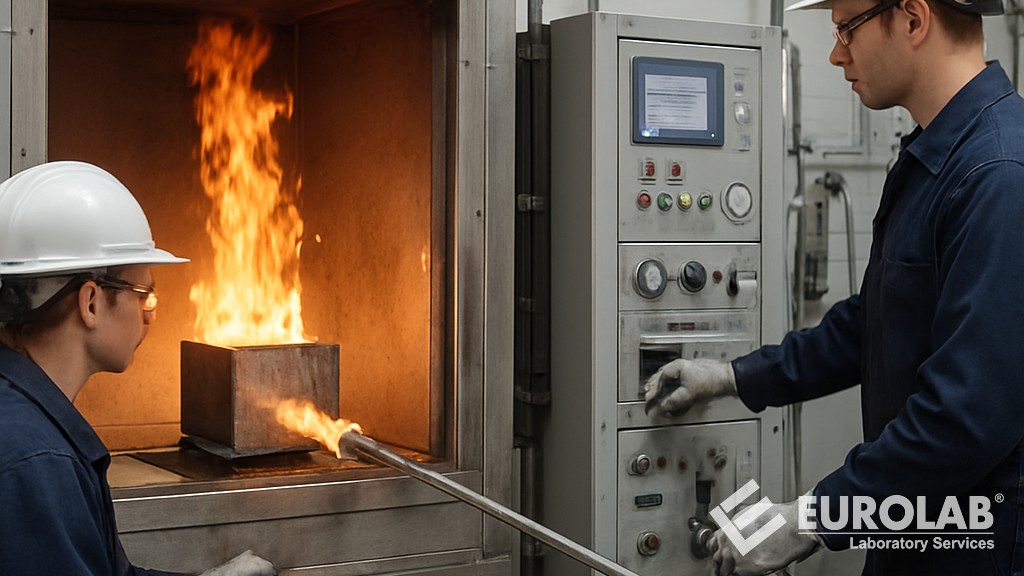
Railway vehicles pose particularly dangerous fire hazards because they carry large numbers of passengers in enclosed spaces. Fires can spread rapidly, produce toxic smoke, or cause secondary fires by dripping molten material. The DIN 54837 standard provides a standardized method for testing materials such as plastics, textiles, gaskets, flooring, and wall panels in terms of their combustion behavior, including flame spread, smoke production, and dripping.
The test results contribute to the classifications within the broader standard “DIN 5510-2 Fire prevention in railway vehicles - Part 2: Combustion behavior of materials and parts and fire side effects”. According to this standard, materials are classified into the following levels:
The DIN 54837 standard has been technically superseded, but this method is still referenced in practice. Furthermore, in new designs across the European Union, the “EN 45545-2 Railway applications – Fire protection in railway vehicles – Part 2: Requirements on the fire behavior of materials and components” standard has largely replaced it.
This test method simulates exposure to a small flame source using a gas burner (typically propane or similar) with a wide-slit nozzle. The basic elements are as follows:
The sample classification requirements, using the test results, are as follows:
Higher ratings (e.g., S4, SR2, ST2) are required for critical components such as internal panels.
Tests are carried out in special combustion chambers conforming to the DIN 50050-2 standard. Many rail material manufacturers (e.g., cables, seats, filters) provide certificates of conformity to demonstrate low fire risk.
Although largely replaced in Europe by the EN 45545-2 standard (which uses different tests such as ISO 5659-2 for smoke and ISO 4589-2 for oxygen index), the DIN 54837 standard retains its validity for older German railway projects or specific certifications.
In short, the DIN 54837 standard plays a crucial role in enhancing fire safety in rail transport by providing a reliable and repeatable method for screening materials with hazardous flammability properties.
The DIN 54837 standard is a critical testing standard because it provides a reliable and repeatable method for evaluating how materials used in railway vehicles behave when exposed to a small flame source that simulates real-world ignition scenarios such as electrical failures or arson. Railway environments are uniquely hazardous for fires: trains are enclosed spaces with high passenger density, limited escape routes (especially in tunnels or underground systems), and the potential for rapid smoke buildup. Fires can spread rapidly, produce toxic fumes, and cause secondary ignition from dripping molten materials.
This standard is considered important for the following reasons:
For many years, our organization, with its competent and experienced staff, has been understanding the needs of its clients, providing the advanced testing services they require, and assisting in the establishment, implementation, and improvement of management systems. Within this framework, we also provide testing services to businesses in accordance with the "DIN 54837 Testing of materials, small components and component parts for rail vehicles - Determination of combustion behavior using a gas burner" standard.
To get an appointment, to get more detailed information or to request an evaluation, you can ask us to fill in our form and reach you.

