

Developed by Underwriters Laboratories (UL), the standard "UL 263 Fire Tests of Building Construction and Materials" describes fire tests for composite assemblies of masonry units and structural materials for buildings, including composite floor and beam assemblies for load-bearing and other walls and partitions, columns, beams, floors, and roofs. This standard also applies to other assemblies and structural units that form permanent integral parts of a finished building.
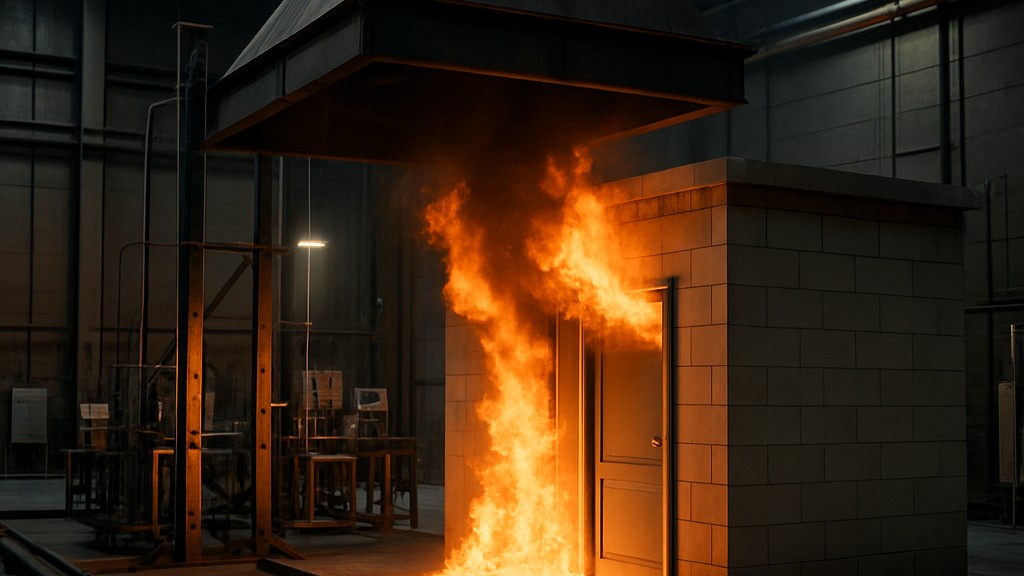
Classifications for building construction and materials are intended to record performance throughout the period of fire exposure and should not be interpreted as determining their acceptability for use after fire exposure.
The requirements outlined in this standard are intended to evaluate how long the assembly types specified in this standard will contain a fire or maintain their structural integrity, depending on the assembly type, during a predetermined test exposure. The test evaluates the assembly's resistance to heat and, in some cases, hose flow, while carrying an applied load, if the assembly is load-bearing.
Under these requirements, a sample is exposed to a standard fire controlled to reach specified temperatures for a specified period of time. In some cases, a specified standard fire hose stream may be applied following the fire exposure. This exposure alone may not be representative of all fire conditions. Conditions may vary depending on changes in the amount, nature, and distribution of the fire load, ventilation, compartment size and configuration, and the heat-sinking properties of the compartment. These requirements provide a relative measure of the fire performance of comparable assemblies under specified fire exposure conditions. Any changes to the structure or conditions under test, such as size, method of assembly, and materials, may significantly alter the performance characteristics of the assembly.
These requirements cover the following measurements and determinations during test exposure:
However, these requirements do not include:
Tests for the combustion properties of building materials based on flame spread speed are included in the "UL 723 Testing of surface combustion properties of building materials" standard.
The tests described herein may be referred to as standard fire tests and the exposure performance may be expressed as 2 hours, 6 hours, half hour or similar.
The results of these tests represent a factor in evaluating the fire performance of building construction and assemblies. These requirements prescribe a standard fire exposure against which to compare the performance of building construction assemblies. Applying these test results to predict the performance of actual building construction requires careful consideration of the test conditions.
If a safety factor exceeding that found under test conditions is required, a proportionate increase in the specified time classification period must be made.
This standard was developed to simulate the types of fires that occur in commercial buildings such as offices, hospitals, and schools. These are often referred to as cellulose fires due to the nature of the contents found in a commercial office building or multi-unit residential building.
Within five minutes, the temperature inside the furnace reaches 538 degrees Celsius. The temperature gradually increases throughout the test, reaching 1093 degrees Celsius within four hours. This is considered the standard time/temperature curve for buildings. Vertical fire-resistant assemblies are also subjected to a hose flow test specific to this standard.
In short, the UL 263 standard is a critical component of building safety protocols, particularly in the context of fire resistance testing. This standard is widely accepted in the construction industry as a benchmark for ensuring that building materials and systems can withstand fire conditions for specified periods. It is designed to provide reliable performance assessments for various components, including walls, ceilings, floors, doors, and structural elements.
The primary purpose of this standard is to evaluate the fire resistance of building materials and structural elements. It specifies the test procedures and criteria that materials and systems must meet to perform when exposed to fire. This includes fire resistance, heat transfer, and structural integrity of building components.
In practice, fire resistance ratings are used to describe how long a building element, such as a wall or floor assembly, can withstand a fire without deteriorating or contributing to the spread of the fire. These ratings are essential for ensuring the safety of building occupants and limiting property damage.
Fire resistance tests according to UL 263 are conducted using an oven-like furnace that exposes building components to fire under controlled conditions. One side of the tested component is exposed to the fire, and its performance is evaluated based on various criteria, such as temperature rise and structural integrity.
The test simulates a real fire scenario by applying temperatures and pressures that mirror the conditions likely to occur in a real fire. Furnace temperatures typically reach 927 degrees Celsius or higher, and the component must maintain its structural integrity throughout the test.
The performance criteria in UL 263 focus on:
After testing, the component is assigned a fire resistance rating based on how long it can withstand fire without deterioration. For example, a component that can withstand fire for two hours without structural collapse or excessive heat transfer would be rated with a 2-hour fire resistance rating.
Our organization, which has been supporting businesses across all sectors for years through a wide range of testing, measurement, analysis, and evaluation activities, has a strong team of employees who closely follow global developments in science and technology and are constantly improving themselves. In this context, we also provide testing services in accordance with the UL 263 Fire Testing of Building Construction and Materials standard.
To get an appointment, to get more detailed information or to request an evaluation, you can ask us to fill in our form and reach you.

