

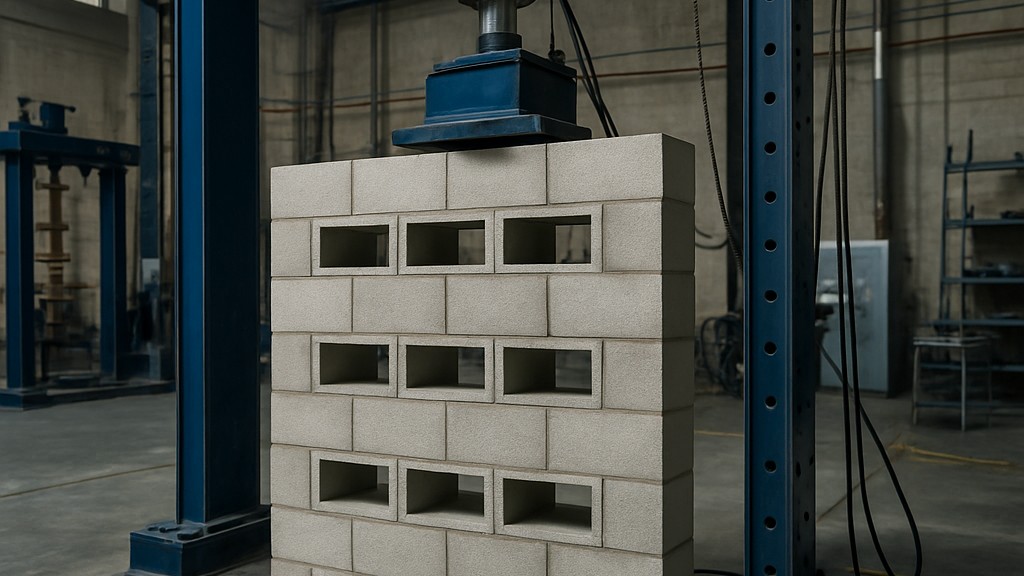
Concrete wall units manufactured under this specification must comply with the specified density classifications and compressive strength requirements.
Non-load-bearing reinforced concrete wall units manufactured to this specification must conform to one of the three density classes specified in the table entitled “Density classification requirements”:
Cementitious materials must meet these ASTM specifications:
The aggregate must meet the following ASTM specifications, but grading requirements do not necessarily apply:
Other ingredients, such as air entraining agents, coloring pigments, integral water repellents, finely ground silica, and other ingredients, must be predetermined as suitable for use in concrete masonry and must comply with applicable ASTM standards or be shown by testing or experience to be non-detrimental to the durability of concrete masonry units or any material commonly used in masonry.
Regarding physical requirements, upon delivery to the buyer, the units must meet the strength requirements specified in the table titled "Strength Requirements." A buyer is a public institution or authority, association, corporation, partnership, or individual who has entered into a contract or agreement to purchase or install concrete masonry units, or both. Delivery to the buyer is FOB ex-works, when the buyer or the buyer's agent transports the concrete masonry units, or FOB ex-site, when the manufacturer or the manufacturer's agent transports the concrete masonry units.
At the time of delivery to the purchaser, the total linear drying shrinkage of the units shall not exceed 0,065 percent. The net cross-sectional area of the solid units in each plane parallel to the bearing surface shall not be less than 75 percent of the gross cross-sectional area measured in the same plane.
The minimum surface shell thickness must be no less than 13 mm. No overall dimension (width, height, and length) must differ from the specified standard dimensions by more than 3,2 mm. The standard unit dimensions are those specified by the manufacturer. The nominal dimensions of modular-sized units are equal to the standard dimensions plus the thickness of a mortar joint. The nominal dimensions of non-modular-sized units generally exceed the standard dimensions by 3,2 to 6,4 mm.
All units must be sound in finish and appearance and free from cracks or other defects which would prevent proper installation of the units or which would significantly impair the strength or permanence of the structure.
Materials used in non-load-bearing concrete wall units must meet specific ASTM standards to ensure quality and consistency:
The ASTM C129 standard specifies the following physical properties to ensure that units meet performance expectations:
Special features such as surface texture, colour or fire resistance are not mandatory but may be specified by the buyer after consultation with suppliers.
The ASTM C129 standard outlines the following sampling and testing procedures to verify compliance:
Non-load-bearing concrete wall units, according to ASTM C129, are primarily used for interior partitions due to their non-structural nature. They can also be used in non-load-bearing exterior walls above ground level if protected from moisture by cladding or sheathing. Lightweight versions (e.g., perlite or cinder blocks) offer improved thermal resistance, reducing energy costs by up to 150 percent compared to commercial blocks, as studies have shown.
As a result, ASTM C129 is a vital standard for ensuring the quality and performance of non-load-bearing concrete wall units. By specifying materials, physical properties, and testing procedures, it provides a reliable framework for manufacturers and constructors. Its application in non-load-bearing partitions and exterior walls, along with its continuous updating to reflect modern materials, has become a cornerstone of concrete wall construction.
Our organization, which has been serving for many years and meticulously following global developments in science and technology, conducts testing, measurement, and analysis in a wide range of areas for businesses in every sector with a skilled team and extensive infrastructure. In this context, we also provide testing services in accordance with ASTM C129 Standard Specification for Non-Load-Bearing Concrete Masonry Units.
To get an appointment, to get more detailed information or to request an evaluation, you can ask us to fill in our form and reach you.

