

The European standard "EN 823 Thermal insulation products for building applications - Determination of thickness" describes the equipment and procedures for determining the thickness of full-size products. These procedures are applicable to thermal insulation products.
This European Standard specifies the equipment and cleaning procedures for determining the complete degradation possible. It is applicable to thermal efficiency products.
In accordance with this standard, the term thickness means the linear dimension measured perpendicular to the length and width plane.
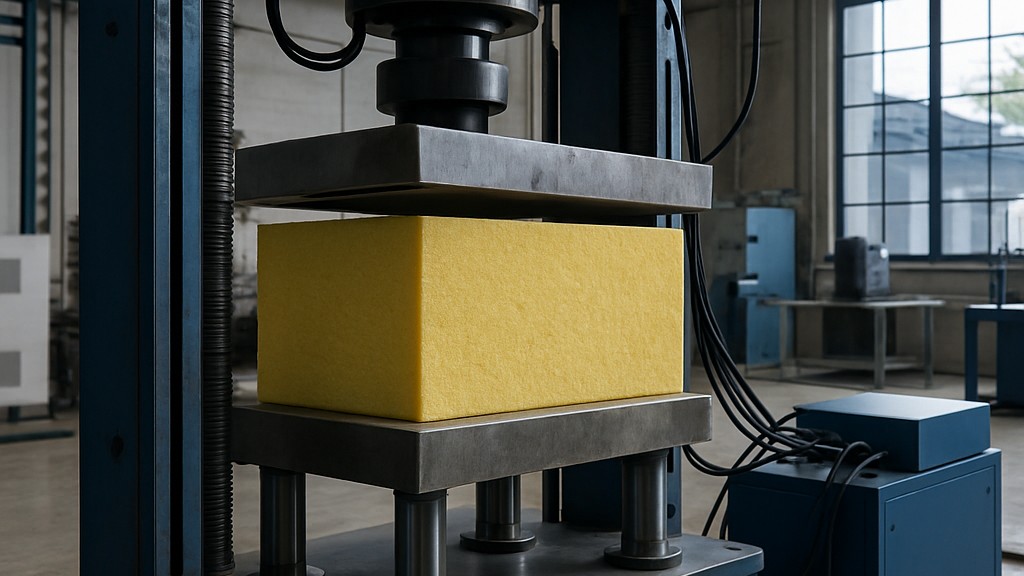
In principle, during this test, the distance is measured, i.e. the distance between a hard flat reference surface on which the test sample rests and a pressure plate that rests freely on the upper face of the test sample.
The device used in the tests is a measuring device consisting of a dial indicator and a square pressure plate. This device has a dial indicator mounted on a rigid frame that is capable of measuring to an accuracy of at least 0,5 mm and is attached to a flat rigid base plate at least as large as the test specimen. This device also has a 200 mm square pressure plate that applies a total pressure of 50 plus/minus 1,5 Pa or 250 plus/minus Pa (including the force applied by the dial indicator) to the test specimen. The pressure should be as specified in the relevant product standard. Any testing equipment that provides at least the same result with the same accuracy may be used.
The test sample must be the full-size product, but it may be necessary to cut the product into appropriately sized pieces. The number of test samples must be as specified in the relevant product standard. In the absence of a product standard, the number of test samples can be agreed upon between the parties.
Test samples should be stored at 23°C plus/minus 5°C for at least 6 hours. In case of disagreement, they should be stored at 23°C plus/minus 2°C and 50% plus/minus 5% relative humidity for the period specified in the relevant product standard.
Test samples (any coating) must be retained. For compressed products, preparation of test samples must be in accordance with the standard annex (Annex A).
The test should be conducted at a temperature of 23 degrees Celsius plus or minus 5 degrees Celsius. In case of disagreement, it should be conducted at a temperature of 23 degrees Celsius plus or minus 2 degrees Celsius and a relative humidity of 50 percent plus or minus 5 percent.
When performing the test, carefully place the test specimen on a flat, rigid base plate and ensure the measurement area is in contact with the base plate. Test specimens coated on one side should be placed so that the coating rests against the base plate. The pressure plate is placed on the test specimen, applying a total pressure of 50 plus/minus 1,5 Pa or 250 plus/minus 5 Pa at a designated location with the dial indicator centrally positioned.
Two measurements shall be taken for test specimens 600 mm or less in length, four measurements shall be taken for test specimens greater than 600 mm and 1500 mm or less in length, and one additional measurement shall be taken for each additional 500 mm in length exceeding 1500 mm.
Accurate thickness measurement according to the EN 823 standard is important because it affects thermal resistance (R-value) and ensures compliance with building codes and energy efficiency regulations.
This standard is primarily relevant for thermal insulation boards, mats, or rolls used in construction. Thickness is typically measured using a flat plate micrometer or similar device under specific pressure and temperature. This helps ensure product consistency and quality control between production batches. This standard applies to factory-made thermal insulation products used in buildings.
Thermal insulation products for building applications are materials specifically designed to reduce heat transfer within buildings. Their primary functions are to increase energy efficiency, improve thermal comfort, and reduce heating and cooling costs.
Thickness tolerances play a crucial role in maintaining quality and consistency across industries. These tolerances for insulation materials are determined according to the EN 823 standard. This standard specifically specifies criteria for insulation products classified as Class T2.
Reducing energy consumption through thermal insulation is a good practice to prevent unwanted heat loss or gain in a building. EN 823 standard covers thermal insulation products for building applications. Its primary purpose is to equip manufacturers with industry best practices for demonstrating the performance of thermal insulation products and ensuring they are fit for purpose.
The EN 823 standard specifies the precise thickness tolerances that manufacturers must adhere to. Simply put, while the exact thickness is not mandatory, it must fall within a specific range. Insulation tolerances define the limits within which material thickness variations are permitted. This standard aims to ensure uniform and reliable performance from insulation materials. By adhering to these tolerances, manufacturers guarantee that the insulation material will provide the expected thermal and acoustic insulation.
Our organization, which has been supporting businesses across all sectors for years through a wide range of testing, measurement, analysis, and evaluation activities, has a strong team of employees who closely follow global developments in science and technology and are constantly improving themselves. In this context, we also provide testing services in accordance with the EN 823 Thermal insulation products for building applications - Determination of thickness standard.
To get an appointment, to get more detailed information or to request an evaluation, you can ask us to fill in our form and reach you.

