

A European standard, “EN 15815 Polymer-modified bituminous coatings for waterproofing - Resistance to pressure”, describes a procedure for determining the resistance to pressure of polymer-modified bituminous coatings for waterproofing purposes.
For the purposes of this standard, the terms and definitions given in the EN 15814 standard apply.
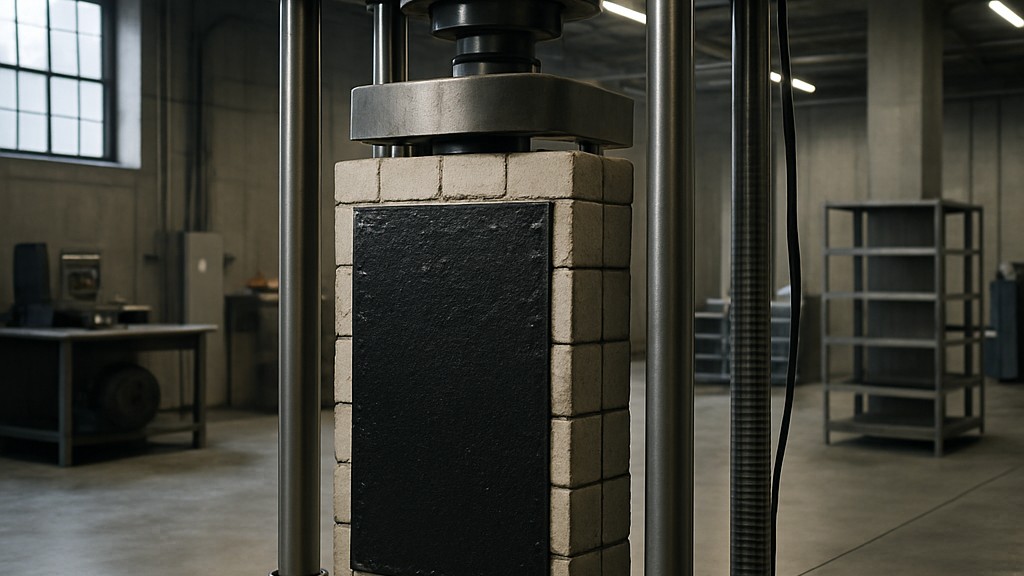
In principle, after the substrate is coated and conditioned, the test specimen is placed in a test fixture. A constant load is then applied to the surface of the coated substrate until the thickness reduction becomes stable.
Equipment used in the tests includes:
A square test sample of approximately 20 cm x 20 cm in size is used in the tests.
Supports and components of polymer-modified bitumen thick coatings should be conditioned for at least 24 hours in accordance with ISO 554 at a normal climate of 23°C plus/minus 2°C and a relative humidity of 50% plus/minus 5% before specimen preparation. The polymer-modified bitumen thick coating should be prepared at the room temperature specified by the product manufacturer and applied to the ground surface of the concrete support, also at room temperature, in an area of 20 cm x 20 cm. The thickness of the wet layer should be such that the thickness of the dry layer corresponds to the thickness specified by the manufacturer for each type of use after drying (minimum 3 mm or 4 mm) with a tolerance of 10 percent. A frame or screed template of appropriate height should be used from which the layer is scraped off to obtain the required thickness. The specimens should be allowed to dry for 28 days in accordance with ISO 554 at a normal climate of 23°C plus/minus 2°C and a relative humidity of 50% plus/minus 5% before testing.
The dry layer thickness of the test sample is measured using a caliper that allows measurements to the nearest 0,1 mm. Twelve measurements are taken. The highest and lowest values are ignored, and the average value is calculated from the remaining 10 values.
Test samples should be stored in a normal climate of 23 degrees plus/minus 2 degrees and a relative humidity of 50 percent plus/minus 5 percent for at least 28 days before testing.
The test should be performed at 23 degrees plus/minus 2 degrees.
Layer thicknesses should be determined at sixteen measurement points, evenly distributed across the sample surface but at least 2 cm from the sample edges. The average thickness of the dry layer should then be determined. At least three samples should be tested in each test. For convenience, several samples can be stacked and tested simultaneously. A suitable separating layer (e.g., silicone-coated paper) should be placed over the samples to prevent the coating surface from adhering to the sample support or loading platens. Samples tested simultaneously should be placed in a suitable testing fixture to prevent any lateral displacement of the samples during the test and to ensure that the force is distributed evenly across the entire surface of the samples. Two measurement marks should be placed on all four sides of the sample supports and loading platens, one-third of the length from the edges, to determine the average change in layer thickness of each sample during the test.
After the specimens are mounted in the test fixture, the distance between the measurement marks on each specimen should be measured to 10 µm. A preload of 0,01 MN/m2 should then be applied. The distances between the measurement marks should be measured again immediately thereafter. The average change in thickness for each specimen should be determined from the differences between individual measurements.
The main load is then applied in accordance with EN 15814. The layer thickness of each sample should be measured daily. The test is considered successful if the average change in thickness of each sample after five days is less than 50 percent of the initial layer thickness and if the difference between the changes over the last three days, for example, between days 2 and 5, does not exceed 3 percent (stabilization). If the change over three days exceeds 3 percent, the test may be extended for a maximum of 40 days or until the change over three days is at least 3 percent, with an overall change of no more than 50 percent. All three samples must meet these requirements.
The average deviation of the thickness of each sample from the initial thickness at each measurement is expressed as the relative change in the thickness of the layer.
The EN 15815 standard is considered important for the following reasons:
Our organization, which has been supporting businesses across all sectors for years through a wide range of testing, measurement, analysis, and evaluation activities, has a strong team of employees who closely follow global developments in science and technology and are constantly improving themselves. In this context, we also provide testing services to businesses in accordance with the EN 15815 standard for "Polymer-modified bituminous thick coatings for waterproofing - Pressure resistance."
To get an appointment, to get more detailed information or to request an evaluation, you can ask us to fill in our form and reach you.

