

The European standard "EN 14617-12 Agglomerated stone - Test methods - Part 12: Determination of dimensional stability" describes a test method for determining the dimensional stability and deflection of agglomerated stone in contact with water. This standard applies to agglomerated stone intended for installation with adhesives on walls and floors. The test method is primarily used to classify the material according to its water sensitivity and to select the appropriate adhesive for the proper installation of agglomerated stone.
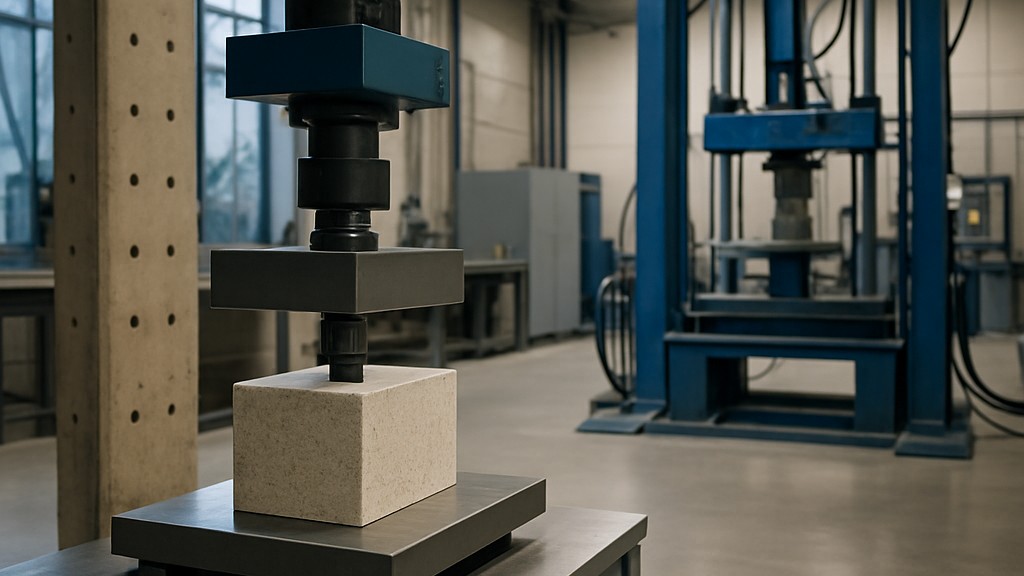
This method uses a wet felt pad placed on the back of the agglomerated stone to measure the vertical displacement of one corner of the tile, simulating contact with water. A series of sensors measure the deformation caused by the moisture released by the pad.
Equipment used in the tests includes:
Standard test conditions should be 23 degrees plus/minus 2 degrees and 50 percent relative humidity.
The material's tendency to warp varies depending on the tile's size, thickness, and moisture content. Therefore, to ensure reliable results:
Before testing the sample, its flatness should be checked.
The tile should be placed upside down on three supports placed on a reference plane near the corners and secured with weights or clamps. Four digital measuring devices should be positioned in contact with the tile, as shown in the figure. A digital measuring device placed 5 mm from either side of the corner measures the deformation of the free corner, while the digital measuring device measures the deformation at the center of the tile. Digital measuring devices measure tile expansion. A wet cloth or felt, reflecting the moisture content of a conventional mortar bed or cement-based adhesive, is placed behind the tile, and a polyethylene film is placed over the felt to prevent rapid evaporation. The cloth or felt should be kept constantly wet with a water spray gun during the test. Deformations are recorded on the digital measuring devices after a 6-hour period.
6 hours after wet felt application, deformation is determined with an accuracy of 0,1 mm using the formula given in the standard.
In the construction and building materials industry, ensuring the durability and performance of materials such as agglomerated stone is vital for long-lasting installations. The EN 14617-12 standard specifically addresses the dimensional stability of these materials when exposed to water. This standard provides a standardized procedure for assessing how agglomerated stone, an engineered composite typically made by bonding quartz, marble, or granite aggregates with resins, responds to moisture. This standard is essential for fabricators, installers, and architects working on wall and floor applications where moisture exposure is common, such as bathrooms, kitchens, or outdoor environments.
The EN 14617-12 standard applies only to stones intended for installation with adhesive on walls and floors and focuses on their susceptibility to moisture absorption. The primary purpose is to classify the material's behavior under water exposure and enable informed decisions regarding adhesive selection and installation techniques to prevent problems such as buckling or delamination.
Unlike general material specifications, this standard emphasizes practical testing to simulate real-world conditions, ensuring agglomerated stone maintains its structural integrity in humid environments. This standard is part of a comprehensive package encompassing a variety of test methods, from abrasion resistance (EN 14617-1) to thermal shock (EN 14617-6), but focuses on water-induced dimensional changes.
Standard EN 14617-12 describes a laboratory-based procedure for measuring changes in length, width, and flatness after water immersion. The steps in the process are simply as follows:
The test complies with normative references such as EN 14617-1 for general requirements and uses statistical analysis for repeatability. Bending is measured at maximum deviation from a flat plane, providing quantifiable data for compliance. This methodical approach ensures that results are reliable and comparable across manufacturers.
The EN 14617-12 standard is vital to the agglomerated stone industry, which supplies materials to residential, commercial, and public projects. Its main applications include:
Floor and wall covering: In wet areas such as showers or pools, where waterproofing prevents failure.
Kitchen countertops: While primarily adhesive-focused, insights inform overall moisture management.
Exterior facades: Assists in selecting stone for installations exposed to weather conditions.
Its importance stems from its promotion of safety and longevity. Poor dimensional stability can lead to cracks, tile delamination, or costly repairs. This standard helps with adhesive matching (e.g., epoxy or cement-based) by classifying sensitivity and reduces installation errors. Compliance increases market access in EU countries, where CE marking typically requires such testing. In the era of sustainable construction, it promotes environmentally friendly materials by minimizing waste from failed installations.
Ultimately, the EN 14617-12 standard is the cornerstone of quality assurance in agglomerated stone, combining materials science with practical construction needs. By standardizing water stability tests, it enables stakeholders to deliver aesthetically pleasing surfaces that are resilient to daily challenges. As construction practices evolve with climatic factors in mind, this standard's role in promoting innovation and reliability is increasingly evident.
Our organization, which has been serving for many years and meticulously following global developments in science and technology, employs a team of experienced professionals and a broad infrastructure to conduct testing, measurement, and analysis in a wide range of areas for businesses across all sectors. In this context, we also provide testing services in accordance with the standard "EN 14617-12 Agglomerated stone - Test methods - Part 12: Determination of dimensional stability."
To get an appointment, to get more detailed information or to request an evaluation, you can ask us to fill in our form and reach you.

