EN 772 Test Methods for Masonry Units
The European standard "EN 772 Test methods for masonry units" consists of numerous subsections published under the same title. These are:
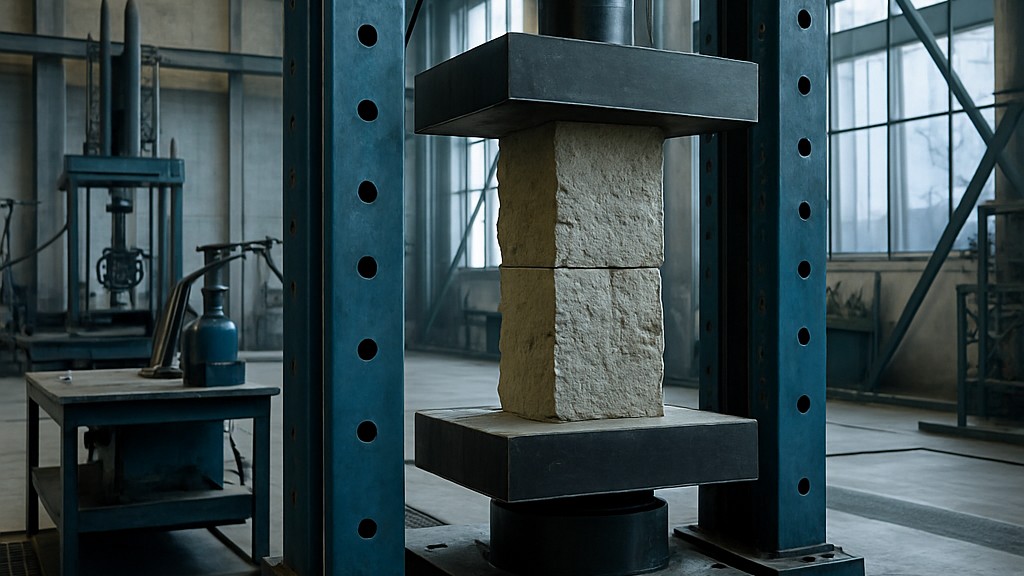
- The standard "EN 772-1 Part 1: Determination of Compressive Strength" describes a test method for determining the compressive strength of masonry units. In principle, after preparation, specimens are placed and centered on the platen of a compression testing machine, if necessary. A uniformly distributed load is applied and continuously increased until failure. Sand and cement with a maximum grain size of 1 mm are used as materials.
The sampling method must comply with the relevant section of this standard. The minimum number of samples must be six, but a greater minimum number may be specified in the product specification, in which case the larger number is used. In the case of large masonry units, representative pieces, such as cubes, may be cut from the masonry unit at different locations, as specified in the relevant section of EN 771.
- The standard "EN 772-2 Part 2: Determination of the percentage area of voids in aggregate concrete masonry units (by paper indentation)" describes a method for determining the percentage area of voids in aggregate concrete masonry units. In principle, after preparing the samples, thick pieces of paper are pressed against the test surfaces of the masonry units, and the percentage area of voids is determined by measuring the indentation.
The sampling method must comply with EN 771-3. The minimum sample size is six, but a higher minimum sample size may be specified in the product specification, in which case the larger number is used. Any roughness on the test surface of the wall unit must be removed.
- The standard "EN 772-3 Part 3: Determination of net volume and percentage voids of clay masonry units by hydrostatic weighing" describes a method for determining the net volume and percentage voids in clay masonry units (including cavities and cells). The principle of this test is to obtain the net volume of the masonry unit by weighing it in air and in water, and to obtain the void volume by subtracting this from the gross volume obtained by measuring its dimensions.
The sampling method must comply with EN 771-1. The minimum sample size is six, but a higher minimum sample size may be specified in the product specification, in which case the larger number is used.
During the test, the length, width, and height of the sample are measured according to EN 772-16. The sample is immersed in water for at least one hour. If the apparent masses measured by two consecutive weighings at 30-minute intervals differ by less than 0,2 percent, the sample is removed from the water and the result of the second weighing is recorded as the apparent mass. Surface water is removed with a damp towel, and the weight is determined immediately.
- The standard "EN 772-4 Part 4: Determination of true and bulk density, and total and open porosity for natural stone masonry units" describes the method for determining the true density, bulk density, and open and total porosity of natural stone masonry units. In principle, the bulk and true densities of the units are calculated after drying to constant mass and calculating the volume and impermeable volume.
The sampling method must conform to the EN 771-6 standard. The minimum number of samples should be five, however, a larger minimum number may be specified in the product specification, in which case the larger number should be used. Test samples may be in the form of a cylinder, cube, or prism and should be obtained by diamond cutting or core drilling. Their volume should be at least 25 cm³. Furthermore, the surface area/volume ratio should be between 0,1 and 0,2 mm⁻¹ . Samples are dried at a temperature of 70 degrees plus/minus 5 degrees until a constant mass is reached. A constant mass is achieved if, during the drying process, in subsequent weighings performed at intervals of at least 24 hours, the mass loss between two determinations is less than 0,1 percent of the mass.
- The standard "EN 772-5 Part 5: Determination of the active soluble salt content of clay masonry units" describes a method for determining the active soluble salt content in clay masonry units. The method is based on water extraction from a representative crushed sample of clay masonry units and determines the amounts of soluble magnesium, sodium, and potassium ions released under the test conditions. This can be linked to the potentially harmful effects of salts of these ions on cementitious mortars or even on the units themselves under certain conditions. These salts are known as active soluble salts in EN 771-1.
The tests use hydrochloric acid (relative density 1,18) with distilled or deionized water to extract active soluble salts from the sample and prepare analytical test solutions. All chemicals must be of analytical reagent grade.
The sampling method must comply with EN 771-1. The minimum number of samples required to determine the active soluble salt content is six and must cover all units, but a larger number may be specified in the product specification, in which case the larger number should be used. Samples should be sampled in such a way that they are not exposed to water, which would leach soluble salts from the units. A representative sample of 50 g to 250 g of material, ground to pass through a 150 µm test sieve, is prepared from the bulk sample of units using the crushing method described here.
- The standard “EN 772-6 Part 6: Determination of the flexural tensile strength of aggregate concrete masonry units” describes a method for determining the flexural tensile strength of aggregate concrete masonry units with a width less than 100 mm and a length/width ratio greater than 10, in accordance with the EN 771-3 standard.
The minimum sample size should be three, but the product specification may specify a larger minimum, in which case the larger number should be used. All unit test samples should be air-conditioned in an environment with the following conditions: relative humidity 65 percent, temperature 15°C, and duration 14 days. During the conditioning process, if the loss in mass is less than 1 percent of the unit mass on consecutive weighings at intervals of at least 24 hours, the unit can be considered air-dried. The sampling method must be stated in the test report. Sample dimensions are measured in accordance with EN 772-16.
- The standard "EN 772-7 Part 7: Determination of water absorption of damp-proof layer clay wall units by boiling in water" describes a method for determining the water absorption of damp-proof coarse clay wall units by boiling samples in water for a fixed period of time. In principle, samples are weighed after drying to a constant mass, then immersed in boiling water for 5 hours, wiped, and weighed. The ratio of the mass increase of the saturated samples to the dry mass is calculated.
The sampling method must comply with EN 771-1. The minimum sample size is six, but a higher minimum sample size may be specified in the product specification, in which case the larger number should be used. Test samples should be dried to constant mass in a ventilated oven at 105°C plus/minus 5°C. During the drying process, constant mass is achieved if, on two consecutive weighings made 24 hours apart, the loss in mass between the two determinations is not more than 0,2 percent of the total mass.
- The standard “EN 772-8 Part 8: Determination of water absorption of aggregate concrete masonry units by wetting” describes a method for determining the water absorption of aggregate concrete masonry units by soaking samples in water for a fixed time.
- The standard "EN 772-9 Part 9: Determination of volume, void percentage, and net volume of clay and calcium silicate masonry units with sand fill" describes a method for determining the volume, void percentage, and net volume of calcium silicate masonry units containing cells, frogs, and holes. The principle of this test is to measure the volume of voids in a masonry unit by measuring the volume of sand required to fill them.
- The standard "EN 772-10 Part 10: Determination of moisture content of calcium silicate and autoclaved aerated concrete masonry units" describes a method for determining the moisture content of calcium silicate and autoclaved aerated concrete masonry units. In principle, after drying to constant mass, the moisture content is calculated as the ratio of the mass loss during drying to the mass after drying.
- The standard “EN 772-11 Part 11: Determination of water absorption due to capillary action of aggregate concrete, aerated concrete, artificial stone and natural stone masonry units and of the initial water absorption rate of clay masonry units” describes a method for determining the water absorption coefficient due to capillary action for aggregate concrete, aerated concrete, natural stone and artificial stone masonry units and of the initial water absorption rate for clay masonry units.
- The standard “EN 772-12 Part 12: Determination of length change during moisture movement in autoclaved aerated concrete wall units” describes the method for measuring the dimensional change of autoclaved aerated concrete wall units between two specified moisture conditions.
- The standard "EN 772-13 Part 13: Determination of net and gross dry density of masonry units (excluding natural stone)" describes a method for determining the net and gross dry density of masonry units (excluding natural stone masonry units). In principle, the samples to be tested are enclosed in the open mouths of circular containers in which the water vapor pressure is maintained at appropriate levels by means of saturated salt solutions. The containers are placed in a temperature-controlled environment with a constant water vapor pressure different from that inside the containers. The moisture transfer rate is determined from the weight change of the containers under constant conditions.
- The standard "EN 772-14 Part 14: Determination of moisture movement in aggregate concrete and manufactured masonry units" describes a method for measuring moisture movement in aggregate concrete and manufactured masonry units between two specified moisture extremes. In principle, this test method determines the following in masonry units with the same concrete composition and the same sampling method:
- Initial state and expansion state after 4 days of soaking in water
- Initial state and shrinkage after drying for 21 days in a ventilated oven at 33 degrees
- The standard "EN 772-15 Part 15: Determination of water vapor permeability of autoclaved aerated concrete wall units" describes a method for determining the steady-state water vapor permeability of autoclaved aerated concrete wall units in the upper and lower hygroscopic range. This test method is limited to products from which disc-shaped specimens of uniform thickness can be made. No requirements are given for conditioning the specimens. However, if the specimens are not in an approximately air-dry condition at the beginning of the test, the test arrangement takes longer to reach equilibrium.
The samples to be tested are placed in the open mouths of circular containers in which the water vapor pressure is maintained at appropriate levels by means of saturated salt solutions. The containers are placed in a temperature-controlled environment with a constant water vapor pressure different from that inside the containers. The moisture transfer rate is determined from the weight change of the containers under constant conditions.
- The standard "EN 772-16 Part 16: Determination of Dimensions" describes the method for determining the overall dimensions, thickness, and combined thickness of walls and shells, the depth of voids, and the plane parallelism of the bearing faces of wall units. In principle, after preparation, the length, width, and height of the samples, the thickness of shells and webs, the depth of holes, and the plane parallelism of the bearing faces are measured with a suitable instrument.
- The standard "EN 772-18 Part 18: Determination of freeze-thaw resistance of calcium silicate masonry units" describes a method for determining the freeze-thaw resistance of calcium silicate masonry units. In principle, calcium silicate masonry units are conditioned by immersion in water for a predetermined period and then subjected to repeated freeze-thaw cycles. Damage is assessed visually. For specimens where visual damage is evident, the compressive strength of the units can be compared with similar specimens not subjected to the freeze-thaw regime.
- The standard "EN 772-19 Part 19: Determination of moisture expansion of large horizontally perforated clay masonry units" describes an accelerated method for determining the moisture expansion of large horizontally perforated clay units with a dimension of 400 mm or greater and a shell thickness of less than 12 mm. In principle, this test measures the change in length resulting from exposure of test specimens to boiling water for 24 hours.
- In the standard “EN 772-20 Part 20: Determination of the smoothness of the surfaces of aggregate concrete, artificial stone and natural stone masonry units”, a method for determining the smoothness of the surfaces of aggregate concrete, artificial stone and natural stone masonry units is described.
The sampling method must be specified in the test report. The minimum sample size is six, but a higher minimum sample size may be specified in the product specification, in which case the larger number should be used. Before measuring, any unneeded material adhering to the unit from the manufacturing process should be removed.
- The standard "EN 772-21 Part 21: Determination of water absorption of clay and calcium silicate masonry units by cold water absorption" describes a method for determining the water absorption of clay and calcium silicate masonry units by immersion in cold water. In principle, after drying to constant mass, a masonry unit is immersed in water for 24 hours and the increase in mass is determined.
- The standard "EN 772-22 Part 22: Determination of the freeze/thaw resistance of clay masonry units" describes a method for determining the freeze/thaw resistance of clay masonry units in one of two categories, F1 or F2. In principle, a clay masonry unit panel is assembled from units and rapid-setting mortar, which, once sufficiently hardened, are immersed in water for a specified period. The panel is then cooled for a specified period, and the water in the adjacent units is repeatedly thawed and refrozen, while the back of the panel remains permanently frozen (producing a so-called compression effect). The damage caused by the freezing and thawing action is evaluated and used to determine the freeze/thaw resistance of bricks.
Our organization, which has been supporting businesses across all sectors for years through a wide range of testing, measurement, analysis, and evaluation activities, has a strong team of employees who closely follow global developments in science and technology and are constantly improving themselves. In this context, we also provide testing services in accordance with the EN 772 Test Methods for Masonry Units standard.



