EN 1026 Windows and Doors - Air Permeability - Test Method
The European standard "EN 1026 Windows and doors - Air permeability - Test method" describes the test method to be used to determine the air permeability of fully assembled window and door sets made of any material when subjected to positive or negative test pressures. This test method is designed to take into account the conditions of use when the window or door set is installed in accordance with the manufacturer's specifications and the requirements of relevant European standards and codes of practice. This standard does not apply to joints between the window or door set frame and the building structure.
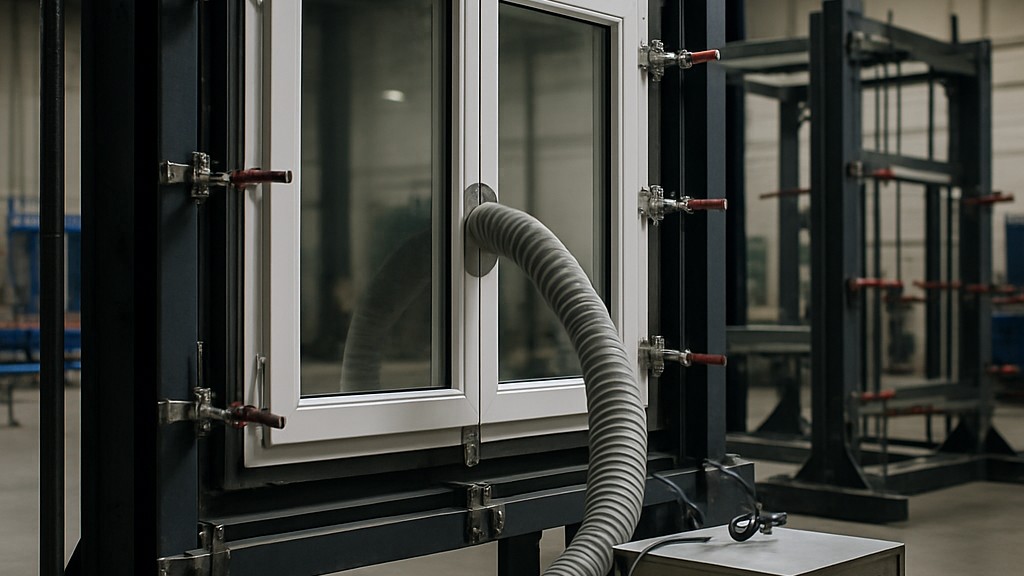
The principle of this test method is based on applying a specific series of test pressures (positive and negative) and measuring the air permeability with a suitable testing device at each test pressure.
For the purposes of this standard, the following terms and definitions apply:
- Closing condition closed: Movable parts rest in or on fixed parts in such a way that they can be secured (latched or locked).
- Closure condition fixed: Where the moving part is fixed at one or more points and is defined by at least one of the two listed below:
- Closing condition latched: The movable part is returned to the closed position and secured by a self-closing fastener or a roller lock or a latch.
- Closing condition locked: The moving part is further secured in the closed position by additional actions (e.g. handle, key, automatic devices or electronic devices) to engage integrated locking devices (e.g. nuts, bolts or latches) that will affect the properties of the product.
- Secure closing condition: Any action that prevents unauthorized release of a fastening device to allow exit or entry (e.g., child safety, theft).
- Test pressure: This refers to the difference between the static air pressure inside and outside the test chamber. If the static air pressure inside the test chamber is higher than that outside the test chamber, the test pressure is positive. If the static air pressure inside the test chamber is lower than that outside the test chamber, the test pressure is negative.
- Air permeability: It is the amount of air passing through all joints between a test specimen's wing or between the wing and frame profiles due to the test pressure. Air permeability should be expressed in cubic meters per hour (m3/h).
- Opening joint: A discontinuity line between a frame and its mating component or between two components that can be opened by structural hardware. Traditionally, this discontinuity is as seen from the opening surface of the test specimen.
- Opening joint length: The length of the discontinuity line as defined above. The joint length should be expressed in meters (m). The actual length of the gaskets or seals installed at the joints of components placed on profiles or openings beneath the components is not relevant.
- Overall area: The area of the test specimen measured parallel to the glass or sheet. Overall area should be expressed in square meters (m2).
The test specimen must be properly secured for its intended use, free from any bending or warping that could affect the test results. The test specimen must be fully functional. The test specimen must be clean and its surfaces must be dry. If ventilation devices are present, they should be covered with tape unless it is necessary to determine the amount of air flow through such devices.
The ambient temperature and humidity near the test specimen should be in the range of 10°C to 30°C and 25% to 75% relative humidity, and the test specimen should be conditioned in this manner for at least 4 hours immediately prior to testing. The temperature should be measured to plus/minus 3°C and relative humidity to plus/minus 5%. Atmospheric pressure should be measured to plus/minus 1 kPa. Test pressure should be applied from 50 Pa to 300 Pa, in 150 Pa increments from 300 Pa. Air permeability results should be given with an accuracy of plus/minus 10 percent. For air permeability below 3,0 m3/h, the accuracy should be plus/minus 0,30 m3/h.
The EN 1026 standard is important for several key reasons related to building performance, energy efficiency, and user comfort. The main reasons for this standard's importance can be listed as follows:
- Evaluates the airtightness of windows and doors: This standard provides a standardized method for measuring air permeability (air leakage) through closed and locked windows or doors under pressure differentials. This helps manufacturers and construction professionals determine how well a product prevents unwanted air exchange.
- Supports energy efficiency goals: Air leakage contributes significantly to heat loss in buildings, especially during colder seasons. By minimizing air permeability, buildings can:
- Improving insulation performance
- Reducing energy consumption for heating and cooling
- To meet European Union energy efficiency regulations and national regulations
- Improves indoor comfort: Minimizing air leakage improves:
- Thermal comfort (no drafts)
- Humidity control
- Protection from external pollutants, dust and noise
- Ensures product quality and comparison: This standard allows manufacturers to:
- Verify compliance with the performance classes defined in the EN 12207 standard
- Providing comparable data for product selection in projects
- Demonstrate the product's consistency and durability under different pressure conditions
- This standard is mandatory in building codes and certifications: It is generally required for:
- Building code compliance
- Sustainability certifications (such as LEED or national energy labels)
- Windows and doors
In short, the EN 1026 standard plays a critical role in improving the overall performance and sustainability of buildings.
Our organization, which has been supporting businesses across all sectors for years through a wide range of testing, measurement, analysis, and evaluation activities, has a strong team of employees who closely follow global developments in science and technology and are constantly improving themselves. In this context, we also provide testing services in accordance with the "EN 1026 Windows and doors - Air permeability - Test method" standard.



