

The European standard "EN 13373 Natural stone testing methods - Determination of geometrical properties in units" describes methods for verifying the geometrical properties of natural stone products such as raw blocks, raw slabs, cladding, flooring, stairs and modular tiles, and finished products for flooring units (slabs, sets and curbs). These methods are applicable in case of a disagreement between the two parties, they are not mandatory for production control.
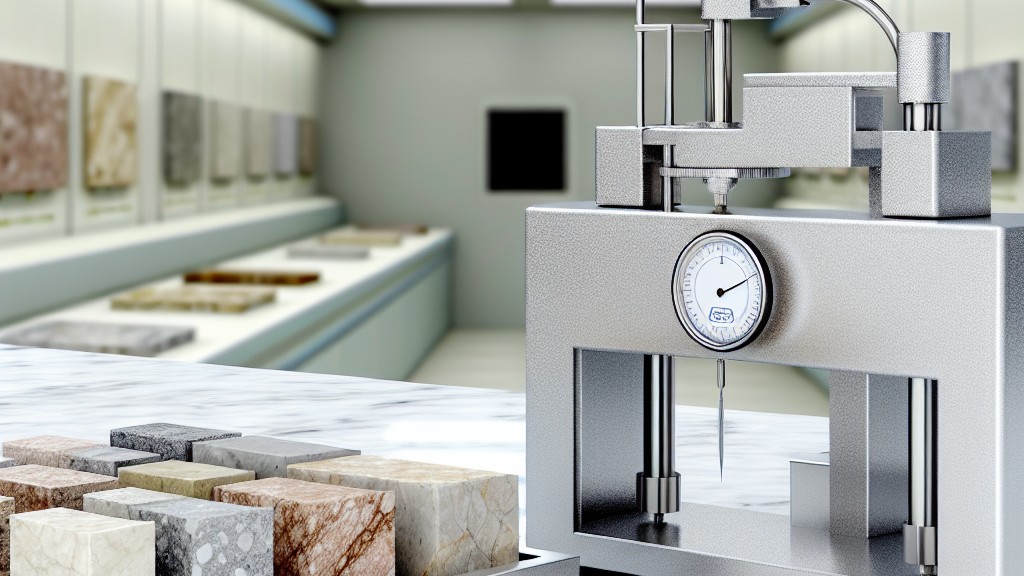
Other measuring equipment may be used as long as it can be demonstrated to be equal to or better than those specified herein. It is essential that all weighing, measuring and testing equipment be calibrated or traceable to measurement standards and regularly inspected according to documented procedures, frequencies and criteria. It is important that the expression of dimensional characteristics is appropriate to the appropriate class of the product being measured.
The principle of measuring the gross dimensions of square rough blocks is to measure the dimensions of the smallest rectangular cuboid containing a straight-sided rough block (cuboid is a polyhedral block with six faces). When measuring, a rigid ruler of suitable length graduated at 0,01 m is used. When measuring, the gross length, gross width and gross height of the block are measured as follows:
The average gross dimension is expressed to the nearest 0,01 m in each direction.
The principle of measuring the net dimensions of rough blocks is to measure the dimensions of the largest rectangular cuboid with straight edges that can be inscribed on a rough block. When measuring, a suitable size hard ruler graduated in 1 mm is used. When measuring, the net length, net width and net height of the block are measured as follows:
The average net size for each direction is expressed to the nearest 0,01 m.
The principle for measuring the gross in-plane dimensions of rough sheets is to measure the dimensions of the smallest rectangle containing a sheet. A rigid ruler of appropriate size graduated to 0,001 m is used when making the measurement.
The gross length and gross width of the board are measured as follows:
The average gross dimension for each direction is expressed to the nearest 0,01 m.
The principle of measuring the in-plane net dimensions of rough sheets is to measure the dimensions of the largest rectangle that can be inscribed in a sheet. A rigid ruler of appropriate size graduated at 0,001 m is used when measuring.
When measuring, the net length and net height of the slab are measured as follows:
The average net size for each direction is expressed to the nearest 0,01 m.
The principle of measuring the dimensions and other geometric features of finished products with cut edges is to measure the length, width and other dimensions of rectangular elements with cut edges. When measuring, a measuring instrument with a measuring range of at least the largest dimension of the measured element and with the accuracy specified in the table given in the standard is used. If the tolerance class of the measured dimension is unknown, the measuring accuracy of the instrument should not exceed 0,1 mm.
When measuring the in-plane dimensions of finished products with cut edges, all measurements must be recorded according to the table given in the standard. For length and width, measurements are taken per visible face according to the figure given in the standard and the following requirements:
The average size for each direction is expressed as 1 mm.
When measuring the thickness and surface irregularities of finished products with cut edges, all measurements should be recorded according to the table given in the standard. The thickness for each side is measured according to the figure given in the standard and the following requirements:
The average size for each direction is expressed as 1 mm.
Our organization has a strong staff that closely follows the developments in the world in the field of science and technology and constantly improves itself. Among the numerous test, measurement, analysis and evaluation studies provided for businesses in various sectors, there are also test services in accordance with the standard "EN 13373 Natural stone test methods - Determination of geometric properties in units".
To get an appointment, to get more detailed information or to request an evaluation, you can ask us to fill in our form and reach you.

