

A European standard, “EN 14579 Natural stone testing methods - Determination of sound propagation speed”, describes a method for determining the propagation speed of ultrasonic longitudinal waves in natural stones, both in the laboratory and on-site.
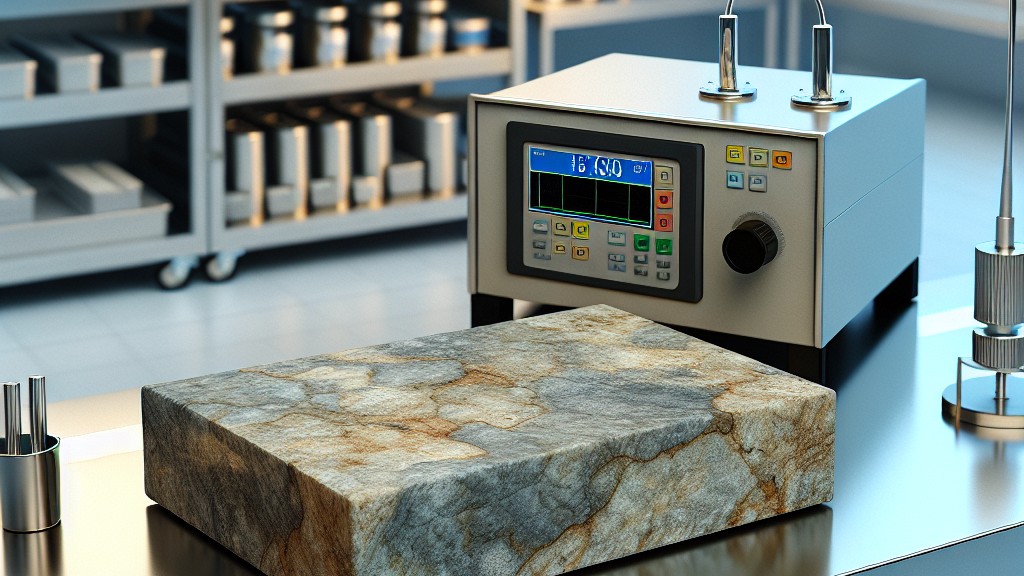
When performing the test, a pulse of longitudinal vibrations is generated by an electro-acoustic transducer that is held in contact with a surface of the stone being tested. After passing a known path length in the stone, the vibration pulse is converted into an electrical signal by a second transducer, and electronic timing circuits enable the transit time of the pulse to be measured.
The apparatus used in these tests consists essentially of an electrical pulse generator, a pair of transducers, an amplifier, and an electronic timing device for measuring the time interval between the onset of a pulse generated at the transmitting transducer and its arrival at the receiving transducer.
There are two types of electronic timing devices:
An oscilloscope provides the ability to examine the waveform, which can be advantageous in complex situations.
The device used in the tests must comply with the following performance requirements:
Transducers are also used in the tests. The natural frequency of these devices should be in the range of 20 to 150 kHz. Sometimes frequencies as low as 10 kHz and as high as 200 kHz can be used. High frequency pulses have a well-defined onset but decay more rapidly than lower frequency pulses as they pass through natural stone. It is therefore preferable to use high frequency transducers (50 kHz to 82 kHz) for short path lengths (up to 200 mm) and low frequency transducers (15 kHz to 10 kHz) for long path lengths (up to 40 m maximum). Transducers with frequencies of 40 kHz to 82 kHz have been found to be useful for most applications.
An apparatus is also used in the tests to determine the arrival time of the pulse. This apparatus should be able to determine the arrival time of the first front of the pulse, even if it is of small amplitude compared to the first half wave of the pulse.
In addition, a weighing device that provides an accuracy of 0,01 percent of the mass to be weighed and a ventilated oven that can maintain a temperature of 70 degrees plus/minus 5 degrees are used in the tests.
Sampling is not the responsibility of the testing laboratory unless specifically requested. At least 6 samples should be selected from a homogeneous batch.
As a standard reference, the final surfaces of the samples should be sawn or roughened. The test samples should be prisms with dimensions of 2 mm x 300 mm x 75 mm with a tolerance of plus/minus 50 mm. If the stone exhibits anisotropy planes (e.g. layering, foliation), the samples should be prepared with their long axes parallel or perpendicular to these planes. The samples should be dried at 70 degrees plus/minus 5 degrees to constant mass. This condition is assumed to be achieved if the difference between two weighings made at 24 hour plus/minus 2 hour intervals is not more than 0,1 percent of the first of these two masses.
During testing, the device must be used within the operating conditions specified by the manufacturer. In order to ensure a repeatable impact velocity measurement, it is necessary to take into account various factors that may affect the measurements. The necessary information is included in the standard annex (Annex B).
When arranging the transducers, it is possible to detect impacts that have passed through the natural stone in a direction other than the direction in which the maximum energy is emitted, although at right angles to the face of the transmitting transducer. It is therefore possible to make impact velocity measurements by placing two transducers on opposite faces (direct transmission), on adjacent faces (semi-direct transmission) or on the same face (indirect or surface transmission).
It may be necessary to place the transducers on opposite faces, but they should not be placed directly opposite each other. Such an arrangement should be considered semi-direct transmission. The indirect transmission arrangement is the least sensitive and should be used for in situ measurements where only one face of the natural stone is accessible or where it is more important to determine the strength of the near-surface layer than the body of the stone itself. The semi-direct transmission arrangement has a sensitivity between the other two arrangements and should be used only when the direct arrangement cannot be used.
For direct transmission, the path length is the distance between the transducers measured to an accuracy of plus or minus 1 percent. For semi-direct transmission, it is generally found to be sufficiently accurate to take the path length as the distance from center to center of the transducers. The accuracy of measuring the path length depends on the size of the transducers compared to the center-to-center distance and must be estimated. In indirect transmission, the path length is not measured, but a series of measurements are made with the transducers at different distances.
Our organization has a strong staff that closely follows the developments in the world in the field of science and technology and constantly improves itself. Among the numerous test, measurement, analysis and evaluation studies provided for businesses in various sectors, there are also test services in accordance with the standard "EN 14579 Natural stone test methods - Determination of sound speed propagation".
To get an appointment, to get more detailed information or to request an evaluation, you can ask us to fill in our form and reach you.

