

The standard "ASTM C648 Standard Test Method for Fracture Strength of Ceramic Tiles," published by the American Society for Testing and Materials (ASTM), describes a test method for determining the fracture toughness of glazed ceramic wall tiles, ceramic mosaic tiles, quarry tiles, and paving tiles with a minimum surface area of 6,4 cm². This test method provides a means of determining whether a wide range of ceramic tiles meet the strength requirements specified in the tile specifications. Tile strength is the force in Newtons required to fracture the tile, as read from a pressure gauge.
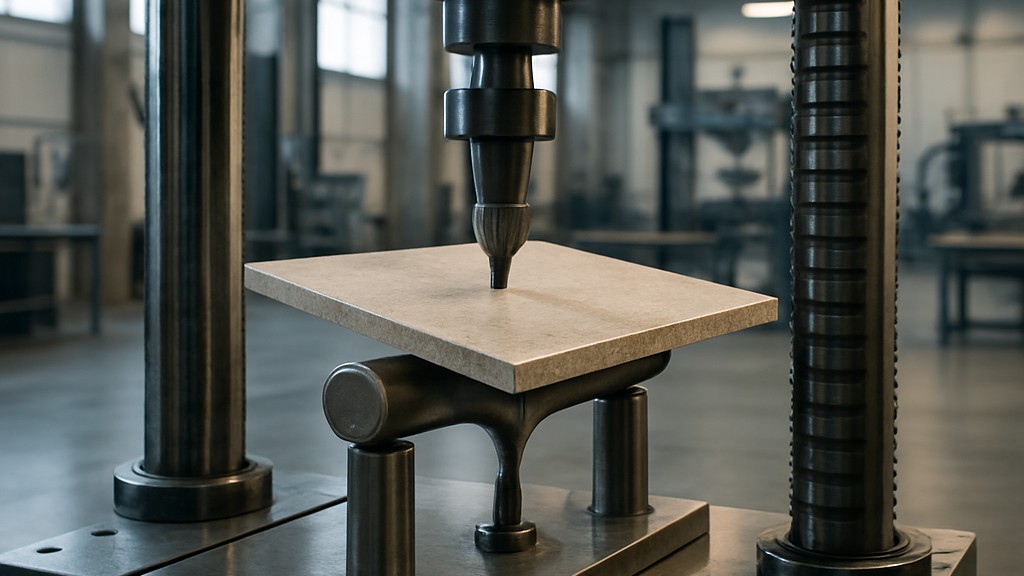
A ceramic tile's fracture toughness refers to the amount of force (usually measured in Newtons) that the tile can withstand before breaking when a load is applied to its center while supported on all sides. Fracture strength allows the tile to withstand the mechanical stresses of foot traffic, heavy furniture, or equipment without cracking or breaking.
Several factors influence a ceramic tile's performance in this test:
Known for their density and durability, porcelain tiles often significantly exceed the minimum requirement, with some reaching 2,67-4,45 kN or more.
Manufacturing industries such as ceramics, tile, polymers, and polymeric composites often utilize ASTM C648. This standard essentially determines whether many ceramic tiles meet the strength requirements that may be included in tile specifications. Fracture strength tests can be performed using a universal testing machine. This standard plays a critical role in assessing the suitability of ceramic or porcelain tiles for use in flooring or other load-bearing applications.
The test method, principally described in the ASTM C648 standard, is particularly applicable to:
This method does not evaluate long-term durability or impact resistance, only strength under a single, constant load.
This method uses a three-point loading system to simulate real-world loading conditions. The typical steps in this process are as follows:
According to the ASTM C648 standard,
Tiles that do not meet this threshold can be used in non-load-bearing areas, but are not recommended for floors or commercial areas.
ASTM C648 compliance is critical for:
The ASTM C648 standard is important because it ensures the mechanical safety, durability, and suitability of ceramic tiles, particularly for floor applications, by objectively measuring their fracture strength. This standard is considered important for the following reasons:
As a result, ASTM C648 is a key benchmark for evaluating the structural performance of ceramic and porcelain tiles. By ensuring tiles meet or exceed the required 1,11 kN breaking strength, the standard helps ensure safety, durability, and suitability for a variety of architectural and construction applications.
Our organization, which has been supporting businesses across all sectors for years through a wide range of testing, measurement, analysis, and evaluation activities, has a strong team of employees who closely follow global developments in science and technology and are constantly improving themselves. In this context, we also provide testing services in accordance with the "ASTM C648 Standard Test Method for Fracture Strength of Ceramic Tiles" standard.
To get an appointment, to get more detailed information or to request an evaluation, you can ask us to fill in our form and reach you.

