

Developments in the field of load-bearing engineered timber structures in earthquake zones require that connections made with mechanical fasteners be tested to obtain information on ductility, energy dissipation, and loss of strength under cyclic loading.
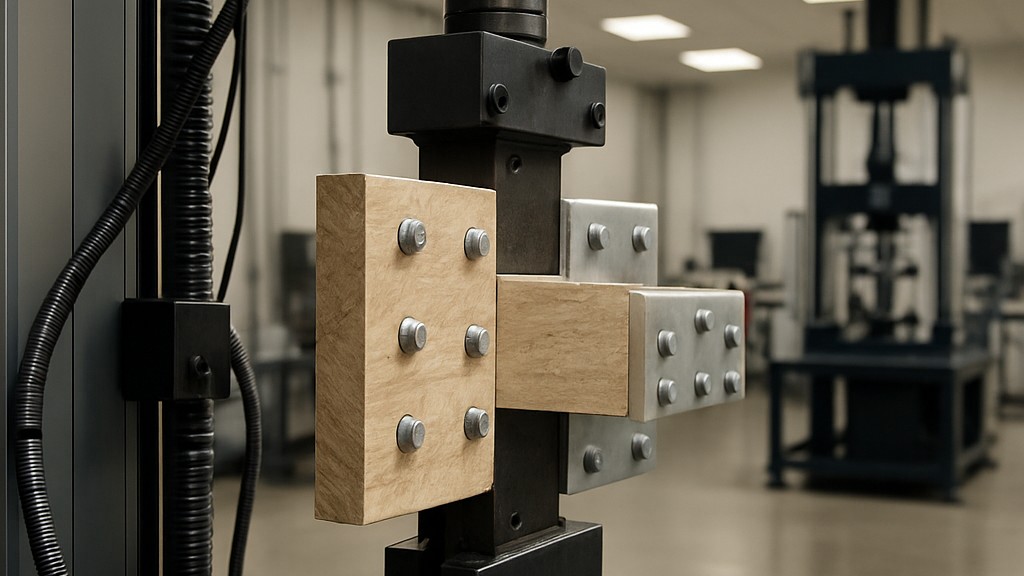
The European standard "EN 12512 Timber structures - Test methods - Cyclic testing of connections made with mechanical fasteners" describes a test method for determining the ductility, strength loss, and energy dissipation properties of connections made with mechanical fasteners under cyclic loading. This standard is designed to ensure uniformity with respect to direct axial loads and their effects only. However, the standard is also suitable for determining the moment resistance properties of connections.
This standard contains general principles to be followed to ensure comparability of results obtained from studies conducted in different laboratories. Two different test procedures are considered for different purposes: a general procedure (full procedure), in which the full cyclic load-shear performance must be determined, and a specific procedure (short procedure), in which only the main performances must be determined at a predetermined ductility level.
In the world of structural engineering, the reliability of connections is paramount, as buildings must withstand not only daily loads but also the unpredictable forces of earthquakes and dynamic events. This is where EN 12512 comes in, a critical tool for assessing the performance of timber connections under cyclic loading. This standard provides a rigorous framework for assessing how these connections behave when subjected to repeated stress cycles. As timber gains popularity as a sustainable building material thanks to innovations like cross-laminated timber panels, standards like EN 12512 are becoming more important than ever.
The EN 12512 standard is part of a broader package for timber structures, specifically focusing on the testing of connections secured with mechanical fasteners such as nails, screws, bolts, and dowels. Unlike static load tests, which measure initial strength, cyclic tests simulate real-world dynamic conditions such as wind gusts, machine vibrations, or seismic activity.
The main objectives of this standard are threefold:
This standard is particularly important in earthquake-prone areas, where wood's natural flexibility can be an advantage when properly designed. This standard ensures that tested components meet safety thresholds for use in load-bearing structures.
The EN 12512 standard includes a precise and repeatable procedure for cyclic testing designed to mimic the irregular loading patterns of earthquakes. Tests are typically performed on full-scale joint specimens in a laboratory environment using universal testing machines capable of applying controlled displacements or forces.
In sample preparation, joints are assembled using timber members (e.g., solid timber, glulam, or cross-laminated timber) connected by mechanical fasteners. Samples should represent actual structural details, including moisture content and grain orientation.
Regarding loading direction, tests can be conducted in shear, tension, or compression, but shear is the most common in seismic simulations. Reverse cyclic loading (alternating directions) is used for shear, while non-reverse cyclic loading is used for tension resulting from compressive constraints. Fixed or pinned supports simulate structural integration.
The cyclic loading protocol follows a displacement-controlled sequence divided into phases of increasing intensity:
Tests are stopped at 80 percent load reduction after peak or complete failure (e.g., fastener pullout or wood crushing).
The EN 12512 standard has been widely adopted and has influenced national standards.
Ultimately, the EN 12512 standard serves as a cornerstone in the quest for durable timber structures by transforming potential joint weaknesses into resistance to dynamic threats. By standardizing cyclic testing, it enables engineers to design buildings that not only stand upright but also sway safely.
Our organization, with its competent and experienced team, has been understanding the needs of its customers for years, providing them with the advanced testing services they need, and assisting them in the establishment, implementation, and improvement of management systems. In this context, we also provide testing services in accordance with the EN 12512 Timber structures - Test methods - Cyclic testing of connections made with mechanical fasteners standard.
To get an appointment, to get more detailed information or to request an evaluation, you can ask us to fill in our form and reach you.

