

The European standard “EN 14707 Thermal insulation products for building equipment and industrial plants - Determination of maximum service temperature for preformed pipe insulation” defines the equipment and procedures for determining the maximum service temperature for preformed pipe insulation. This standard is also applicable to thermal insulation products.
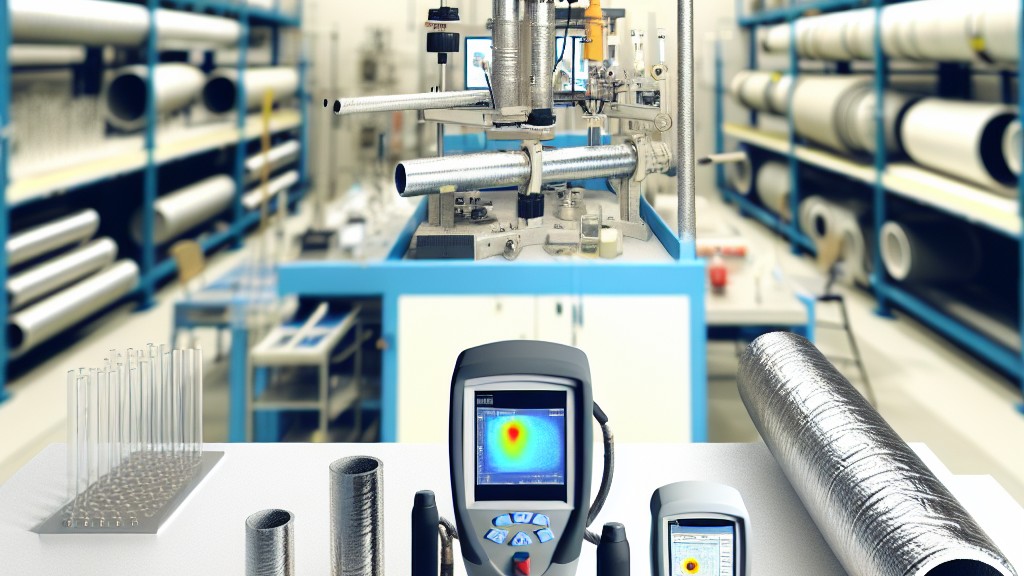
For the purposes of this standard, the maximum service temperature refers to the highest temperature at which the insulation product, when installed at the recommended thickness for a particular application, will continue to perform within the specified performance limits. The required performance may be in the areas of dimensional stability, thermal and mechanical properties, and resistance to the creation of hazards such as changes in appearance and internal self-heating. In the present test procedure used as a reference, the test specimen is exposed to a temperature difference ranging from ambient temperature to the maximum service temperature. This may not reflect actual application conditions when products are exposed to different temperatures on two main surfaces, for example in multilayer systems or in products with surfaces where the surface may limit the maximum service temperature.
In principle, the thickness and length are measured after single-sided heat treatment for a specified period of time at the maximum service temperature achieved using a specified rate of temperature increase. The thickness of the test specimen is measured during heat treatment and its length only after cooling to ambient temperature. The procedure may be an iterative process. Additional requirements for assessing the maximum service temperature of specific materials are described in the normative annexes of this standard or the relevant product standard or any other technical specification.
A general arrangement of the device is shown in the figure given in the standard and consists essentially of:
The dimensions of the test samples should be:
The dimensions shall be as specified in the relevant product standard or in an annex to this standard. In the absence of a product standard or other technical specification, the dimensions may be freely agreed between the parties. Testing may be carried out on multilayer systems to simulate the conditions existing in practice. If the pipe insulation is cut from a homogeneous, isotropic flat product, the maximum service temperature may be obtained from tests on flat product with similar properties in accordance with EN 14706.
The number of test samples shall be as specified in the relevant product standard. If the number is not specified, at least one test sample shall be used for each dimension. In the absence of a product standard or other technical specification, the number of test samples may be freely agreed upon between the parties.
Test samples must be conditioned at 6 degrees plus/minus 23 degrees for at least 5 hours. In case of disagreement, they must be stored at 23 degrees plus/minus 2 degrees and 50 percent plus/minus 5 percent relative humidity for the period specified in the relevant product standard or for at least 24 hours.
The initial temperature of the test sample and the hot pipe should be 23 degrees plus/minus 5 degrees.
Our organization, which has been trying to support businesses from every sector with its testing, measurement, analysis and evaluation studies carried out in a wide range for years, has a strong staff that closely follows the developments in the world in the field of science and technology and constantly improves itself. In this context, testing services are also provided to businesses in accordance with the standard “EN 14707 Thermal insulation products for building equipment and industrial facilities - Determination of maximum service temperature for pre-formed pipe insulation”.
To get an appointment, to get more detailed information or to request an evaluation, you can ask us to fill in our form and reach you.

