

The European standard “EN 12179 Curtain wall systems - Wind load resistance - Test method” describes a method for determining the wind load resistance of curtain wall systems, both fixed and openable, under positive and negative static air pressure. This standard applies to all curtain wall products defined in the “EN 13830 Curtain wall - Product standard”.
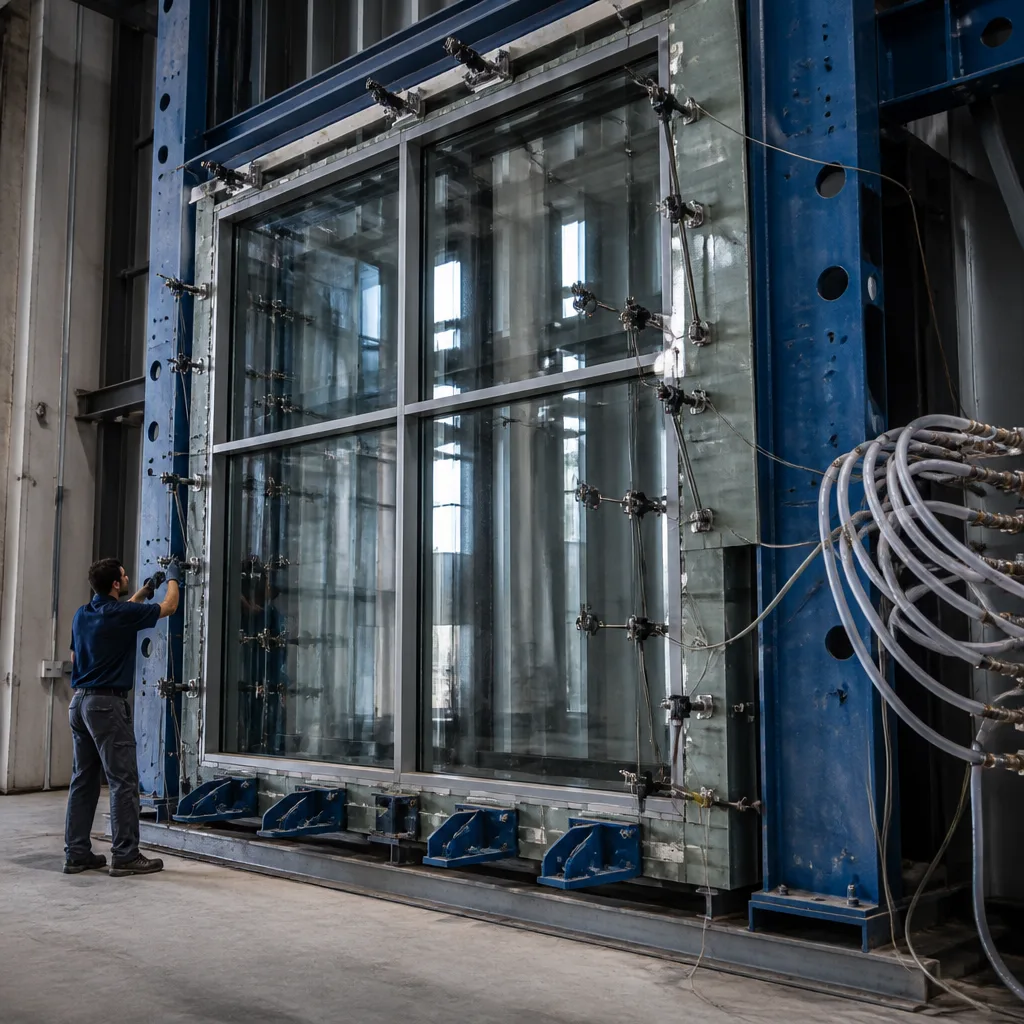
The described test method is based on the principle of applying a series of test pressures (positive and negative) and measuring the displacements at each pressure.
If the curtain wall test specimen has openable parts during testing, each openable part of the test unit is opened, closed, and locked five times before testing. Its resistance to wind load is tested first with positive test pressure, then with negative test pressure.
All measuring devices are reset or reset to their initial readings, and these are recorded. Changes in the sample's condition are noted.
The curtain wall unit is subjected to test pressures in 4 stages, each lasting at least 15 seconds plus/minus 5 seconds, up to the design wind load, i.e., up to 25%, 50%, 75%, and 100% of the design wind load.
Front surface displacements are measured at each test pressure, and front surface deflections are determined as specified in the EN 13116 standard.
Permanent deformities are recorded no later than 1 hour after the completion of the test.
For each test pressure, measurements of the front surface displacements are listed, front surface deflections are calculated, and these are graphically expressed as functions of the test pressure. Permanent deformations are recorded. Any damage is noted in the front view drawing of the specimen. Front deflections and permanent deformations are compared with the maximum allowable values specified in EN 13116 standard and evaluated as pass or fail.
In short, EN 12179 evaluates both fixed and openable elements of shear walls when subjected to positive and negative static air pressures, simulating the actual wind conditions to which building facades are exposed. This standard applies to shear wall systems used as external facades. This standard defines a procedure for evaluating the structural performance of these systems under wind load conditions. This procedure includes:
The aim is to verify that the facade can safely withstand the specified wind pressures without excessive deformation, damage, or failure.
During the test, the sample is placed in a pressure chamber where controlled positive and negative air pressures are applied to simulate the effect of wind. During the test:
Equipment typically used in tests includes:
The device must be able to accurately generate and maintain the specified pressure levels for the required duration.
The described test method follows these steps:
Measured deviations are compared against the allowable limits set by product specifications and project requirements.
A curtain wall system generally passes the test under the following conditions:
These criteria help ensure the long-term safety and usability of the facades.
The EN 12179 standard is commonly used in conjunction with the following:
Together, these standards provide a comprehensive framework for evaluating curtain wall performance.
The main reasons why the EN 12179 standard is considered important are as follows:
For high-rise buildings, airports, commercial towers, and other structures with large glass facades, wind resistance testing is critical to ensuring occupants safety and long-term durability.
In conclusion, the EN 12179 standard is a test standard used to evaluate the resistance of curtain wall systems to wind loads. This standard verifies structural integrity, deformation behavior, and overall performance under realistic wind conditions by subjecting curtain wall systems to controlled positive and negative air pressures. Compliance with this standard helps manufacturers, designers, and building owners ensure that curtain wall systems remain safe, reliable, and durable throughout their service life.
For many years, our organization, with its competent and experienced staff, has been understanding the needs of its clients, providing the advanced testing services they require, and assisting them in the establishment, implementation, and improvement of management systems. Within this framework, we also provide testing services in accordance with the EN 12179 standard.
To get an appointment, to get more detailed information or to request an evaluation, you can ask us to fill in our form and reach you.

