

The European standard "EN 1027 Windows and doors - Watertightness - Test method" describes the test method to be used to determine the watertightness of fully assembled window and door sets made of any material. This test method is designed to take into account the conditions of use when the window or door set is installed in accordance with the manufacturer's specifications and the requirements of relevant European standards and codes of practice. This standard does not apply to joints between the window or door set frame and the building structure.
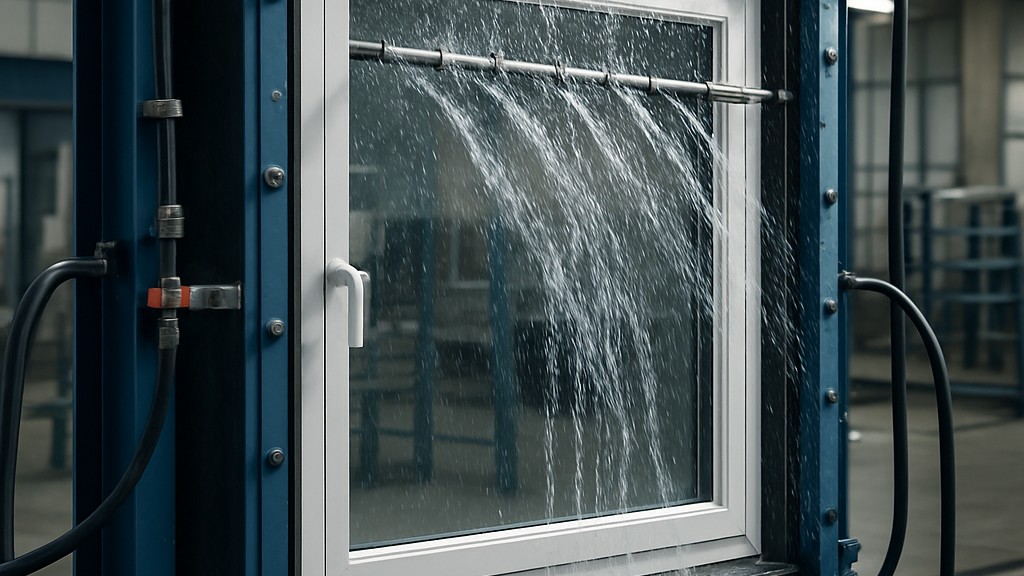
The principle of this test method is based on continuously spraying a specified amount of water onto the outer surface of the test specimen and applying positive test pressure increments at regular intervals while recording the test pressure and details of where the water penetrates.
For the purposes of this standard, the following terms and definitions apply:
The test sample must be properly secured for its intended use, without any bending or warping that could affect the test results. The test sample must be fully functional. The surrounding area, including frame joints, must be prepared and positioned so that any water leaks can be easily detected. The test sample must be cleaned and its surfaces must be dry. Any ventilation devices must be taped.
The spray method (Method A or Method B) should be selected by the manufacturer based on the location of the test sample (protected or unprotected) in the intended studies. A test should be conducted using only one setup. A template for setting up the spray system should be followed.
The nozzle line connecting the nozzle tips shall be positioned not more than 150 mm above the uppermost horizontal joint line of any movable frame or the glass line of any fixed glazing to ensure complete wetting of adjacent horizontal frame members. The nozzle line shall be positioned 250 mm plus 10 mm minus 0 mm from the outer surface of the test specimen as defined by the outermost joint plane of the movable members or the glass plane of the fixed members.
The nozzles should be spaced 400 mm plus/minus 10 mm apart along the axis of the spray bar and the nozzles should be arranged so that the lateral distance between the outer edge of the perimeter and the outermost nozzles is greater than 50 mm but not more than 250 mm.
The nozzle axis shall lie on a line 24 degrees plus 2 degrees – 0 degrees below the horizontal line for testing according to Method 1A and 84 degrees plus/minus 2 degrees below the horizontal line for testing according to Method 1B.
For test specimens up to 2,5 m high, including, for example, extension profiles or shutter boxes, a single nozzle row should be used, with each nozzle spraying an average of 2 l/min for both Method 1A and Method 1B spraying. The spray rates specified above are suitable for test specimens 2,5 m high. For smaller test specimens, the nozzles spray the water beyond the threshold, so the actual flow in the sprayed area is approximately 2 l/(min m2) when testing according to Method 1A and 1 l/(min m2) when testing according to Method 1B.
For test specimens exceeding 2,5 m in height, including, for example, extension profiles or shutter boxes, the upper nozzle row should be fixed as described above. Additional nozzle rows should be fixed at vertical intervals 1,5 m (within a tolerance of plus/minus 150 mm) below the upper nozzle line. Where any horizontal projection occurs, these additional rows should be positioned at a level where water will not be sprayed upwards from below the projection. The average flow rate of each nozzle should be 1 l/min for spray method 2A and 2 l/min for spray method 2B.
For test specimens containing one or more horizontal water rods projecting more than 50 mm, an additional row of nozzles should be arranged for each water rod, as described above.
The water temperature should be between 4 degrees and 30 degrees, and the water should be clean enough to ensure that all nozzles spray correctly.
Our organization, which has been supporting businesses across all sectors for years through a wide range of testing, measurement, analysis, and evaluation activities, boasts a strong team of employees who closely follow global developments in science and technology and are constantly improving themselves. In this context, we also provide testing services in accordance with the "EN 1027 Windows and doors - Watertightness - Test method" standard.
To get an appointment, to get more detailed information or to request an evaluation, you can ask us to fill in our form and reach you.

