

A European standard, “EN 1925 Test methods for natural stone - Determination of the capillary water absorption coefficient” describes a method for determining the capillary water absorption coefficient of natural stone. This method is not suitable for stones with less than 1936 percent open porosity when determined according to the standard “EN 1 Test methods for natural stone - Determination of true density and apparent density and total and open porosity”.
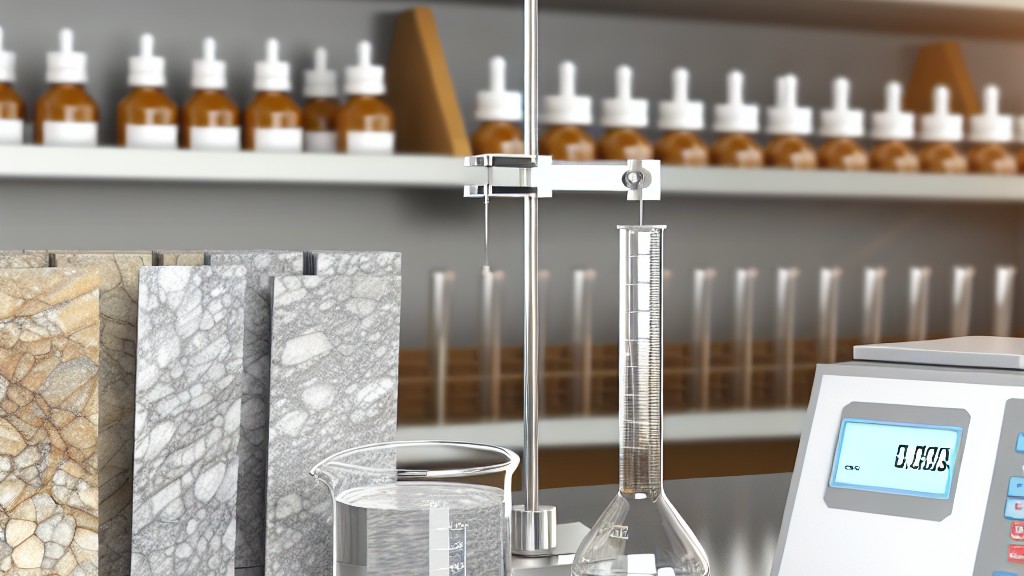
When performing this test, in principle, after drying to a constant mass, the sample is immersed in water 3 mm plus/minus 1 mm from one side (never from the processed side) and the mass increase is measured as a function of time.
The main equipment used in these tests includes:
When preparing samples, sampling is not the responsibility of the testing laboratory unless specifically requested. At least six samples should be selected from a homogeneous batch and tested in each direction of water elevation with respect to the position of each isotropic plane (e.g. bedding planes, foliation, etc.). These planes should be marked on all samples with at least two parallel lines.
Specimens should be rough cut or have one or two polished or roughened surfaces. These surfaces should be placed vertically (the machined surface should never be the submerged surface).
Test specimens shall be cubes with sides of 70 mm plus/minus 5 mm or 50 mm plus/minus 5 mm or right circular cylinders with a diameter and height equal to 70 mm plus/minus 5 mm or 50 mm plus/minus 5 mm.
The test samples shall be dried to constant mass in a ventilated oven at 70 degrees plus/minus 5 degrees. Constant mass is obtained when the difference between two successive weighings made at 24 hour plus/minus 2 hour intervals is not more than 0,1 percent of the mass of the sample. The samples shall be kept in a dryer until they reach room temperature (20 degrees plus/minus 5 degrees).
After drying, the samples are weighed to an accuracy of 0,01 g and the area of the base to be immersed is calculated by measuring the two media to the nearest 0,1 mm. This area is expressed in square metres. The samples are placed in the tank on thin supports provided so that they only partially rest on their bases. It is necessary to ensure that the position of the anisotropy planes in relation to the rising water corresponds to the requirements. The base is immersed in water to a depth of 3 mm plus/minus 1 mm. The timer is started. The water level is kept constant throughout the test by adding water as necessary and the container is closed to prevent evaporation of the moist samples. At first very short, then longer intervals, each sample is removed in turn, the immersed part is gently dried with a damp cloth so that all water droplets are removed and weighed immediately to the nearest 0,01 g, then returned to the container. The time elapsed from the beginning of the test to each weighing time is noted.
The time selection depends on the type of stone. For a highly absorbent stone, suitable times are: 1, 3, 5, 10, 15, 30, 60, 480 and 1440 minutes. For a low absorbent stone, suitable times are: 30, 60, 180, 480, 1440, 2880 and 4320 minutes. These times are measured to an accuracy of 5 percent. A minimum of 7 measurements are required. The end of the test is reached when the difference between two consecutive weighings is not more than 1 percent of the mass of water absorbed by the sample.
The mass of water absorbed, in grams, is plotted as a function of the square root of time expressed in seconds, divided by the area of the immersed base of the sample, in square metres.
Our organization has a strong staff that closely follows the developments in the world in the field of science and technology and constantly improves itself. Among the numerous test, measurement, analysis and evaluation studies provided for businesses in various sectors, there are also test services in accordance with the standard "EN 1925 Natural stone test methods - Determination of water absorption coefficient by capillarity".
To get an appointment, to get more detailed information or to request an evaluation, you can ask us to fill in our form and reach you.

