

The standard "ASTM C686 Standard Test Method for Peel Strength of Mineral Fiber Blanket and Mattress Insulation," published by the American Society for Testing and Materials (ASTM), describes a test method for evaluating the tensile strength of mineral fiber quilt and blanket insulation products. This method is useful for determining the comparative tensile properties of these products, whose samples cannot be held with more traditional clamp-type holders. This is a quality control method, and the results should not be used for design purposes. However, this method is not suitable for sheet-type products.
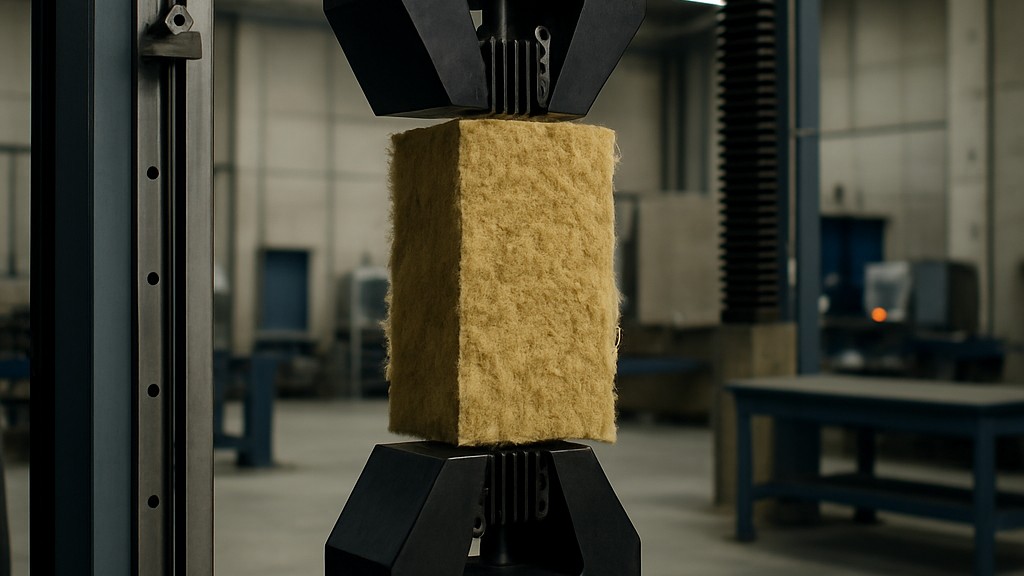
Tensile strength is a key property associated with mineral fiber production because it is affected by the fiber type, fiber deposition, the type and amount of binder, and the method by which the resin is cured to form a bonded insulation product. This test method provides an indication of product integrity and the product's ability to be successfully processed and applied in the field.
The main equipment used in these tests are as follows.
The test sample should consist of the entire O-ring cut from the entire thickness of the product to be tested. A sample should not be cut from a product that exhibits a 65 percent difference from the standard when tested according to the ASTM C167 test method. Any sample showing significant damage to the insulation or delamination in the insulation thickness should not be tested.
Samples are conditioned for 1 hour in a room maintained at 23 degrees plus/minus 1 degree atmospheric temperature and 50 percent plus/minus 2 percent relative humidity in accordance with ASTM E171 standard.
Each specimen is weighed to the nearest 0,01 g during the test and its weight is recorded. Pole-type holders are attached to the tensile testing unit and aligned in the vertical plane. The moving head speed is set at 305 mm/min. The moving head stops are adjusted until the holders are approximately 6,3 mm apart at the starting position. The specimen is placed in the pole-type holder with both poles within the rectangular hole of the specimen (higher-density side first, if applicable). The higher-density side of the specimen should be in contact with the pole shield. The load is applied, and the maximum load at fracture is read and recorded to the nearest 0,4 N. Ten specimens, each cut in the machine and cross-machine directions, are tested. If the machine direction cannot be easily determined, the longest dimension of the specimen to be tested is considered longitudinal, and the shortest dimension is referred to as transverse.
The report should include the following information:
In high-temperature industrial environments, refractories play a vital role in protecting equipment and ensuring energy efficiency. Precise thermal performance testing is essential to assess the heat insulation properties of these materials. One such widely accepted test is defined in ASTM C686. This standard outlines procedures for determining the thermal conductivity of refractory materials under controlled laboratory conditions.
ASTM C686 specifically covers the determination of thermal conductivity of refractories using the shielded hot plate method. The results help engineers and manufacturers select suitable materials for furnaces, ovens, incinerators, and other high-temperature environments.
This standard provides a method for measuring the steady-state thermal conductivity of refractories at temperatures up to approximately 1200°C. This test is applicable to:
This standard is valid for both homogeneous and layered materials in sheet or cylinder form.
The shielded hot plate method essentially involves placing a test sample between a heated plate and a cooling plate (heat sink). Heat flows through the sample, and sensors measure the temperature gradient. Thermal conductivity is calculated from these measurements.
This test consists of the following steps:
Understanding the thermal conductivity of a refractory is crucial for:
Industries such as steelmaking, glass production, cement manufacturing, and petrochemical refining rely on accurate data to ensure safe and efficient operations.
As a result, ASTM C686 remains a cornerstone in refractory material testing. By standardizing how thermal conductivity is measured, it enables manufacturers and engineers to reliably evaluate materials for high-temperature applications. Today, energy efficiency and sustainability are increasingly critical, and compliance with ASTM C686 and similar standards is more important than ever.
Our organization, which has been supporting businesses across all sectors for years through a wide range of testing, measurement, analysis, and evaluation activities, boasts a strong team of employees who closely follow global developments in science and technology and are constantly improving themselves. In this context, we also provide testing services in accordance with the "ASTM C686 Standard Test Method for the Peel Strength of Mineral Fiber Blanket and Mattress Insulation."
To get an appointment, to get more detailed information or to request an evaluation, you can ask us to fill in our form and reach you.

