

The European standard "EN ISO 16535 Thermal insulation products for building applications - Determination of long-term water absorption by immersion," subsequently published by the International Organization for Standardization (ISO), describes the equipment and procedures used to determine the long-term water absorption of test samples. These procedures apply to thermal insulation products.
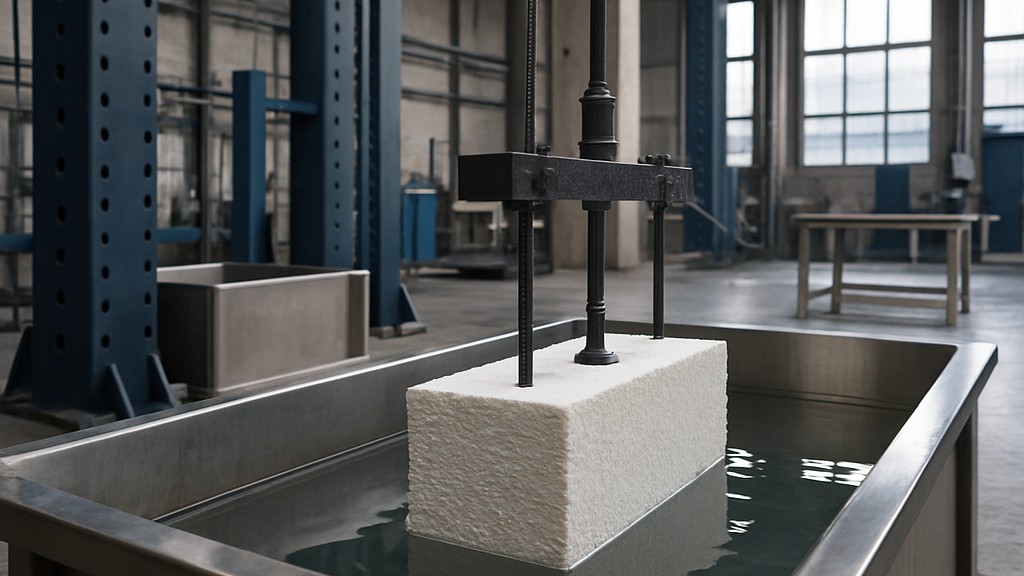
This standard includes two methods:
Prolonged water absorption by partial immersion is intended to simulate water absorption caused by prolonged exposure to water. Prolonged water absorption by full immersion is not directly related to field conditions, but has been considered a relevant test condition for some products in some applications.
Principally,
The device used in these tests must have the following equipment:
The thickness of the test specimens shall be equal to the thickness of the original product. Test specimens shall be square-cut prisms with sides of 200 mm plus/minus 1 mm. The number of test specimens shall be as specified in the relevant product standard or any other technical specification for thermal insulation products. In the absence of such a specification, a minimum of four test specimens shall be used. In the absence of a product standard or any other technical specification, the number of test specimens may be agreed upon between the parties. Test specimens shall be cut so as not to include the edges of the original product. Test specimens shall be prepared by methods that do not significantly alter the original structure of the product. Any external surfaces, finishes, and/or coatings shall be preserved. Specific preparation methods, where necessary, are specified in the relevant product standard or any other technical specification for thermal insulation products.
Test samples must be conditioned at 23°C (+/- 5°C) for at least 6 hours. In case of disagreement, they must be stored at 23°C (+/- 2°C) and 50% (+/- 5%) relative humidity for at least 6 hours, for the period specified in the relevant product standard. Different conditioning conditions may apply in tropical countries. In this case, the conditions must be 27°C (+/- 5°C) and 65% (+/- 5%) relative humidity for at least 6 hours and must be clearly stated in the test report.
Tests should be conducted at 23 degrees Celsius plus/minus 5 degrees Celsius. In cases of disagreement, they should be conducted at 23 degrees Celsius plus/minus 2 degrees Celsius. Different test conditions may apply in tropical countries. In this case, the conditions should be 27 degrees Celsius plus/minus 2 degrees Celsius and 50 percent relative humidity plus/minus 5 percent, and must be clearly stated in the test report.
The test method shall be as specified in the relevant product standard or other technical specification for thermal insulation products. In the absence of such a specification, the method may be agreed upon by the parties. Long-term water absorption is determined after 28 days of immersion. Upon request, readings may be taken at shorter time intervals, such as 7 and 14 days of immersion. The dimensions of the test specimens should be measured to the nearest 0,5 mm to ISO 29768 before testing. If any dimensional changes are noted after the immersion period, the dimensions of the test specimens should be re-measured.
The method of long-term water absorption by partial immersion is carried out as follows:
Our organization, which has been supporting businesses across all sectors for years through a wide range of testing, measurement, analysis, and evaluation activities, has a strong team of employees who closely follow global developments in science and technology and are constantly improving themselves. In this context, we also provide testing services in accordance with the standard "EN ISO 16535 Thermal insulation products for building applications - Determination of long-term water absorption by immersion."
To get an appointment, to get more detailed information or to request an evaluation, you can ask us to fill in our form and reach you.

