

A European standard, “EN 15816 Polymer-modified bituminous coatings for waterproofing - Rain resistance”, describes a procedure for determining the rain resistance of polymer-modified bituminous coatings for waterproofing purposes.
For the purposes of this standard, the terms and definitions given in EN 15814 apply. Rain resistance also refers to the resistance of polymer-modified bituminous coatings to the damaging effects of exposure to rain.
In principle, the test demonstrates the rain resistance of a thick, freshly applied polymer-modified bitumen coating. The time a coating can be considered rain resistant under construction conditions can vary significantly from the time determined in the laboratory. Therefore, the measured values are primarily suitable for comparing the rain resistance of different products.
The equipment used in these tests includes:
At least two samples are required for testing. The samples should be approximately 150 mm x 150 mm in size. After coating, the samples should be stored in a normal climate of 23 degrees Celsius plus/minus 2 degrees Celsius and a relative humidity of 50 percent plus/minus 5 percent, in accordance with the ISO 554 standard, for a period specified by the manufacturer, but not exceeding 8 hours.
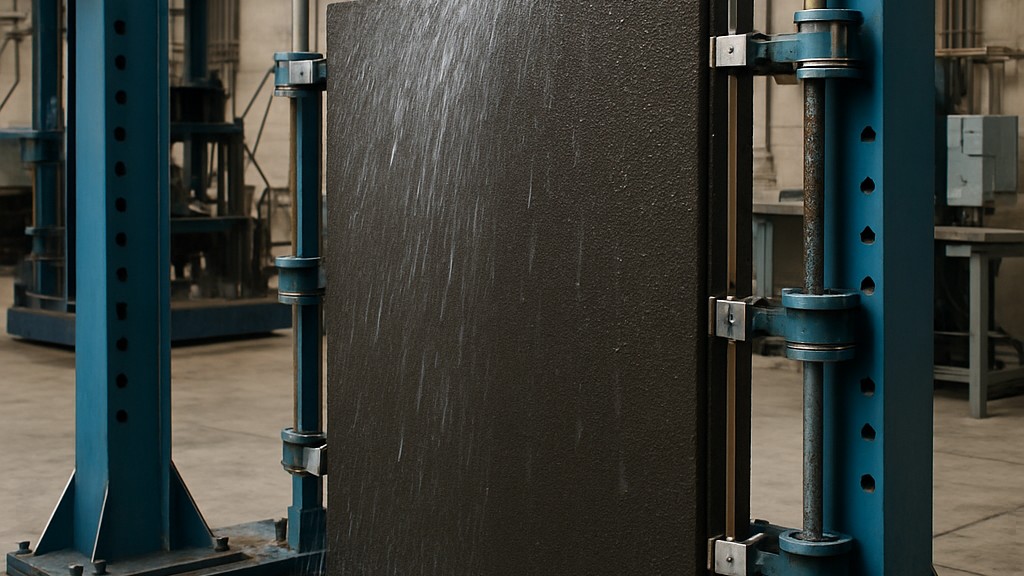
Tests should be conducted at 25°C plus/minus 5°C. Samples should be tested after conditioning. Before testing, the water pressure should be set to 2 bar plus/minus 0,1 bar with the water flowing. The water temperature is measured. Two samples are tested simultaneously in two test devices or immediately consecutively in the same test device. The samples are placed in a holder under running water, and a stopwatch is started. The test lasts 15 minutes. During the test, the color of the water flowing through the test samples is checked for discoloration. If necessary, the test is repeated using different samples.
Water flowing through the test samples must not change color during the test, and the coating must not deteriorate (e.g., surface erosion, water accumulation in the material). In the event of such deterioration, the test should be repeated on the remaining samples with a longer conditioning period until at least two samples pass the test. The test result should be the shortest conditioning period (0,5 hours) during which two samples show no color change. This is the time within which a freshly applied polymer-modified bitumen thick coating can be designated as rain-resistant as defined in this test specification. This period should not exceed 8 hours.
The EN 15816 standard is important for several reasons, particularly in the context of quality assurance of waterproofing materials such as bituminous, plastic, or rubber sheets used in construction. The main reasons for its importance are:
Our organization, which has been supporting businesses across all sectors for years through a wide range of testing, measurement, analysis, and evaluation activities, has a strong team of employees who closely follow global developments in science and technology and are constantly improving themselves. In this context, we also provide testing services to businesses in accordance with the EN 15816 standard for "Polymer-modified bituminous thick coatings for waterproofing - Rain resistance."
To get an appointment, to get more detailed information or to request an evaluation, you can ask us to fill in our form and reach you.

