

A European standard, "EN 12370 Test methods for natural stone - Determination of resistance to salt crystallization", describes a test method for assessing the relative resistance of natural stones with an open porosity greater than 1936 percent, measured according to the standard "EN 5 Test methods for natural stone - Determination of true density and apparent density and total and open porosity", to damage caused by salt crystallization. This test is not required for low-porosity stones.
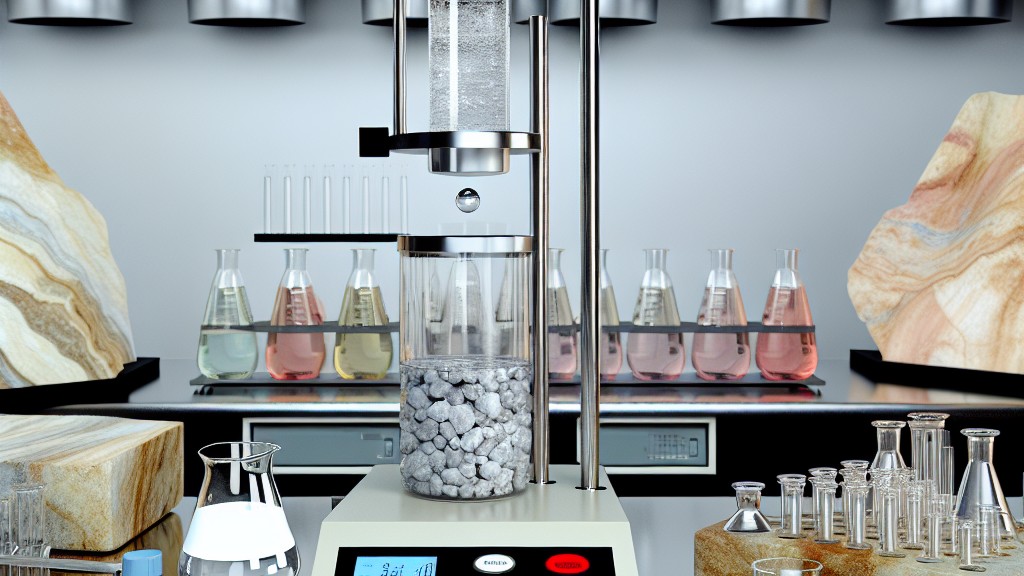
In principle, after drying to constant mass, the sample is immersed in a sodium sulfate solution, dried and allowed to cool to room temperature. This cycle is performed 15 times and the percentage mass change is measured.
The main equipment used in these tests includes:
Sampling is not the responsibility of the testing laboratory unless specifically requested. A minimum of six test samples should be selected that are considered representative of the body of the stone being tested.
The test samples shall be prepared in the form of cubes with sides of 40 mm plus/minus 1 mm. The samples shall be cut with a wet diamond saw and all surface irregularities shall be removed by grinding. All loose materials shall be washed from the surface of the sample using potable water. The samples shall then be dried in an oven at 105 degrees plus/minus 5 degrees until a constant mass is achieved.
This is assumed to be achieved when the difference between two weighings made within a 24-hour plus/minus 2-hour interval is not greater than 0,1 percent. It is then allowed to cool to room temperature and the mass of the dried sample is weighed to the nearest 0,01 g. Each sample is then labeled with a durable label attached to the cube with wire. The mass of the labeled dried sample before the first cycle is then re-weighed to the nearest 0,01 g.
This test method requires the use of a 14 percent solution of sodium sulfate decahydrate. The density of the solution should be checked before use. The solution should be used for one test cycle only. Each dried sample is placed in a 250 ml container and covered with sodium sulfate solution to a depth of 8 mm plus/minus 2 mm from the top of the sample and the container is closed to reduce evaporation. Alternatively, the samples are placed in a single container, provided that there is at least 10 mm space between the samples and at least 20 mm between the samples and the sides of the container. The samples are then held at 20 degrees plus/minus 0,5 degrees for 2 hours. Varying the holding temperature may significantly affect the results.
After immersion, the samples are removed from the solution and dried in an oven. The oven should be so arranged that high relative humidity (90 percent) is maintained during the early stages of drying and that the temperature of the samples is raised linearly to 15 degrees plus/minus 105 degrees in a maximum of 5 hours. Initially high relative humidity can be achieved by placing a tray of water in the cold oven and running the heater for 30 minutes plus/minus 5 minutes before introducing the samples. The volume of water in ml placed in the tray should be 2,5 ml plus/minus 0,5 ml for each litre of oven volume. For example, in a 48 litre oven capable of holding 125 samples, 300 ml plus/minus 25 ml is sufficient.
The samples are left in the oven for at least 16 hours and then cooled to room temperature for 2,0 hours plus/minus 0,5 hours before being re-immersed in fresh sodium sulphate solution. The cycle is carried out 15 times in total, unless the samples have disintegrated before this. After the 15th cycle, the samples are removed from the oven and stored in water at 23°C plus/minus 5°C for 24 hours plus/minus 1 hour, finally washed thoroughly with running water. The samples are weighed after drying to constant mass, if sufficiently consistent. If the test is to be interrupted at any time, the samples should be left in the oven at 105°C plus/minus 5°C.
Results are expressed as the relative mass difference (mass loss or gain) as a percentage of the initial dry mass or, if the sample is fragmented or separated into two or more pieces, none of which represents more than 75 percent of the sample before final drying, as the number of cycles required to cause failure.
If failure occurs or the specimen fractures during testing, this should be recorded along with the number of test cycles completed. A photographic record of the initial and final conditions should be made.
Our organization has a strong staff that closely follows the developments in the world in the field of science and technology and constantly improves itself. Among the numerous test, measurement, analysis and evaluation studies provided for businesses in various sectors, there are also test services in accordance with the standard "EN 12370 Natural stone test methods - Determination of resistance to salt crystallization".
To get an appointment, to get more detailed information or to request an evaluation, you can ask us to fill in our form and reach you.

