

The European standard EN 323 Wood-based panels - Determination of density describes a method for determining the density of test pieces of wood-based panels. The results can be used to estimate the density of wood-based panels according to standard N 326-1 Wood-based panels - Sampling, cutting and inspection - Part 1: Sampling and cutting of test pieces and expression of test results.
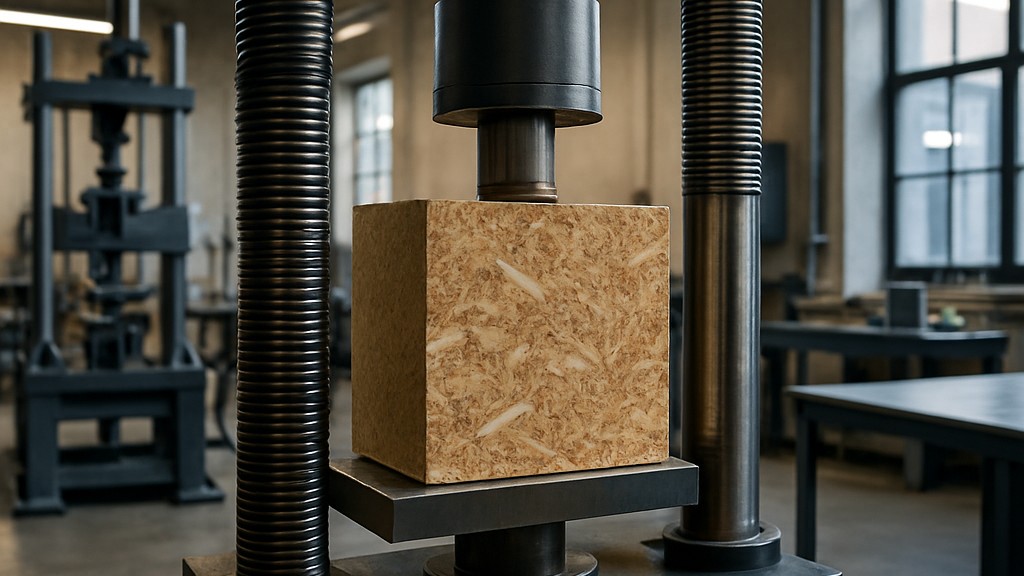
This standard is one of a series of standards relating to wood-based panels within the scope of the Council Directive on construction products and has been published to supplement the "Common combined rules for timber constructions".
In principle, density is determined as the ratio of the mass of each test piece to its volume by measuring both test pieces at the same moisture content, and these results are used to estimate the density of all the boards.
The EN 323 standard is the main European standard for testing wood-based panels such as particleboard, fibreboard (medium-density fibreboard, MDF, or high-density fibreboard/rigid board, HDF), oriented strand board (OSB), and plywood. This standard provides a uniform method for determining the density of wood-based panels. Density is a fundamental physical property that influences other properties of the material, including:
This standard ensures consistency and comparability of density results across manufacturers, laboratories and applications by defining a clear and standardized procedure.
This standard applies to all wood-based panels, regardless of type, thickness or production method, and includes:
The procedure defined in the EN 323 standard includes the following steps:
The EN 323 standard is important because it enables the accurate and consistent determination of the density of wood-based panels. This is a critical characteristic for assessing the material's quality, performance, and suitability for various applications. This standard is considered important by:
Using this standard allows engineers and builders to predict how a panel will perform under load or tension, especially in structural or load-bearing applications.
Designers and engineers rely on accurate density data to select the right panel for the right purpose.
The EN 323 standard plays a vital role in the characterization and quality assurance of wood-based panels. Its simple yet rigorous procedure enables reliable measurement of density, one of the most fundamental physical properties, supporting applications in furniture, construction, packaging, and many other fields. For engineers, manufacturers, and testers, EN 323 is a fundamental reference for ensuring material performance and compliance with industry expectations.
Our organization, which has been supporting businesses across all sectors for years through a wide range of testing, measurement, analysis, and evaluation activities, boasts a strong team of employees who closely follow global developments in science and technology and are constantly improving themselves. In this context, we also provide testing services in accordance with the EN 323 Wood-based panels - Density determination standard.
To get an appointment, to get more detailed information or to request an evaluation, you can ask us to fill in our form and reach you.

