

The standard “EN 717 Wood-based panels - Determination of formaldehyde emission” published by the German Automotive Industry Association (VDA) consists of the following subsections published under the same title:
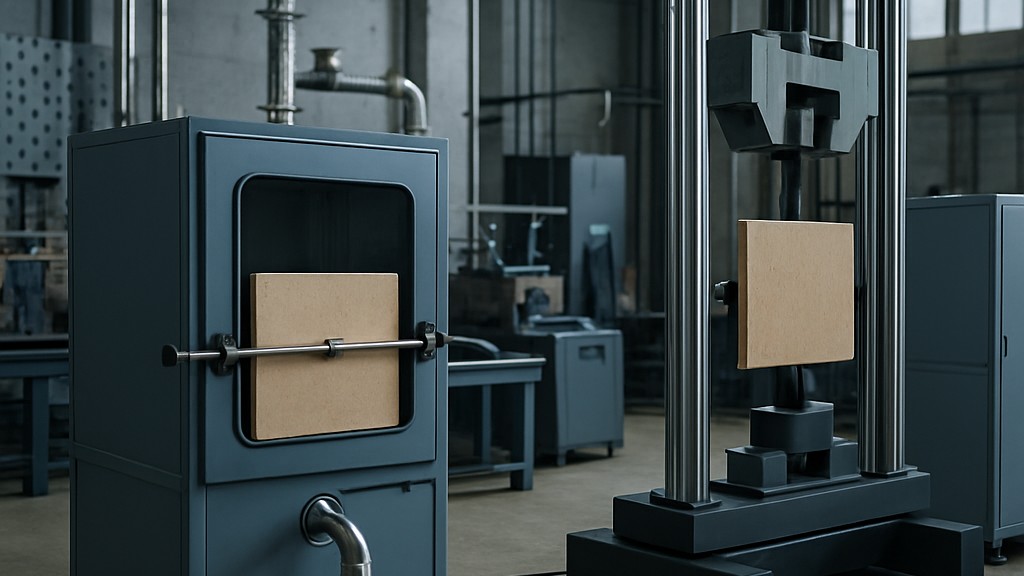
In principle, test pieces with known surface area are placed in a chamber where the temperature, relative humidity, air velocity, and rate of change are controlled at specific values. Formaldehyde emitted from the test pieces mixes with the air in the chamber. The air in the chamber is sampled periodically. The formaldehyde concentration is determined by drawing air from the chamber through scrubber bottles containing water that absorbs the formaldehyde. The formaldehyde concentration in the water is determined. The formaldehyde concentration in the chamber atmosphere is calculated using the concentration in the water in the scrubber bottles and the volume of the sampled air. It is expressed in milligrams per cubic meter (mg/m3). Sampling continues periodically until the formaldehyde concentration in the chamber reaches a steady state.
The effects of temperature, relative humidity, loading factor, and air exchange rate on formaldehyde concentration in the room atmosphere can be described using formulas (e.g., the Andersen formula). It is clear that there is a relationship between the structure of the test pieces, particularly their surfaces, and air velocity, but this relationship cannot be fully explained by a single formula.
The EN 717-1 standard is a critical test method used to determine the amount of formaldehyde released from wood-based panels such as particleboard, MDF (medium-density fiberboard), plywood, and other engineered wood products. This standard plays a crucial role in ensuring indoor air quality and consumer safety, particularly in residential and commercial interiors where these materials are commonly used.
Formaldehyde is a colorless, pungent-smelling gas commonly used in the production of building materials and household goods. It is commonly found in adhesives and resins used in composite wood products. Due to its potential health risks, such as eye, nose, and throat irritation, and its classification as a carcinogen, regulating formaldehyde emissions is crucial.
This standard provides a controlled and standardized way to measure formaldehyde emissions from wood products under specified conditions. The main objectives of this standard are to:
The EN 717-1 standard uses the chamber method, considered the most accurate and reliable way to measure formaldehyde emissions. The sample panel is placed in a test chamber (typically 1 m³ or larger) where temperature, humidity, and airflow are strictly controlled (typically 23 degrees Celsius and 45 percent relative humidity). Air from the chamber is continuously monitored, and formaldehyde concentration is measured using spectrophotometric or chromatographic techniques. Formaldehyde emissions are reported in mg/m³ of air. This method simulates indoor environmental conditions, providing data that reflects the amount of formaldehyde people might be exposed to in real-world environments.
Products tested under the EN 717-1 standard are classified according to their formaldehyde release levels:
The EN 717-1 standard is particularly important for: furniture manufacturers, suppliers of building and construction materials, interior designers and architects, and regulatory bodies and testing laboratories.
In principle, a test piece with a known surface area is placed in a closed chamber where temperature, humidity, airflow, and pressure are controlled according to specific values. Formaldehyde released from the test piece mixes with the air in the chamber. This air is continuously drawn from the chamber and passes through gas scrubber bottles containing water, which absorb the released formaldehyde. At the end of the test, the formaldehyde concentration is determined photometrically. The formaldehyde release is calculated from this concentration, the sampling time, and the area to which the test piece was exposed and is expressed in milligrams per square meter per hour (mg/m²h).
Formaldehyde emissions from wood-based panels are a significant concern in industries such as furniture production, construction, and interior design. Various standards have been developed to assess and control these emissions. Among these, EN 717-2 is a widely used method for assessing formaldehyde emissions using gas analysis.
The EN 717-2 method is often used for factory production control and routine quality assurance because it provides faster testing compared to the EN 717-1 standard. The main objectives of this standard are:
This standard is considered suitable for quality control in production environments. Testing involves exposing a sample of wood-based panel to controlled weathering conditions and then analyzing the formaldehyde released using gas detection equipment.
The gas analysis method allows the classification of materials into formaldehyde emission classes, the most common of which are:
Some manufacturers also use E0 (up to 0,5 mg/m2h), but this is not part of the official EN 717 series, although it may be valid for eco-labelling or in international markets.
The EN 717-2 standard is particularly valuable for:
This standard is widely used in the production of the following products: particleboard, MDF, plywood, oriented strand board and laminates and veneer panels.
In principle, formaldehyde release is determined by suspending test pieces of known mass above water in a closed container at constant temperature. Formaldehyde released from the test pieces over a specified period is absorbed by the water. The formaldehyde content of water is determined photometrically using the acetylacetone method, and the result is expressed in milligrams of formaldehyde per kilogram of dry matter.
This standard is part of a series of EN 717 standards that assess formaldehyde emissions from wood-based panels. Formaldehyde, a volatile organic compound (VOC), is used in the production of resins and adhesives for particleboard, plywood, and other engineered wood products. However, exposure to formaldehyde can pose health risks and therefore requires regulation.
The EN 717-3 standard includes a method for measuring formaldehyde release into the air from wood-based panels under specified conditions using the bottle method. This standard provides a simplified and cost-effective method for determining formaldehyde release. This method is particularly suitable for quality control and routine testing in production processes.
Unlike the more sensitive but complex EN 717-1 standard chamber method or the EN 717-2 standard gas analysis method, the EN 717-3 standard is designed for small-scale testing, making it ideal for internal factory controls.
The bottle method involves placing a test sample of a wood-based panel in a sealed container (usually a glass bottle) with a specified amount of water or other absorbent material. The formaldehyde released from the panel dissolves in the water. After a specified time (typically three hours at 40 degrees Celsius), the water is chemically analyzed to determine the amount of formaldehyde absorbed. The unit of measurement is milligrams of formaldehyde per square meter per hour.
The EN 717-3 standard is widely used in the following areas:
Although this method is not generally used for certification purposes due to its lower accuracy compared to the EN 717-1 standard, it is a valuable tool in maintaining consistent product quality.
While not the most accurate testing method, the EN 717-3 standard provides valuable information throughout the production process and helps ensure that materials are within safe emission limits.
Our organization, which has been serving for many years and meticulously following global developments in science and technology, employs a team of experienced professionals and a broad infrastructure to conduct testing, measurement, and analysis in a wide range of areas for businesses across all sectors. In this context, we also provide testing services in accordance with the EN 717 Wood-based panels - Determination of formaldehyde emission standard.
To get an appointment, to get more detailed information or to request an evaluation, you can ask us to fill in our form and reach you.

