

The standard "ISO 7892 Vertical structural members - Impact resistance tests - Impact frames and general test procedures," published by the International Organization for Standardization (ISO), describes conventional impact frames and general test procedures used to reproduce the effects of actual impacts on vertical structural members. Test procedures specific to each type of structural member tested are provided in the standards specific to that structural member.
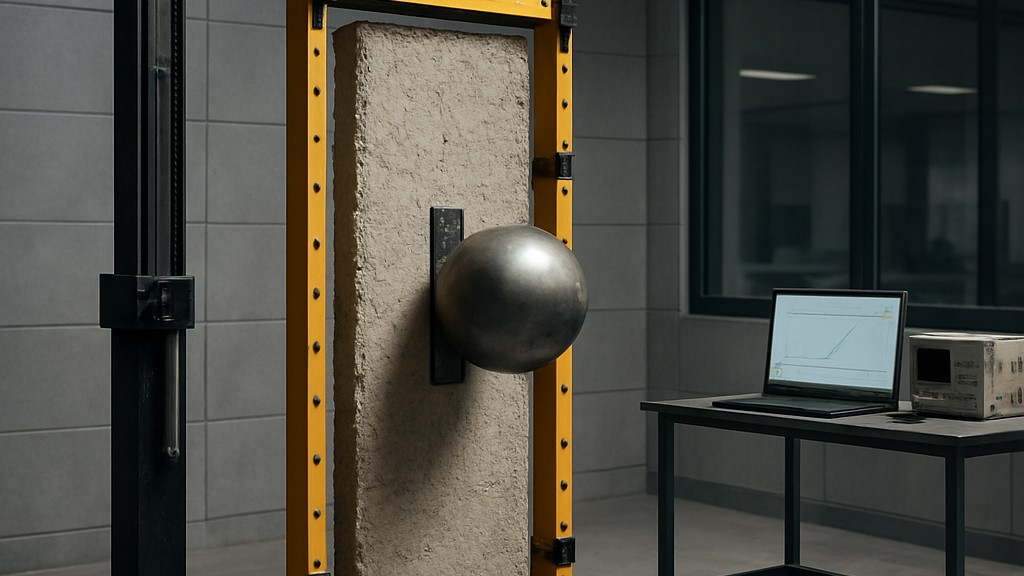
This standard is valid for all vertical (or nearly vertical) building elements except for door sets for which a method is specified in the ISO 8270 standard.
Impacts used to verify a material's properties are generally specific to that material and are defined in standards for those materials. Impacts used to create shock effects in specific wall types are not addressed in this standard. Characteristics specific to each type of structural element (such as impact energy, location, and number of impacts) and criteria for evaluating the results are included in the testing and performance standards for those structural elements.
The three types of conventional impact to be applied are:
In the world of construction and architecture, ensuring the durability and safety of building components is crucial. International standards play a key role in establishing uniform testing protocols that enhance structural integrity worldwide. One such standard, ISO 7892, focuses on the impact resistance of vertical building elements such as walls, partitions, doors, and facades, which form the structural framework of the built environment. This standard provides a framework for simulating real-world impacts to assess how well these elements withstand stress.
Buildings are not merely static structures; they are subject to daily assaults such as accidental impacts, falling objects, and even intentional forces. Vertical elements, in particular, bear the brunt of human activity, including doors slamming shut, crashing cars in warehouses, or debris generated during renovations. Without rigorous testing, these impacts can lead to cracks, deformations, or outright failures, compromising safety and increasing maintenance costs.
The ISO 7892 standard addresses this issue by defining standardized methods for assessing impact resistance. Its primary goal is to reproduce the effects of real-world impacts using controlled "impact bodies," simulated objects such as soft bags or rigid pendulums that mimic everyday hazards. This helps verify that building materials and structural elements can withstand foreseeable abuse without catastrophic damage. This standard is especially vital in high-traffic areas such as hospitals, schools, and commercial spaces, where user safety is non-negotiable.
The scope of this standard is comprehensive: it covers general test procedures applicable to a variety of vertical elements, from lightweight partitions to solid curtain walls. It does not set specific performance thresholds (these are typically determined by national regulations or customer specifications), but it does ensure that tests are reproducible and comparable among laboratories worldwide.
The ISO 7892 standard is essentially divided into two parts: the specification of impact bodies and the outline of testing procedures. This standard covers a variety of impact bodies designed to represent different threat levels:
Each frame is meticulously dimensioned with tolerances to ensure consistency. For example, the standard specifies the suspension method, drop height, and impact point to minimize variation.
The ISO 7892 standard finds use across a variety of industries. Commercial equipment uses it to make cost-effective durability claims, while high-rise facades are tested for wind-blown debris.
In short, the ISO 7892 standard standardizes how to test for the impacts and impacts of everyday life. It's an essential tool for professionals in the construction industry.
Our organization, with its competent and experienced team, has been understanding the needs of its customers for years, providing them with the advanced testing services they need, and assisting them in the establishment, implementation, and improvement of management systems. In this context, we also provide testing services in accordance with the ISO 7892 Vertical Structural Elements - Impact Resistance Tests - Impact Frames and General Test Procedures standard.
To get an appointment, to get more detailed information or to request an evaluation, you can ask us to fill in our form and reach you.

