

The standard "ASTM C1352/C1352M Standard Test Method for Flexural Modulus of Elasticity of Dimensional Stone," developed by the American Society for Testing and Materials (ASTM), describes a test method for determining the flexural modulus of elasticity of stone using a simple quadrant-point-loaded beam. Stone tests can be performed with the load applied perpendicular to the bedding plane or crack, and with the load applied parallel to the bedding plane or crack. Stone tests can be performed in wet and dry sample conditions. The tester must determine which conditions will be used.
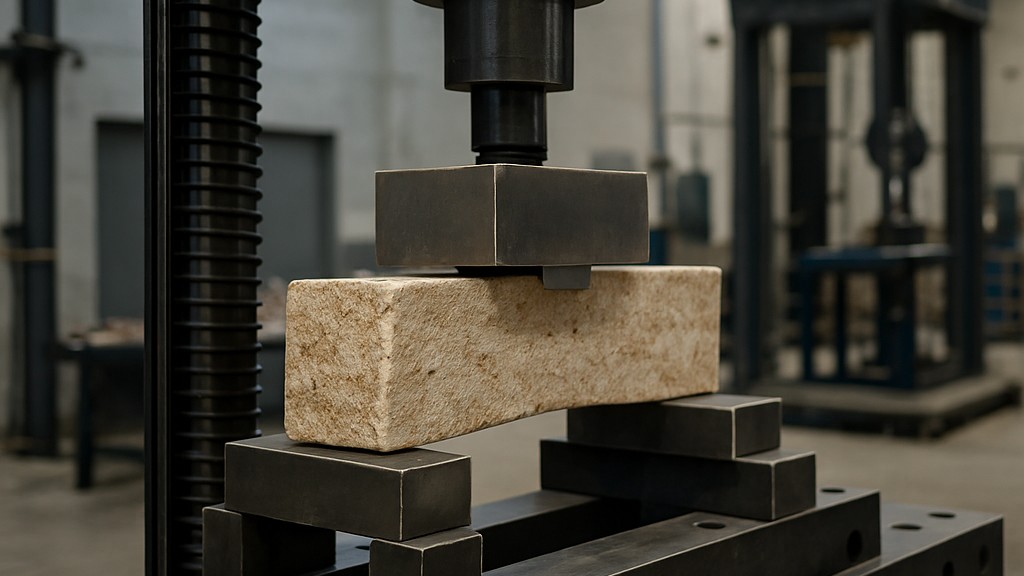
This test method is useful for providing engineering values for stress and deflection analysis of stone panels. It is also useful for demonstrating differences in flexural modulus between different-sized stones and stones of the same type in different loading directions (parallel and perpendicular to the crack or fissure).
For the purposes of this standard, the modulus of elasticity is also known as the stress per unit strain, Young's Modulus.
The testing machine used in these tests complies with the requirements of ASTM E4 standard. The quarter-point loading method is used in bending tests of stones using load-bearing blocks to ensure that the forces applied to the beam are only vertical and without eccentricity. The device must be able to maintain the span length and the distances between the load-bearing and support blocks within plus/minus 1,3 mm. The load must be applied at a uniform rate and in a manner that prevents shock.
Deflection meters capable of reading down to 0,002 mm are also used in the tests to measure the mid-span deflections at the two free edges and the support deflections at both ends.
Test specimens shall be 100 mm wide, 32 mm thick, and 380 mm long, with a tested opening of 320 mm. The specimen edges shall be perpendicular to the top and bottom. The specimens shall be coated with a fine abrasive on the planes perpendicular to the load and a fine saw surface on the other four planes. The specimen dimensions shall be measured and recorded to the nearest 0,2 mm. At least five specimens shall be tested for each test condition. The average value calculated from the graphs of the test results shall be reported as the flexural modulus of elasticity for that condition.
When the work thickness is determined (when the thickness of the stone panels for the project is determined), it is often requested that flexural modulus of elasticity tests be performed at the work thickness. The following governs the sample size when testing at the work thickness is requested and when the work thickness varies from 32 mm. The tested span should be ten times the thickness. Specimen lengths should be no less than 50 mm and no more than 100 mm longer than the tested span. When the thickness is less than 70 mm, the specimen width should be 100 mm. When the thickness is greater than 70 mm, the width should be 1,5 times the thickness. When the thickness varies from 32 mm and the sample size meets the work thickness criteria specified above, the average value of the test results for each condition is reported as the flexural modulus of elasticity of the stone at the work thickness for that condition.
For specimens with rough surfaces, prepare flat bed areas for the span supports and quarter-point loading blocks, and apply a 15 mm wide bead of water-resistant sealing compound to the center of these areas. Allow the sealing compound to dry or cure according to the manufacturer's recommendations before proceeding with conditioning the specimens.
Before testing, the samples are dried in a dry environment at 60°C (60°F) plus/minus 2°C for 48 hours. At hours 46, 47, and 48, the samples are weighed to ensure they are the same weight. If the weight continues to decrease, the samples are dried until three consecutive hourly readings of the same weight are obtained. After removal from the oven, the samples are cooled to room temperature in a desiccator before testing.
Before being tested in a wet environment, the samples are immersed in water at 22°C (22°F) plus/minus 2°C (22°F) for 48 hours. Immediately after the samples are removed from the bath, the water on their surfaces is wiped off and the samples are tested.
To begin the test, the apparatus is assembled, the specimen is placed on the span supports, and quarter-point loading blocks are adjusted to contact the specimens. The specimen is preloaded twice to a maximum load corresponding to 50 percent of the expected ultimate strength and then returned to zero. The load is increased at a rate corresponding to the change in flexural stress of not more than 4,14 MPa per minute. Ultimate flexural strength values are best determined by ASTM C880. A preload of 44 N is applied, the deflection indicators are zeroed, and the load reading device is used.
The load is increased in increments of approximately 10 percent of the expected failure load. At each increment, loading is stopped, and the mid-span edge deflections of both specimens are recorded. Load increments and deflection readings are continued until failure occurs. It is often difficult to set deflection indicators to zero when there is no load on the specimen. A common practice is to apply a small initial load, such as 44 N, to the specimen and set the deflection indicators to zero for this load. Since only the slope of the stress-strain curve is desired, this initial load does not affect the final result.
In short, the ASTM C1352/C1352M standard includes a test method used to determine the resistance of refractory materials to deformation under constant compressive load at high temperatures. This test is important for evaluating how refractory materials used in furnaces, kilns, incineration furnaces, and reactors perform under real-world thermal and mechanical stress. This test method measures the creep behavior of a refractory material subjected to a constant load at high temperature for a specific period of time. It is particularly useful for evaluating:
This standard applies to a wide range of shaped refractory products, including chamotte bricks, high alumina bricks and insulating refractories.
Refractories must maintain their shape and structural performance under extreme heat and pressure. Creep deformation, or slow deformation under high-temperature loads, can compromise lining performance in industrial equipment, leading to premature failure or safety risks. This standard provides a standardized way to measure this performance factor, ensuring consistency and reliability in material selection and quality control.
The main parameters evaluated here are:
Industries that use this standard for refractory evaluation include:
This standard helps manufacturers and engineers select the right refractory materials for demanding applications where long-term thermal and mechanical stability is critical.
Benefits of the ASTM C1352/C1352M standard include:
As a result, ASTM C1352/C1352M is a vital tool for evaluating the high-temperature mechanical performance of refractory materials. By simulating service conditions involving heat and pressure, this standard ensures that materials used in extreme industrial environments can withstand the test of time, temperature, and stress.
Our organization, which has been serving for many years and meticulously following global developments in science and technology, conducts testing, measurement, and analysis in a wide range of areas for businesses in every sector with a skilled team and extensive infrastructure. In this context, we also provide testing services in accordance with the "ASTM C1352/C1352M Standard Test Method for Flexural Modulus of Elasticity of Dimensional Stone."
To get an appointment, to get more detailed information or to request an evaluation, you can ask us to fill in our form and reach you.

