

The standard "DIN 52185 Testing of wood - Determination of compressive strength parallel to the grain direction," developed by the German Institute for Standardization (DIN), describes a method for determining the compressive strength of wood parallel to its grain using small, flawless samples. The compressive strength values determined according to this standard cannot be readily applied to structural components because their strength depends on the dimensions and quality of the wood (growth characteristics, wood defects). A test procedure for determining Young's modulus has been omitted from this standard.
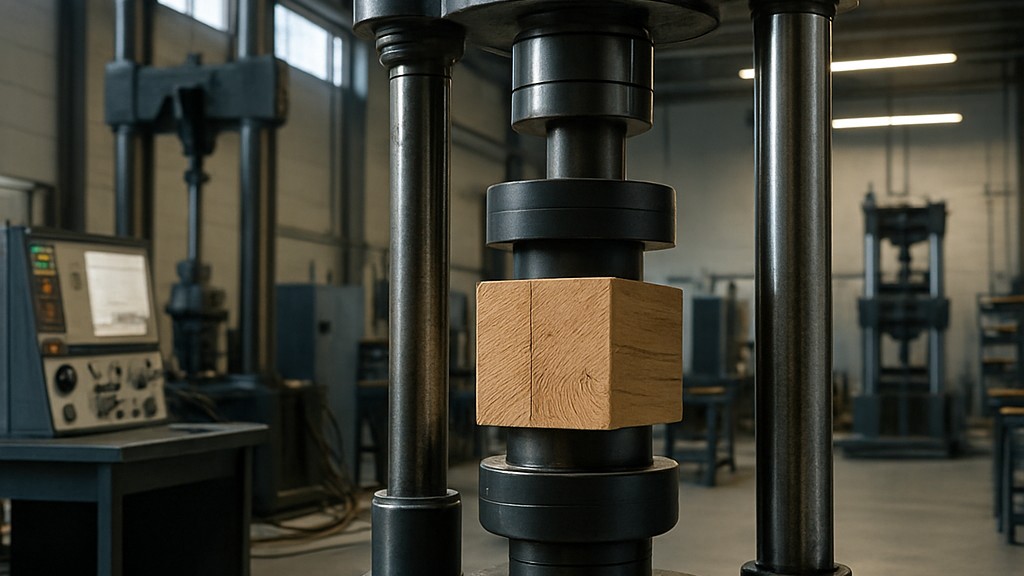
For the purposes of this standard, compressive strength refers to the maximum force developed under compressive load relative to the initial cross-section of the specimen.
To determine the compressive strength of wood in the grain direction, the following testing equipment is required:
For compressive strength determination, cubic specimens with a square cross-section and a side length of 20 mm should be used whenever possible. For wood with very irregular grain, especially those with extensive interlocking grain areas, larger cross-sectional dimensions (up to 50 mm side length) should be used, if possible, so that at least five growth rings or growth zones are recorded. The length (height) of the specimen in the direction of the grain should be between 1,5 mm and 3 mm. Specimen surfaces should be flat and smooth enough that dimensions can be determined to an accuracy of 0,1 mm. Production should be carried out in a climate-controlled environment, ensuring parallelism of opposing surfaces, especially end surfaces, and perpendicularity of adjacent surfaces.
Before testing, samples must be stored in a humid environment until they reach constant weight in a standard climate (20°C plus/minus 1°C and 65% plus/minus 3% relative humidity, in accordance with DIN 50014). In a climate-controlled environment, constant weight is considered to have been achieved if the sample weight does not change by more than 0,1% compared to the previous weighing at 24-hour intervals.
In the world of materials engineering and forestry, standardized testing procedures are essential to ensure the quality, reliability, and safety of wood products used in construction, furniture, and various industrial applications. One of these fundamental standards is DIN 52185. This standard provides a rigorous methodology for assessing the compressive strength of wood along its grain direction. While modern European and international standards have evolved to incorporate or replace elements of this standard, DIN 52185 remains a fundamental reference.
The DIN 52185 standard was created to address the need for a uniform method for assessing the mechanical properties of wood under compression, a critical factor for structural applications such as beams, columns, and load-bearing elements in buildings. Prior to these standards, testing methods varied widely, leading to inconsistencies in material properties and safety assessments.
Although this standard has not been officially withdrawn, it proposes a transition to new standards such as "DIN EN 408 Timber structures - Structural timber and glued-laminated timber - Determination of certain physical and mechanical properties," which build on and improve upon the original procedures. However, DIN 52185 remains in existence.
The primary purpose of this standard is to determine the compressive strength of wood parallel to the grain, a fundamental mechanical property that measures how much load a wood sample can withstand under axial compression before failing. This test is vital for:
This standard applies to solid wood samples, typically obtained from softwoods or hardwoods, and does not cover engineered products such as plywood or laminated veneer lumber unless otherwise specified. It emphasizes testing along the longitudinal grain direction, which is the wood's strongest direction due to the alignment of the cellulose fibers.
By standardizing variables such as specimen dimensions, loading rates, and fracture criteria, DIN 52185 minimizes experimental errors and ensures comparable results across laboratories and countries.
The DIN 52185 standard outlines a simple yet rigorous compression testing protocol designed for universal testing machines commonly found in materials laboratories. This procedure primarily involves the following steps:
Safety precautions such as using protective shields around the machine should be taken to prevent splinter hazards.
The DIN 52185 standard has profoundly impacted the timber industry by providing reliable data for design regulations governing timber structures in Europe. For example, the compressive strength values derived from this test determine the permissible stresses in building codes, reducing over-engineering and material waste.
This standard is used in the following areas of application:
Ultimately, DIN 52185 exemplifies the power of concise, practical standards in fostering innovation and safety. By standardizing pressure testing in line with texture, it has enabled engineers to build with confidence using wood. Whether in a mobile sawmill or a cutting-edge research laboratory, its principles continue to underpin the world's structural integrity.
Our organization, which has been serving for many years and meticulously following global developments in science and technology, employs a skilled team and extensive infrastructure to conduct testing, measurement, and analysis in a wide range of areas for businesses across all sectors. In this context, we also provide testing services in accordance with the DIN 52185 "Testing of wood - Determination of compressive strength parallel to the grain direction."
To get an appointment, to get more detailed information or to request an evaluation, you can ask us to fill in our form and reach you.

