

The European standard "EN 12372 Natural stone testing methods - Determination of flexural strength under concentrated load" describes a test method for determining the flexural strength of natural stone under concentrated load. Both a specification and a technological product testing procedure are included. The principle of this method is to place a sample in two cylinders and load the sample gradually in the middle. The breaking load is measured and the flexural strength is calculated.
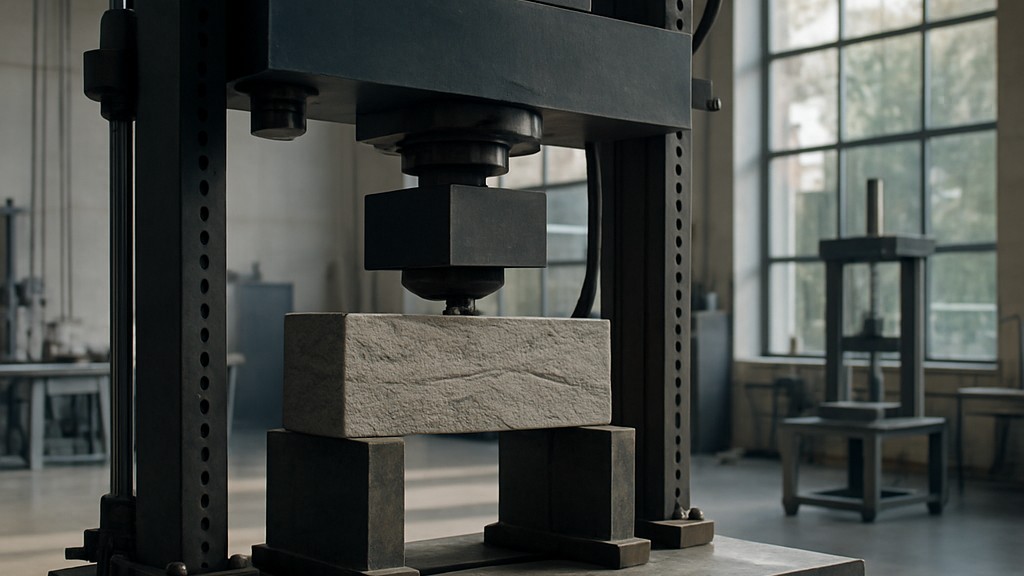
Equipment used in the tests includes:
Sampling is not the responsibility of the testing laboratory unless specifically requested. A minimum of 10 samples should be selected from a homogeneous batch. The surface finish of the samples used as standard references should be sawn, honed, or polished.
Samples for technological testing may be finished products or sawn samples from boards or other semi-finished or finished products. If a sample has a surface texture applied (e.g., flame hammered, bush hammered, shot blasted), the nature of the applied texture must be stated in the report. If a sample has a mesh or similar reinforcement attached, it must be removed before testing or its presence must be noted in the test report. The dimensions of the samples must be reported.
For stones with a maximum grain size of less than 25 mm, the preferred dimensions are 50 mm x 50 mm x 300 mm, with a tolerance of plus/minus 3 mm for each dimension. Other sizes are also possible, but must meet the following requirements:
The distance between the support rollers should be equal to five times the thickness.
The tolerance of the distance between the support rollers must be plus/minus 1 mm.
If the stone exhibits planes of anisotropy (e.g., bedding, foliation), the samples should be prepared in accordance with at least one of the arrangements shown in the figures, and the direction of the planes of anisotropy should be marked on each sample with at least two parallel lines. If the stone's use in terms of the direction of the planes of anisotropy is known, the test should be performed with the force applied to the surface to be loaded during use. If the stone's use is unknown, but the direction of the planes of anisotropy is indicated on the samples (by at least two parallel lines), the test should be performed in each of the three arrangements shown in the figures. The total number of samples should then be three times 10.
Samples should be dried to a constant mass at 70°C plus/minus 5°C or 40°C plus/minus 5°C. For geologically defined marble, 40°C is considered appropriate. Constant mass is achieved when the difference between two weighings taken 24 hours plus/minus 2 hours apart is no greater than 0,1 percent of the first of the two masses. After drying and before testing, samples should be stored at 20°C plus/minus 5°C until thermal equilibrium is reached. Testing should then be performed within 24 hours.
During the test, the cylinder surfaces are cleaned, and loose sand is removed from the sample surfaces that will contact the cylinders. The sample is placed in the center of the support cylinders. The loading cylinder is placed in the center of the sample. The load is gradually increased at a rate of 0,25 plus/minus 0,05 MPa/s until the sample fractures. The fracture load is rounded to the nearest 10 N, and the location of the fracture is recorded. The width and thickness of the sample are measured adjacent to the fracture plane, and dimensions are expressed in millimeters to the nearest 0,1 mm.
The flexural strength of each specimen is calculated using the formula given in the standard. The result is expressed to the nearest 0,1 megapascal. If the fracture is off-center, more than 15 percent of the distance between the supporting cylinders from the center of the specimen, or if it is due to the presence of defects (such as veins or cracks), it is noted in the test report. Off-center fracture conditions are specified in the standard appendix (Appendix B).
Our organization, which has been supporting businesses across all sectors for years through a wide range of testing, measurement, analysis, and evaluation activities, boasts a strong team of employees who closely follow global developments in science and technology and are constantly improving themselves. In this context, we also provide testing services in accordance with the standard "EN 12372 Natural Stone Testing Methods - Determination of Bending Strength Under Intense Load."
To get an appointment, to get more detailed information or to request an evaluation, you can ask us to fill in our form and reach you.

