

The European standard “EN 679 Determination of compressive strength of autoclaved aerated concrete” describes a procedure for determining the compressive strength of autoclaved aerated concrete.
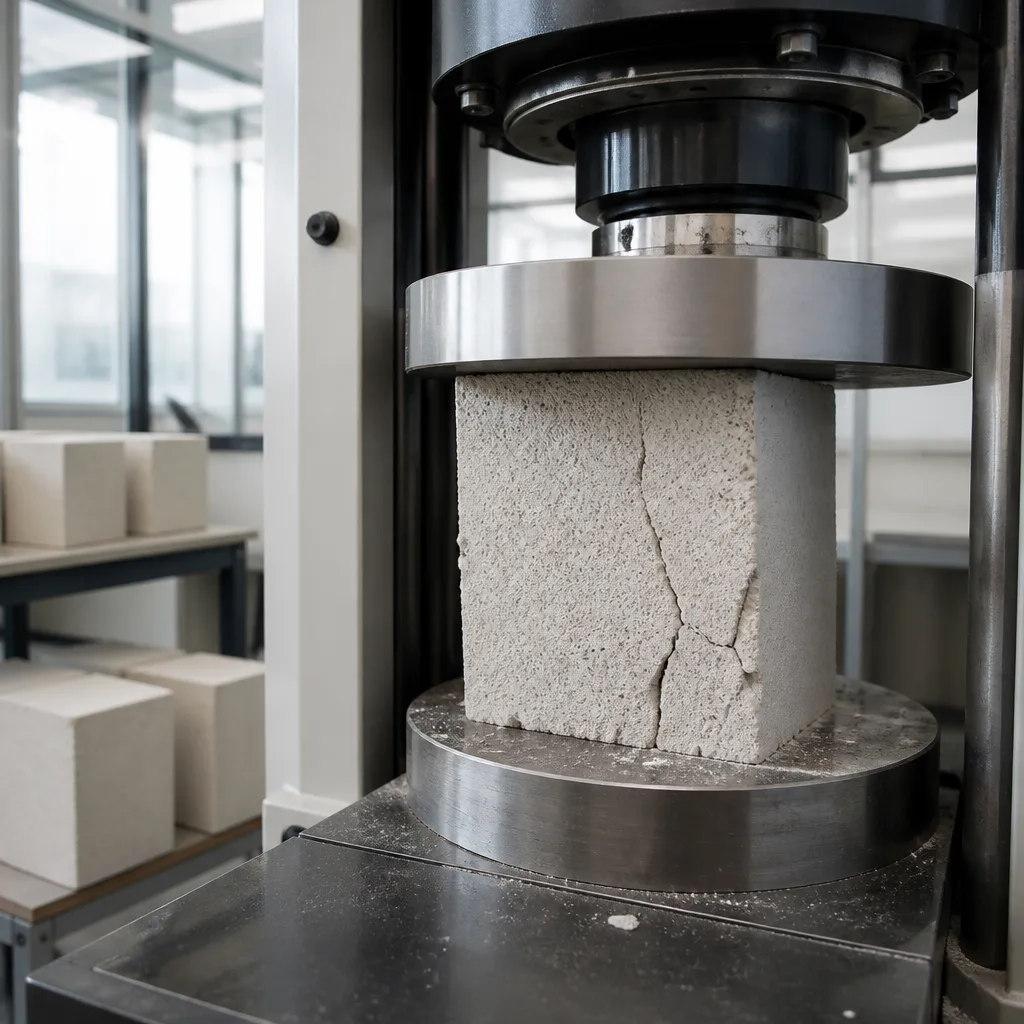
In principle, compressive strength is determined as the ratio between the fracture load under axial compression in test specimens and the cross-sectional area of the test specimen perpendicular to the loading direction.
The EN 679 standard includes a method for determining the heat transmittance (U-value) of insulated glass units. This method is widely used in the construction and glazing industries to evaluate how well double or triple glazing prevents heat transfer.
The EN 679 standard focuses on the following:
The U-value (heat conductivity) is a measure of how easily heat passes through a material or structure (e.g., wall, roof, window, or door). This value indicates how much heat is lost (or gained) through 1 m² of material when the temperature difference between the interior and exterior is 1 degree (or 1 K). A lower U-value indicates better insulation. It is critical for improving energy efficiency in buildings.
The EN 679 standard typically uses a shielded hot plate or heat flow meter method. Here,
This testing method provides the following:
The EN 679 standard takes the following into account (these are the factors that affect the results):
The EN 679 standard is part of the framework supporting compliance with the EN 1279 standard, which is required for CE marking of insulating glass.
EN 679 and related standards are as follows:
Practical applications of the EN 679 standard are as follows:
In short, the EN 679 standard focuses on precise laboratory determination under defined conditions. Standards for determining U-values are not merely technical formalities; they solve real problems in construction, manufacturing, and energy management. The main reasons why this standard is considered important are as follows:
This standard creates a level playing field for innovation.
EN 679 and similar standards are necessary because they translate thermal performance into a measurable, reliable, and legally usable value. This is crucial for energy efficiency, product quality, and fair competition.
In conclusion, the EN 679 standard is a critical thermal performance test standard for insulating glass. By providing a consistent and accurate method for measuring U-values, it plays a central role in energy-efficient building design, product quality assurance, and regulatory compliance across Europe.
For many years, our organization, with its competent and experienced staff, has been understanding the needs of its clients, providing the advanced testing services they require, and assisting them in the establishment, implementation, and improvement of management systems. Within this framework, we also provide testing services in accordance with the EN 679 standard.
To get an appointment, to get more detailed information or to request an evaluation, you can ask us to fill in our form and reach you.

