

The European standard "EN 1607 Thermal insulation products for building applications - Determination of surface tensile strength" describes the equipment and procedures required to determine the surface tensile strength of a product. These procedures apply to thermal insulation products.
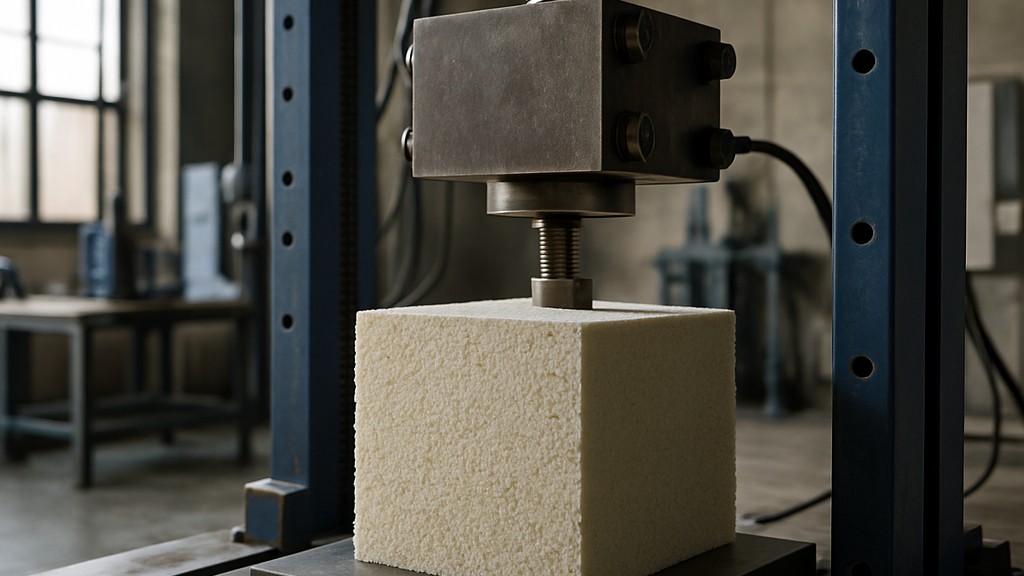
For the purposes of this standard, the tensile strength perpendicular to the surfaces is the value obtained by dividing the maximum tensile force recorded perpendicular to the product surfaces during the tensile process by the cross-sectional area of the test sample.
In principle, a test specimen is placed between two rigid plates or blocks, secured in a tensile testing machine, and pulled apart at a specified speed. The maximum tensile force is recorded, and the tensile strength of the test specimen is calculated.
The tensile testing machine used in these tests is capable of measuring force with an accuracy of plus or minus 1% and a constant crosshead speed of 10 mm/min, suitable for the relevant force and displacement range. Additionally, rigid plates or blocks with self-aligning connections are used to prevent uneven distribution of tensile stress during the test. Examples of suitable arrangements for bonding the test specimen are provided in the standard. The following adhesives are also used to bond the test specimen between the rigid plates or blocks during the tests:
The thickness of the test specimens shall be equal to the thickness of the original product, including all external surfaces, finishes, and coatings. Test specimens shall be square prisms with the following recommended side dimensions: 50 mm x 50 mm, 100 mm x 100 mm, 150 mm x 150 mm, 200 mm x 200 mm, or 300 mm x 300 mm. The dimensions used shall be as specified in the relevant product standard. In the absence of a product standard or other European technical specification, the dimensions of the test specimens may be agreed upon between the parties. Linear dimensions shall be determined to an accuracy of plus or minus 0,5 percent in accordance with EN 12085.
The mechanical properties defined in EN 1607 are critical in assessing how insulation materials perform under stress in applications such as building envelopes, particularly when bonded to surfaces or used in composite systems. This standard applies to all factory-made thermal insulation products, including:
The primary purpose of the test is to determine the mechanical integrity of insulation boards when forces act perpendicularly (i.e., at a 90-degree angle) to the primary surface. This is particularly important in applications where panels are bonded to surfaces or where wind suction or mechanical loads could cause such stress.
In general, these tests consist of the following steps:
The results help manufacturers and engineers:
A higher tensile strength value indicates that the insulation material better resists separation or delamination, which is crucial for ensuring long-term performance in exterior thermal insulation composite systems and other similar applications.
The EN 1607 standard is important because it ensures that thermal insulation materials used in construction are mechanically sound, especially when subjected to tensile forces (tensile stress) perpendicular to their surfaces. The main reasons for this standard's importance are:
Consequently, the EN 1607 standard plays a vital role in assessing the durability and reliability of thermal insulation products in construction. Understanding and applying this standard helps select the right material for specific applications, particularly where mechanical stresses can affect performance.
Our organization, which has been supporting businesses across all sectors for years through a wide range of testing, measurement, analysis, and evaluation activities, boasts a strong team of employees who closely follow global developments in science and technology and are constantly improving themselves. In this context, we also provide testing services in accordance with the standard "EN 1607 Thermal insulation products for building applications - Determination of perpendicular tensile strength of surfaces."
To get an appointment, to get more detailed information or to request an evaluation, you can ask us to fill in our form and reach you.

