

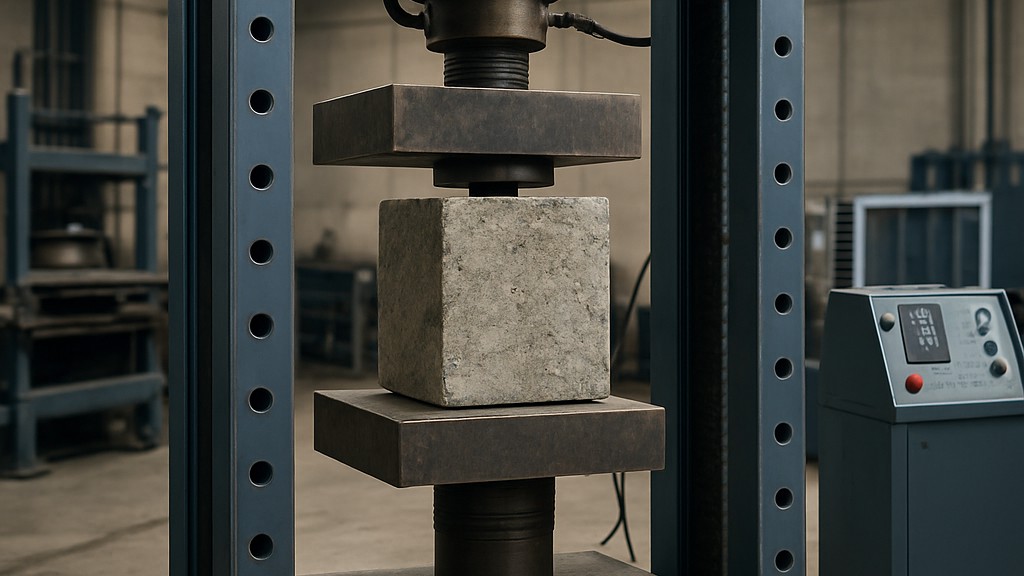
This method is valid for all types of repair mortars and concrete with a maximum aggregate size of 8 mm. It distinguishes between hydraulic and polymer-bound mortars. For repair mortars and concrete with aggregate sizes greater than 8 mm, conventional concrete testing methods are used according to the standard "prEN 206 Concrete - Specification, performance, production and suitability."
For the purposes of this standard, the definitions in EN 1504-1 apply.
The test method for Portland cement (PC), plain cement concrete (PCC), and hybrid cement (HC) mortar is designed to determine the compressive strength of 40 mm cube specimens. An alternative method is to use the equivalent cube method based on prismatic test specimens measuring 40 mm x 40 mm x 160 mm. Compressive strength in Portland cement (PC) mortar prisms is determined after preparing the specimen by cutting it into 40 mm cubes.
The following mixing technique is used to prepare the repair mortar. A mortar mixer set at low speed is used unless otherwise specified by the manufacturer. For plain cement concrete (PCC) and cementitious mortar, the measuring liquid is added to the bowl, followed by the dry ingredients and mixed for a total mixing time of at least two minutes. For Portland cement (PC) mortar, the constituent parts of the mortar are combined according to the manufacturer's instructions and mixed until completely mixed and streak-free.
When the manufacturer's instructions prohibit the use of bulk bags of material, a concrete mixer or other method recommended by the manufacturer must be used.
Some types of repair mortar have been found to foam excessively under the influence of the mixer specified in EN 196-1. Alternatively, a concrete mixer can be used.
The mixed material should be carefully placed in the mold and compacted using a hand tamper or a bar as needed. If permitted by the manufacturer, the mortar should be compacted using a vibrating table or other means. Handling and storage of test samples before removal from the mold, and the removal of samples from the mold, must comply with EN 196-1.
After production, test samples must be cured in accordance with the annex to this standard (Annex A).
In the bulk density test, the bulk density of three mortar test prisms or six mortar test cubes is determined by weighing them to the nearest 0,1 g after storage. The dimensions of the samples are measured to the nearest 0,1 mm. Bulk density is calculated to the nearest 10 kg/m3 using the equation given in the standard. The mean value and standard deviation of the density are calculated to the nearest 10 kg/m3.
The water displacement method described in prEN 206 is used as an alternative method for hybrid cement (HC) mortar cured under water or for plain cement concrete (PCC) or Portland cement (PC) mortars with low water absorption of less than 1 percent. The mean value and standard deviation are calculated to the nearest 10 kg/m3.
In compressive strength testing, plain cement concrete (PCC) and cement-mortar prisms are prepared by cutting or splitting the specimens into equal halves using suitable tools that do not subject them to detrimental stresses. Cube specimens for Portland cement (PC) prisms are prepared by sawing.
For each age, the compressive strength of six cube or prism end specimens is determined in accordance with EN 196-1. The age of the mortar at the time of testing shall be as defined in the EN 1504 series of standards and shall be at least 7 days and 28 days for HC and PCC, and 7 days for PC. The compressive strength shall be calculated to the nearest 0,5 N/mm2 using the equation given in the standard.
Our organization, which has been supporting businesses across all sectors for years through a wide range of testing, measurement, analysis, and evaluation activities, boasts a strong team of employees who closely follow global developments in science and technology and are constantly improving themselves. In this context, we also provide testing services in accordance with the standard "EN 12190: Products and systems for the protection and repair of concrete structures - Test methods - Determination of compressive strength of repair mortar."
To get an appointment, to get more detailed information or to request an evaluation, you can ask us to fill in our form and reach you.

