

The European standard "EN 1156 Wood-based panels - Determination of load duration and creep factors" describes a method for determining both the load duration and creep factor for wood-based panels subjected to flat bending stress, with and without a shear component, under constant climate conditions. Details of an alternative but provisional method using medium-sized test pieces are included in the standard's appendix (Annex A). This method can also be used for test pieces loaded under varying climate conditions.
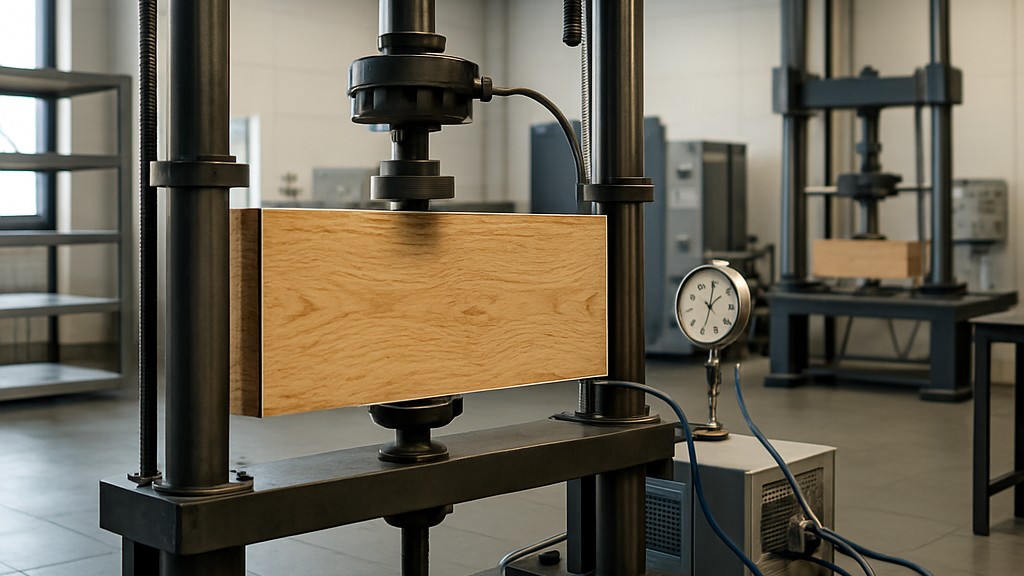
The duration load factor is necessary to obtain long-term values by modifying the characteristic strength values obtained in short-term structural tests. The creep factor obtained in the test is used to estimate the long-term deflection resulting from the initial elastic deflection.
This standard is based on the principle that, under constant climatic conditions, a constant moment is applied to and maintained at the center of a test piece, and the load duration factor (loss of strength over time under load) and the creep factor (ratio of the increase in deflection over time to the initial elastic deflection) are determined in bending. Both the time to fracture and the increase in deflection over time are measured.
Wood-based panels such as plywood, particleboard, medium-density fiberboard, and oriented strand board are essential to modern construction. These engineered materials, produced by bonding wood fibers, particles, or veneers with adhesives, offer a versatile and cost-effective alternative to solid wood.
In the world of civil and materials engineering, standardized test methods are essential for ensuring the quality, safety, and performance of building components. One of these critical standards, EN 1156, provides a precise methodology for measuring how wood-based panels, such as plywood, particleboard, and fiberboard, interact with water vapor.
This standard addresses water vapor permeability, a key property that directly impacts the durability, moisture resistance, and overall lifespan of wood products used in flooring, walls, ceilings, and furniture. As climate change leads to more humid conditions in buildings and sustainable materials gain importance, EN 1156 has become more relevant than ever.
This standard is a technical specification outlining a laboratory-based test for measuring water vapor transmission rates through wood-based panels. Water vapor permeability refers to a material's ability to allow moisture in vapor form to pass through it. This differs from liquid water absorption and instead focuses on gaseous diffusion, which is crucial for preventing problems such as mold growth, warping, or structural deterioration in humid environments.
This standard is part of a larger family of standards for wood-based panels, including EN 382 for water swelling and EN 317 for particleboard density. It applies to both uncoated and coated panels, providing versatility across applications. Compliance with EN 1156 helps manufacturers certify their products for use in regulated markets, such as the European Union's Construction Products Directive (CPR), which mandates declarations of performance for building materials.
The EN 1156 standard covers flat wood-based panels, typically with thicknesses ranging from 3 mm to 50 mm. It principally measures the steady-state diffusion of water vapor under controlled humidity gradients using a container method. Equipment such as closed test vessels, dryers, and climate chambers are used to maintain precise conditions during the tests.
Wood-based panels are hygroscopic, meaning they absorb and release moisture from the surrounding air. Excessive permeability can lead to:
Conversely, excessively impermeable materials can trap vapor inside structures, leading to condensation and decay. The EN 1156 standard allows designers to select panels with optimum permeability values, typically expressed in grams per square meter, tailored to specific climates. For example, outdoor plywood requires low permeability (below 10 g/m² day ), while indoor particleboard can withstand higher values. In sustainable building applications, EN 1156 standard data supports lifecycle assessments by predicting long-term performance and reducing waste from premature failures.
The EN 1156 standard is widely used in the following areas:
Ultimately, the EN 1156 standard is a testament to the rigorous science behind everyday building materials. By measuring water vapor permeability, it enables the industry to create safer structures that stand the test of time and moisture.
Our organization, with its competent and experienced team, has been understanding the needs of its customers for years, providing them with advanced testing services, and assisting them in the establishment, implementation, and improvement of management systems. In this context, we also provide testing services in accordance with the EN 1156 Wood-based panels - Determination of load duration and creep factors standard.
To get an appointment, to get more detailed information or to request an evaluation, you can ask us to fill in our form and reach you.

