

A European standard “EN 1109 Flexible sheets for waterproofing - Bituminous sheets for roof waterproofing - Determination of flexibility at low temperature” describes a procedure for determining the flexibility of bituminous sheets at low temperatures.
The test can be performed sequentially on the top or bottom face of the sheet at a predetermined temperature or at different temperature steps to determine the cold bending temperature, which represents a limiting temperature. Therefore, the test can be used to verify the minimum cold bending temperature for a product or to determine the specific cold bending temperature for a product, for example, to determine the change in these properties as a result of artificial aging.
For slabs with the same bituminous compound on both sides and where the reinforcement is visually closer to the top surface, testing is performed only on the bottom side. If the top surface is covered with a non-woven (e.g., tissue, fleece) or metal coating, testing is performed only on the bottom side. If the top surface of the slab is coated with a permanent lightweight surface protection and the reinforcement is visually closer to the top surface, testing is performed only on the bottom side.
For the purposes of this standard, the following terms and definitions apply:
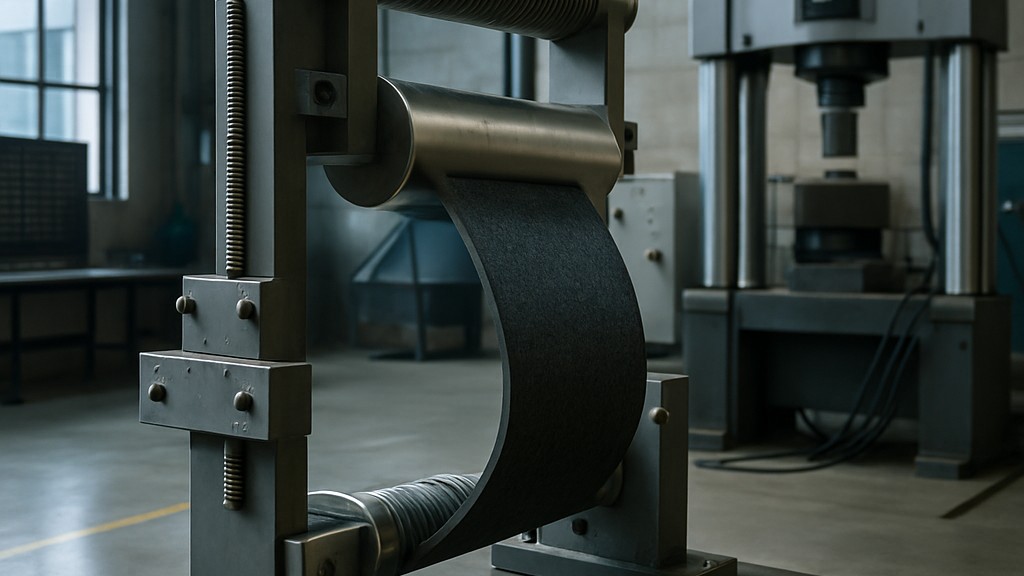
In principle, test specimens from the test sample are bent 180 degrees in a mechanical bending apparatus immersed in a cooling fluid. After bending, the specimens are examined for cracks in the coating.
The structure and operation of the device used in the tests are shown in the standard. The device consists of two non-rotating cylinders with a diameter of 20 mm plus or minus 0,1 mm and a cylindrical or semi-cylindrical bending mandrel with a diameter of 30 mm plus or minus 0,1 mm that can move upwards, positioned between them.
Because the distance between the rollers is adjustable, the distance between the rollers and the bending mandrel can be adjusted according to the sheet metal thickness. The bending section of the device is immersed in a thermostatic bath whose temperature can be controlled to within 0,5 degrees Celsius between +20 degrees Celsius and -40 degrees Celsius. The coolant used has the following properties:
For elastomeric-modified bitumen sheets, an ethanol/water mixture (2:1 volume ratio) can be used at any temperature. An additional thermometer capable of measuring to within 0,5°C is required to control the test temperature. The thermometer should be placed in the test medium at the same level as the test sample.
Suitable removable holding devices must be used to position test specimens flat and fully immersed in the test fluid for conditioning. The holding devices must be capable of holding at least five test specimens in a series. For testing, the bending mandrel is lifted from below against the test specimen at a speed of 360 mm/min, bending the specimen through a 180-degree angle. The electronic control system must ensure that the travel speed is maintained at 360 plus/minus 40 mm/min throughout the bending process and at all temperatures.
Cracks are detected by visual inspection by the tester without any optical aids. To allow accurate assessment, the travel path is defined so that the test specimen protrudes from the coolant at the end of the procedure. The travel path must be limited by appropriately adjusted limit switches.
Rectangular test specimens, measuring 140 mm plus/minus 1 mm x 50 mm plus/minus 1 mm as required for the tests, are taken uniformly across the width of the sheet, with the larger dimension extending longitudinally. Test specimens should be taken no closer than approximately 150 mm from the sheet's edges. Test specimens are numbered consecutively, starting from one edge of the sheet, and the underside of the sheet is marked.
When preparing test specimens, any protective film or foil should be removed, preferably by applying a self-adhesive tape at ambient temperature, cooling the test specimen to approximately the assumed cold bending temperature, and then removing the adhesive tape from the test specimen. Alternatively, or additionally, the film can be removed using a compressed air jet (maximum pressure approximately 5 bar, nozzle diameter approximately 0,5 mm). Removal of the film or foil using heat (e.g., gas flame) is not permitted. The test specimens should then be conditioned on a flat support at 23°C plus/minus 2°C for at least 4 hours before testing, ensuring they do not touch each other. There should be no adhesive bond to the support. If necessary, a sheet of siliconized paper may be used. Loose surface granules should be removed by gentle tapping beforehand.
Our organization, which has been supporting businesses across all sectors for years through a wide range of testing, measurement, analysis, and evaluation activities, boasts a strong team of employees who closely follow global developments in science and technology and are constantly improving themselves. In this context, we also provide testing services in accordance with the EN 1109 standard: Flexible sheets for waterproofing - Bituminous sheets for roof waterproofing - Determination of flexibility at low temperatures.
To get an appointment, to get more detailed information or to request an evaluation, you can ask us to fill in our form and reach you.

