

The International Organization for Standardization (ISO) standard "ISO 24336 Laminate floor coverings - Determination of thickness swelling after partial immersion in water" describes a test method for determining the thickness swelling of laminate flooring elements after partial immersion in water. This method is destructive and primarily aims to evaluate the behavior of a laminate flooring element in contact with water. Any soft backing material, substrates, or other integrated materials pre-attached to the bottom surface of the flooring element are not included in the test and therefore must be removed before testing.
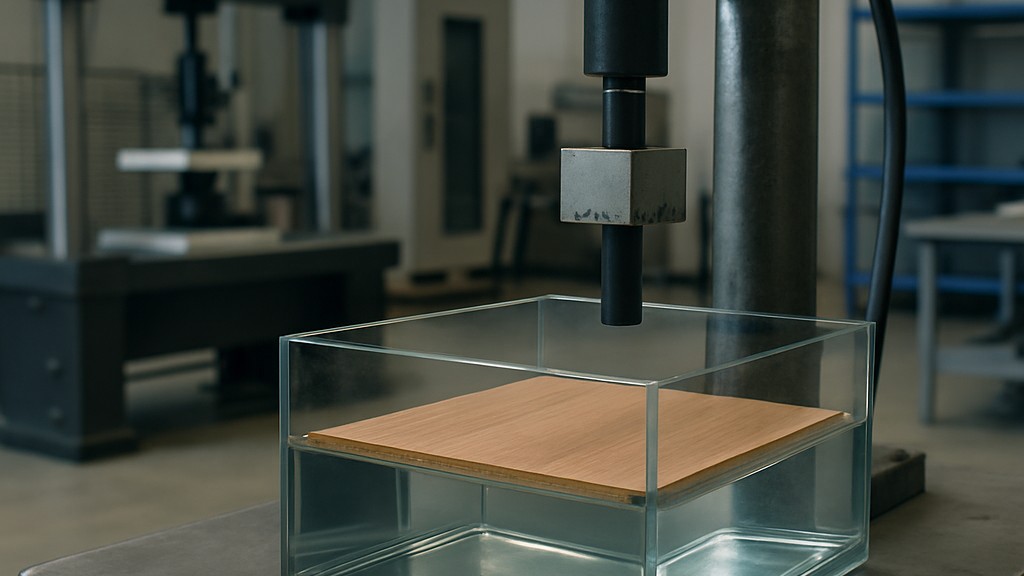
In principle, samples of laminate flooring elements are partially immersed (up to 50 mm) in water at a temperature of 20 degrees for 24 hours and the resulting thickness swelling is determined.
For testing, four samples measuring 150 mm plus or minus 1 mm x 50 mm plus or minus 1 mm are cut from a laminate flooring element. Two samples are taken parallel to one edge of the element and two samples perpendicular to this first direction. The element is then divided into approximately two equal parts along both directions. Both sets of samples are taken from each half of the element in both directions. If possible, samples are taken at least 20 mm from each edge of the element. If this is not possible for some samples, the distance from the edge may be less than 20 mm, but in all cases, the joint profile must be completely cut. If the width of the laminate flooring element is less than 150 mm, excluding the joint profile, all four test samples can be taken in the length direction, if possible. If this is not possible, as many samples as possible should be taken from one flooring element.
Before testing or conditioning test specimens, any pre-adhered soft backing, substrate, or other material integrated into the underside of the floor covering element must be removed. All laminate floor coverings normally include a backing (balancing) layer, as defined in standard EN 13329. This backing layer must be retained. Any other pre-adhered material must be removed completely, or at least 75 mm, from the bottom edge of the specimen using a sharp knife or other sharp edge. The glue or adhesive used to bond the pre-adhered material to the substrate must be specifically removed.
Test samples are measured upon receipt. For type approval or verification purposes, test samples must be maintained at a constant mass at a temperature of 23°C plus/minus 2°C and a relative humidity of 50% plus/minus 5%. Constant mass is considered achieved when the results of two consecutive weighings, performed 24 hours apart, do not differ by more than 0,1 percent from the mass of the test samples.
The water bath used in the tests was large enough to ensure a constant water level and was designed to maintain the water temperature within 20 degrees Celsius plus or minus 1 degree Celsius throughout the test. A micrometer with a minimum diameter of 5 mm, flat, parallel circular measuring surfaces, and an accuracy of plus or minus 0,05 mm was also used in the tests.
To begin the tests, determine the initial thickness of the test specimens perpendicular to the end edges, as shown in the figure provided in the standard. Measure the thickness of the sample to be placed under water, removing any pre-attached material. The existing test specimens are placed in the water bath as shown. After 24 hours plus/minus 15 minutes, the test specimens are removed and immediately dried with a towel. Within 5 minutes of removing them from the water bath, determine the final thickness of the test specimens at the measurement points where the initial thickness was determined.
All values are recorded, and the differences between the initial and corresponding final thickness values are determined. For each pair of values, the thickness swelling is calculated as a percentage according to the formula given in the standard. Using the individual thickness swelling results from the measurement points, the average thickness swelling is expressed as a percentage to the nearest 0,1 percent.
Laminate flooring has become an increasingly popular choice for both residential and commercial applications thanks to its durability, aesthetic appeal, and affordability. The ISO 24336 standard was developed to ensure consistency, performance, and safety in global markets. This standard specifies requirements for laminate flooring with a layered structure, typically consisting of a surface layer of paper or other materials impregnated with thermosetting resins. This standard specifies definitions, classifications, and test methods for evaluating the performance of laminate flooring. This standard is part of the broader ISO 24300 series of standards, which address different types of resilient, textile, and laminate floor coverings.
The ISO 24336 standard applies to laminate floor coverings specifically designed for use in:
This standard also provides a common framework for:
Products are classified using a numerical code system (similar to the EN 685 standard classification) according to their use and durability. For example,
This standard outlines key performance indicators, including:
The ISO 24336 standard describes specific methods for testing each of these properties under controlled laboratory conditions. This ensures consistency in product evaluation across manufacturers and regions.
This standard is considered important for the following reasons:
Consequently, the ISO 24336 standard plays a vital role in standardizing the quality and performance of laminate flooring. It benefits every link in the flooring supply chain, from production to installation, by ensuring that products are safe, durable, and fit for purpose. As demand for high-performance and sustainable flooring continues to grow, these and similar standards will remain essential for quality assurance and market access.
Our organization, which has been supporting businesses across all sectors for years with a wide range of testing, measurement, analysis, and evaluation activities, boasts a strong team of employees who closely follow global developments in science and technology and are constantly improving themselves. In this context, we also provide testing services in accordance with the ISO 24336 Laminate floor coverings - Determination of thickness swelling after partial immersion in water standard.
To get an appointment, to get more detailed information or to request an evaluation, you can ask us to fill in our form and reach you.

