

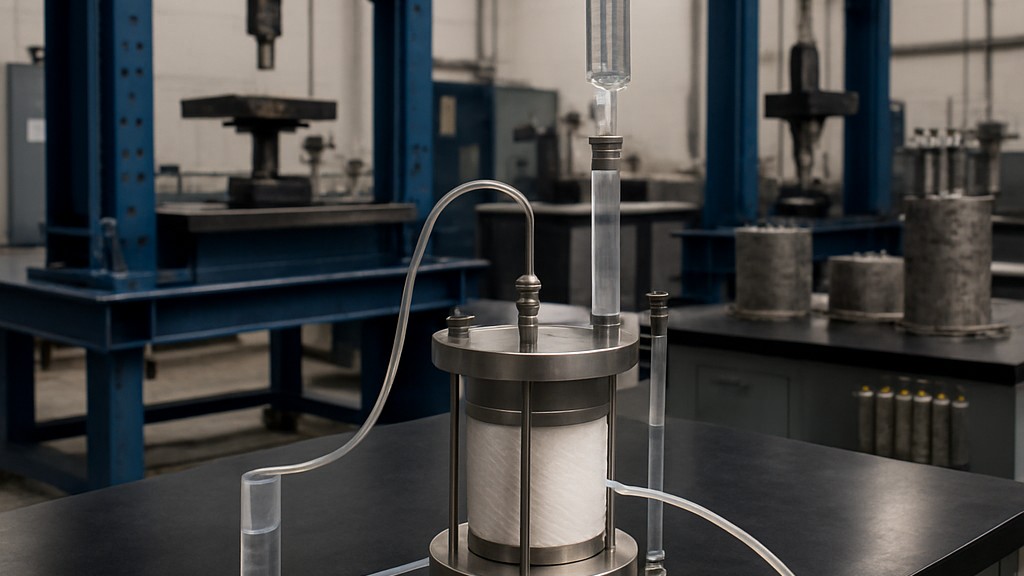
The standard "ASTM D4491/D4491M Standard Test Methods for Water Permeability of Geotextiles by Permeability," developed by the American Society for Testing and Materials (ASTM), describes test methods for determining the hydraulic conductivity (water permeability) of geotextiles in the uncompressed state under standard test conditions. This standard includes three procedures: the constant-pressure and decreasing-pressure methods using a water flow device, and the air flow method using an air flow device.
These test methods are considered adequate for acceptance testing of commercial shipments of geotextiles because these methods are widely used in the trade for acceptance testing.
In the event of a dispute arising from differences in test results reported during the use of these test methods for acceptance testing of commercial shipments, the buyer and supplier should conduct comparative tests to determine whether a statistical deviation exists between their laboratories. Competent statistical assistance is recommended for investigating the deviation. At a minimum, both parties should obtain a group of test samples consisting of as homogeneous a number of materials of the type in question as possible. The test samples should then be assigned in random numbers to each laboratory for testing. The average results from the two laboratories should be compared. If a deviation is detected, either the cause must be identified and corrected, or the buyer and supplier must agree to interpret future test results in light of the known deviation.
If the dispute involves test results obtained by the Method B falling pressure test or the Method C airflow test, the Method A constant pressure test performed at 50 mm pressure should be used as the arbitrator method.
If the dispute involves Method C, the actual water temperature used for water flow tests should be recorded and the viscosity of the water at the test temperature should be used in the conversion from air flow to water flow without applying temperature correction, as described in this standard.
Permeability is an indicator of the amount of water that can pass through a geotextile in an isolated state.
Because there are many applications and environmental conditions in which a geotextile may be used, caution should be exercised when attempting to apply the results of these test methods to the field performance of a geotextile.
Because geotextiles come in various thicknesses, estimating them using the Darcy coefficient of permeability can be misleading. In most cases, it's more important to evaluate the amount of water that will pass through a geotextile under a given pressure over a given cross-sectional area. This is referred to as permeability.
If the permeability of an individual geotextile is important, a nominal permeability coefficient can be calculated from geotechnical engineering. The nominal permeability coefficient is obtained by multiplying the permeability by the nominal thickness of the geotextile, as determined by ASTM D5199.
Nominal thickness is used because it is difficult to assess the pressure on the geotextile during testing and therefore difficult to determine the thickness of the fabric under these test conditions.
In short, ASTM D4491/D4491M defines test methods for evaluating the water permeability of geotextiles under standard test conditions in the uncompacted state. Geotextiles are permeable fabrics used to enhance soil stability and manage water flow in civil engineering applications such as road construction, drainage systems, and erosion control. This standard is critical for ensuring the quality and performance of geotextiles in these applications.
In ASTM D4491/D4491M, the hydraulic conductivity of geotextiles is expressed as permeability, which is the volumetric flow rate of water per unit pressure head per unit area. The three test methods described in this standard are:
These test methods are considered reliable for acceptance testing geotextiles due to their widespread use in the industry. As long as the procedures are followed meticulously, they allow for consistent comparison of results between different laboratories. This standard is particularly important for:
In cases of dispute, this standard provides a framework for resolving discrepancies in test results and ensuring fairness in commercial transactions.
The ASTM D4491/D4491M standard is widely used in civil engineering, particularly in the following areas:
Consequently, the ASTM D4491/D4491M standard is essential for assessing the water permeability of geotextiles, ensuring their suitability for critical civil engineering applications. It supports quality assurance, performance verification, and global trade compliance by providing standardized and repeatable test methods. An interlaboratory study involving six laboratories and 25 samples was conducted to determine the sensitivity of this standard and ensure reliable and repeatable results.
Our organization, which has been serving for many years and meticulously following global developments in science and technology, conducts testing, measurement, and analysis in a wide range of areas for businesses in every sector with a skilled team and extensive infrastructure. In this context, we also provide testing services in accordance with the "ASTM D4491/D4491M Standard Test Methods for Water Permeability of Geotextiles by Permeability."
To get an appointment, to get more detailed information or to request an evaluation, you can ask us to fill in our form and reach you.

