

The standard "ASTM C1403 Standard Test Method for Water Absorption of Masonry Mortars," developed by the American Society for Testing and Materials (ASTM), describes a test method for determining the capillary (wicking) characteristics and relative water absorption of masonry mortars. This test method is not applicable for determining the effectiveness of water-repellent coatings.
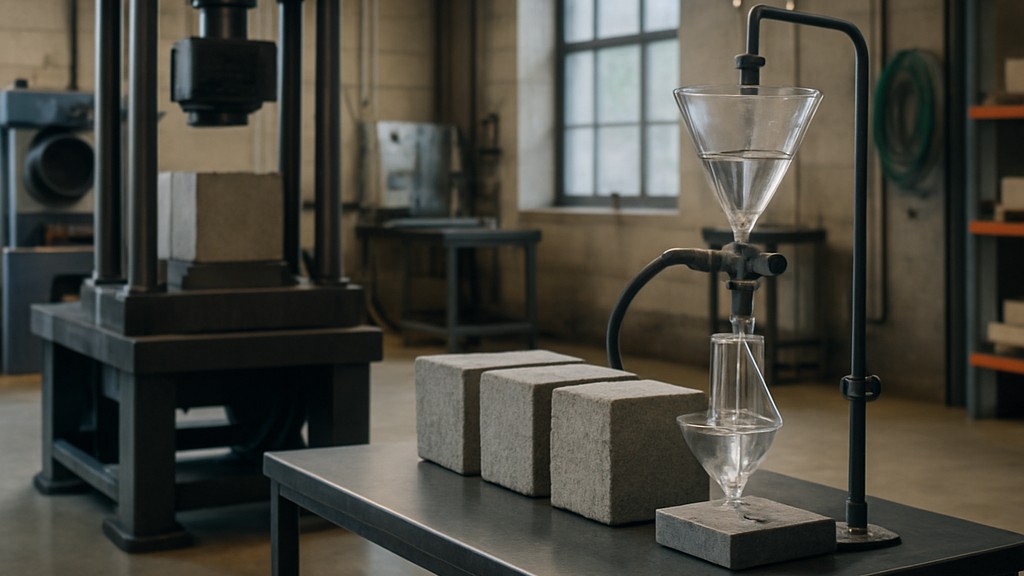
This test method provides a laboratory procedure for determining the relative water absorption properties of mortars used in masonry over time. Because samples are made under laboratory conditions and do not account for the effects of the masonry substructure or field mixing procedures, this method is not intended for field use. Data obtained from this test method can be useful for determining the relative effectiveness of water-repellent admixtures or the effect of other admixtures or mortar components on the water repellency of a mortar. However, caution is required when interpreting the results. While the resistance of masonry to water penetration can be related to the water absorption properties of the mortar, it also depends on other factors such as workmanship, bond strength, and the properties of the masonry units and mortar.
This test method is specified in ASTM C1384 to demonstrate the compatibility of mortar additives classified as water repellent. In this compatibility test, the mixed mortar is compared to a reference mortar made with the same mortar ingredients except that the additive is not included. For quality control testing of water repellent premixed dry mortar mixes, the reference mortar is generally not available because the water repellent additive is added during the production process before bagging the final product. In these cases, the procedure in Annex A1 should be used to determine the relative resistance of the mortar to capillary absorption.
The method, briefly described in ASTM C1403, is specifically designed to evaluate the rate at which mortar materials used in masonry absorb water. The rate of absorption is a key factor in assessing the durability and long-term performance of mortars in various environmental conditions. The primary purpose of this standard is to measure the amount of water a mortar sample absorbs over a specified period of time when partially immersed. This standard helps quantify the water transport properties of mortar, which influence:
This test method is applicable to both laboratory-prepared and field-extracted mortar samples. It provides data that can be used for product development, quality control, and compliance verification.
This testing method includes these basic steps:
The areas of application of this standard include:
ASTM C1403 is considered important because it helps ensure the durability, quality, and performance of masonry by evaluating how mortar absorbs water. This standard is widely used for the following reasons:
This standard helps identify mortars that resist water uptake, improving their long-term performance.
This ensures that materials perform as expected in different climates and applications.
As a result, ASTM C1403 is a valuable tool for evaluating the water absorption properties of masonry mortars. By providing a standardized approach to assessing moisture uptake, it helps ensure that building materials meet performance expectations, particularly in environments where water ingress could cause serious structural or aesthetic problems.
Our organization, which has been supporting businesses across all sectors for years through a wide range of testing, measurement, analysis, and evaluation activities, has a strong team of employees who closely follow global developments in science and technology and are constantly improving themselves. In this context, we also provide testing services in accordance with the "ASTM C1403 Standard Test Method for Water Absorption of Mortars."
To get an appointment, to get more detailed information or to request an evaluation, you can ask us to fill in our form and reach you.

