

The European standard "EN 1609 Thermal insulation products for building applications - Determination of short-term water absorption by partial immersion" describes the equipment and procedures for determining the short-term water absorption of test samples by partial immersion. This standard applies to thermal insulation products. It is designed to simulate water absorption caused by a 24-hour rain period during construction work.
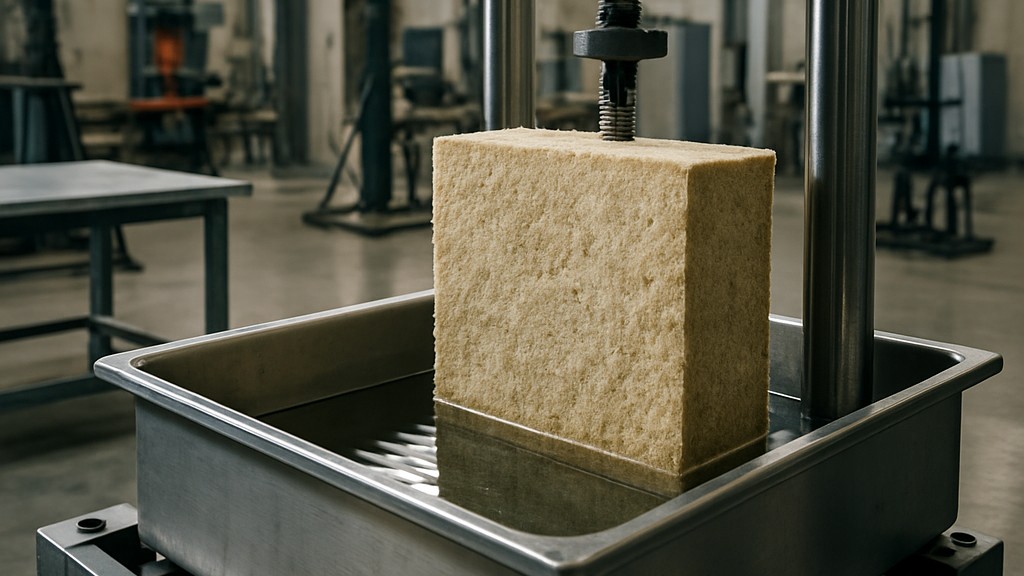
In principle, the lower part of a test sample is placed in water for 24 hours and the mass change is measured. Excess water adhering to the surface but not absorbed by the test sample is removed by drainage (method A) or accounted for by deducting the initial water uptake (method B).
The equipment used in these tests includes:
The thickness of the test samples shall be the thickness of the original product. Test samples shall be square-section prisms with a side length of 200 mm plus/minus 1 mm. The number of test samples shall be as specified in the relevant product standard. If no number is specified, a minimum of four test samples shall be used. In the absence of a product standard or other European technical specification, the number of test samples may be agreed upon between the parties.
Test samples should be cut so as not to include the product edges. Test samples should be prepared using methods that do not alter the original structure of the product. Surfaces and coatings should be protected. Where necessary, specific preparation methods are specified in the relevant product standard or another European technical specification.
Test samples are conditioned at 23 degrees plus/minus 5 degrees for at least 6 hours. In case of disagreement, they are conditioned at 23 degrees plus/minus 2 degrees and 50 percent plus/minus 5 percent relative humidity for the period specified in the relevant product standard.
Tests are performed at 23 degrees plus/minus 5 degrees. In case of disagreement, tests are performed at 23 degrees plus/minus 2 degrees and 50 percent plus/minus 5 percent relative humidity.
When performing testing, the selection of Method A or Method B must be as specified in the relevant product standard. In the absence of a product standard or other European technical specification, the method can be agreed upon between the parties. The dimensions of the test specimens must be measured in accordance with EN 12085. The test methods are as follows:
Thermal insulation materials are essential for energy-efficient buildings, but their performance can be compromised by water ingress or exposure to weather during construction. The EN 1609 standard addresses this gap by providing a standardized method for assessing short-term water absorption, ensuring insulation maintains its thermal properties even under temporary wetting. This standard allows manufacturers and builders to verify material durability by simulating real-world conditions, such as 24 hours of rain on a construction site.
This standard is widely used throughout Europe for quality control and regulatory compliance, particularly in the context of the EU construction products regulation (CPR) and the energy performance of buildings directive (EPBD).
The EN 1609 standard specifies equipment and procedures for measuring the short-term water absorption of thermal insulation products through partial immersion testing. It applies to a wide range of materials, including rigid boards, flexible mats, and loose-fill materials such as mineral wool, foam plastics, or natural fibers. By focusing on the increase in mass after a controlled immersion period, the test provides data on how much water the material can absorb without suffering long-term damage.
Water absorption directly affects insulation effectiveness: even brief exposure can reduce thermal conductivity in hygroscopic materials by up to 50 percent, leading to higher energy consumption and potential mold growth. The EN 1609 standard provides precise measurements, supporting informed decisions in wet climates or exposed installations.
In terms of compliance, it supports CE marking and performance declarations under the CPR and helps prevent costly failures. In sustainable design, low emission values contribute to life cycle assessments, minimizing the embodied energy from spare parts.
Ultimately, the EN 1609 standard is a vital tool in protecting the integrity of thermal insulation against the destructive effects of water and promoting sustainable and efficient buildings. By standardizing short-term absorption tests, it enables the industry to innovate with confidence while meeting stringent environmental targets. As climate-resilient construction evolves, this standard will continue to guide material selection and validation.
Our organization, which has been serving for many years and meticulously following global developments in science and technology, employs a team of experienced professionals and a broad infrastructure to conduct testing, measurement, and analysis in a wide range of areas for businesses across all sectors. In this context, we also provide testing services in accordance with the standard "EN 1609 Thermal insulation products for building applications - Determination of short-term water absorption by partial immersion."
To get an appointment, to get more detailed information or to request an evaluation, you can ask us to fill in our form and reach you.

