

A European standard "EN 13161 Test methods for natural stone - Determination of flexural strength under constant moment" describes a method for determining the flexural strength of natural stones under constant moment. This standard includes provisions for both a diagnostic test and a technological test.
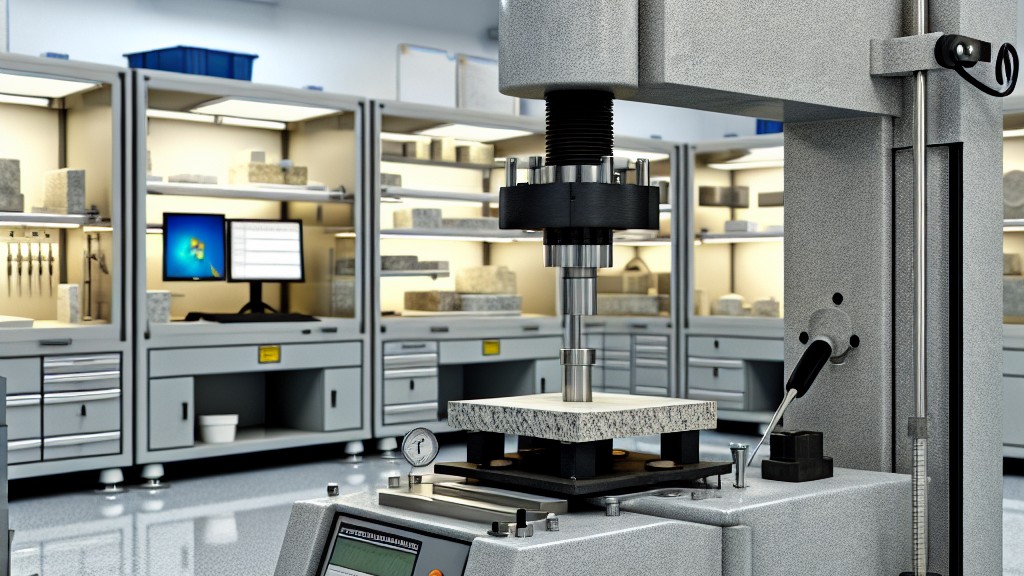
After suitable preparation, a sample of the rock to be tested is placed between two supports and centred. The sample is then subjected to a load using two parallel rollers acting on the upper surface of the sample. These loading rollers are centred and spaced one third of the length of the span. The loads are steadily increased until failure.
The main equipment used in these tests includes:
Sampling is not the responsibility of the testing laboratory when preparing samples, unless specifically requested. At least 10 samples should be selected from a homogeneous batch.
As a standard reference, the surface quality of the samples should be cut, ground or polished (identification test). When testing is required on end products (technological test), the surface quality of the samples can be flame treated or sandblasted depending on the end use. Samples for technological test can be end products or cut from end products. The surface intended for use must be in contact with two support rollers. However, the type of surface quality must be stated in the report.
The dimensions of the samples are determined by their thickness:
Limit deviations shall be plus/minus 1 mm of the nominal dimensions. In the case of identification testing, surfaces shall not deviate from perpendicularity to the axis of the specimen by more than 2 percent when measured in any direction, with a maximum difference of 2 mm.
Anisotropy is the non-isotropy, also defined as the change of physical or mechanical properties of substances depending on direction. In the identification test, if the stone shows anisotropy planes (e.g. bedding, foliation), the direction of the anisotropy planes should be marked on each sample with at least two parallel lines. If the use of the stone in terms of the position of the anisotropy planes is known, the test should be carried out with the force applied to the surface to be loaded during use. If the use of the stone is unknown but the position of the anisotropy planes is indicated on the samples, the test is carried out on each of the three arrangements shown in the figures given in the standard. The total number of samples should be three times 10.
In technological testing, samples are tested only for the relevant product direction, i.e. with the force applied to the surface to be loaded during use.
Our organization has a strong staff that closely follows the developments in the world in the field of science and technology and constantly improves itself. Among the numerous test, measurement, analysis and evaluation studies provided for businesses in various sectors, there are also test services in accordance with the standard "EN 13161 Natural stone test methods - Determination of bending strength under constant moment".
To get an appointment, to get more detailed information or to request an evaluation, you can ask us to fill in our form and reach you.

