

The “ISO 16936 Glass in buildings - Forced entry security glazing” standard published by the International Organization for Standardization (ISO) consists of the following subsections published under the same title:
In this standard, resistance categories are not assigned to specific applications. The glass classification is intended to be specified separately for each application and the expected force acting on the glass. This standard deals only with mechanical resistance to impact.
This standard evaluates security glass products, more commonly known as vandal-proof and burglar-proof glass products. Because no single test can cover a wide range of vandal-resistant properties, four separate test methods are provided to evaluate the break-in resistance properties of security glass.
It is important that safety glass products be installed in a frame that provides adequate impact resistance and also provides adequate support for the safety glass product. It is important to avoid cuts and holes in safety glass products, which could affect the product's durability, whenever possible.
The test method specified in this standard does not reproduce the conditions of an actual human attack, but is intended to provide a comparative durability classification.
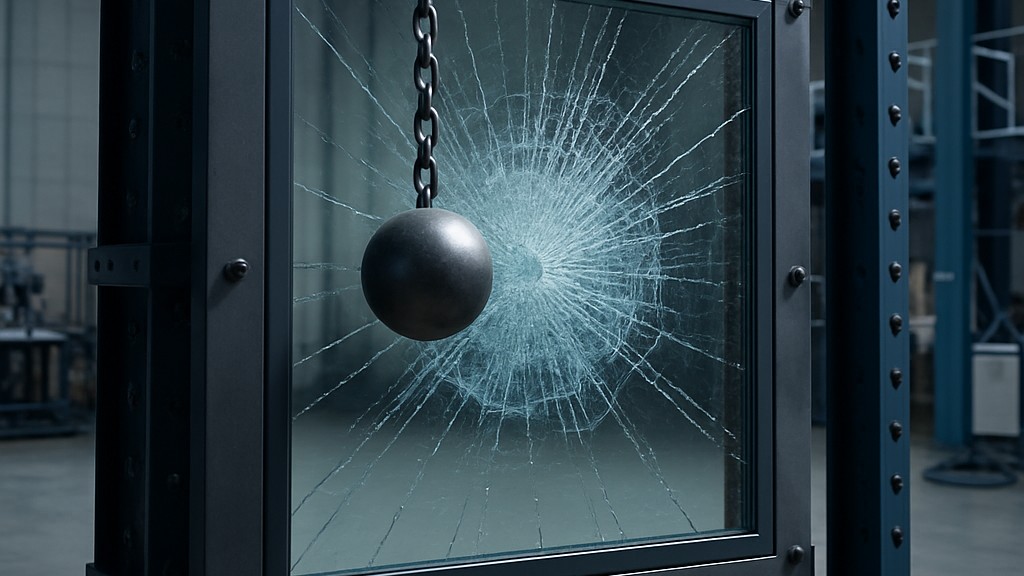
This standard addresses only mechanical resistance to impact (not ballistic, fire, or other threats). The test method involves repeatedly dropping a steel sphere (ball) onto a glass sample from increasing heights to simulate a hard-object impact. Glass is classified according to the number of impacts it can withstand before breaking.
Products are categorized by their resistance levels (for example, by the mass of the sphere and the drop height), but the categories are not tied to specific applications; selection must be application-specific.
This standard includes a test method and classification system for safety glass to retard unauthorized entry by withstanding repeated mechanical impacts from hammers and axes.
This standard addresses resistance to manual attack under ambient conditions, not ballistic, fire, or other threats. The test method involves subjecting glass samples to controlled, repetitive impacts using standard hammer and axe tools at room temperature. The test evaluates the glass's ability to resist penetration or significant damage, and performance is classified according to the number and intensity of impacts.
Glasses are classified by resistance levels based on test results, but these are not dependent on specific applications, users should select the levels that suit their needs.
This standard is designed to delay unauthorized entry by allowing security glass to withstand manual attacks, such as those involving crowbars, hammers, or other hand tools. This standard focuses on mechanical resistance under realistic attack scenarios, not ballistic, fire, or other threats.
The test method involves subjecting glass samples to controlled manual attacks by a human tester using specified instruments. This method evaluates the glass's ability to resist penetration or significant damage, with performance classified according to the duration and intensity of the attack it can withstand.
Glasses are classified according to resistance levels based on test results, but these levels are not dependent on specific applications; users should select levels appropriate to their safety needs.
This standard evaluates the mechanical resistance of security glass under combined thermal and impact conditions, not ballistic or other threats, designed to retard unauthorized entry by withstanding pendulum impact after exposure to thermal or fire stress.
The test method involves subjecting glass samples to controlled thermal or fire stress (e.g., elevated temperatures or fire exposure) and then subjecting them to pendulum impacts to simulate forced entry attempts. This method evaluates the glass's ability to resist penetration or significant damage, and performance is classified according to post-stress impact resistance.
Glasses are classified according to resistance levels based on test results, but these levels are not dependent on specific applications; users should select levels appropriate to their safety needs.
In short, the ISO 16936 series of standards addresses forced-entry security glazing, specifically designed to resist manual attacks and delay unauthorized access to protected areas such as homes, offices, or public buildings. This standard is considered important for the following reasons:
In short, ISO 16936 standards are necessary to bridge the gap between basic glass durability and advanced safety needs, thereby contributing to safer and more durable building environments.
Our organization, which has been operating for many years and meticulously follows global developments in science and technology, employs a skilled team and extensive infrastructure to conduct testing, measurement, and analysis in a wide range of areas for businesses across all sectors. In this context, we also provide testing services in accordance with the ISO 16936 "Glass in Buildings - Forced Entry Security Glazing" standard.
To get an appointment, to get more detailed information or to request an evaluation, you can ask us to fill in our form and reach you.

