EN ISO 26987 Durable Floor Coverings - Determination of Stain Retention and Chemical Resistance
A European standard, subsequently published by the International Organization for Standardization (ISO), “EN ISO 26987 Resistant floor coverings - Determination of stain retention and resistance to chemicals” describes a procedure for determining the reaction of resilient floor coverings to chemical agents.
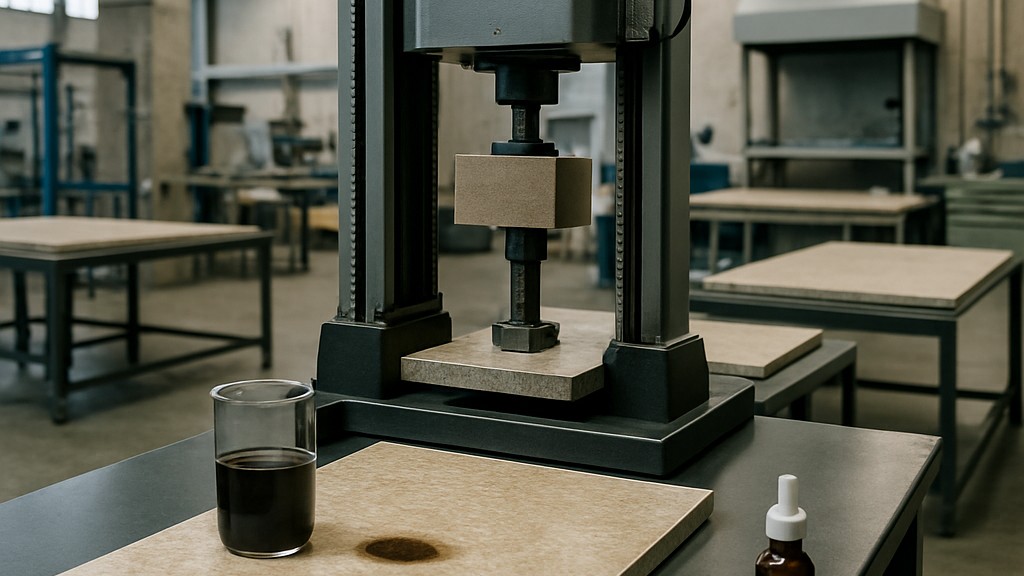
In principle, various chemical substances in liquid or paste form are placed on a test piece for specified periods of time and then removed. After cleaning, the resulting change in appearance is evaluated under specified lighting conditions.
The main devices and materials used in these tests are:
- Standard laboratory equipment:
- Pipettes.
- Watch: Diameter 40 mm.
- Spatulas.
- Chemicals in liquid or paste form: This standard does not specify or recommend the chemicals to be tested.
- Standard cleaning and stain removal products:
- White cotton in pad or cloth form.
- Hard brushes that are less likely to leave scratches on the surface.
- Warm water used alone or with selected cleaning products.
- Abrasive materials (abrasives, abrasive scouring pads, steel wool or scouring powder No. 00, or abrasive papers with a grit of P 240 or finer used with water).
- Specific cleaning products recommended by the flooring manufacturer.
- Illumination device consisting of a lamp with a correlated color temperature between 5500 K and 6500 K (mounted on the viewing platform to provide a light intensity of 1500 plus/minus 100 lx and illuminate the test piece vertically from above). The environment should be neutral and dark. The light intensity should be checked frequently using a luxometer. The lamp life specified by the manufacturer should not be exceeded.
- A rotating viewing table that allows the test piece to be rotated to be viewed from all sides under standard lighting.
During the sampling and test piece preparation process, a representative sample is taken from the existing floor covering material. The sample should be taken from a new roll or cardboard and should not have any floor finish applied. A test piece with a surface area of at least 3.000 mm2 is taken from each color to be tested. If the test uses a chemical substance that could cause the test piece to swell or deform (for example, prolonged contact with a solvent), the test piece should be affixed to a fiber-cement board at least 5 days prior to the test. The test pieces corresponding to each substance being tested are identified by marking numbers on the test piece (using a mark that is not affected by the material used in the test) or by using a drawing, diagram, or photograph.
Test pieces are kept at a temperature of 23 degrees Celsius plus/minus 2 degrees Celsius and a relative humidity of 50 percent plus/minus 5 percent for at least 24 hours. This condition is maintained throughout the test.
The testing procedure consists of the following steps:
- Applying liquids: Using a clean pipette, pour a small amount of the liquid chemical to be tested onto the center of the marked location on the test piece. The convex surface of a watch glass is applied to the liquid and immediately removed. If the liquid chemical splash diameter exceeds 15 mm, reapply the watch glass. This time, leave it in place to create a liquid chemical splash covering an area of 300 mm² to 400 mm². If the chemical does not exceed 15 mm², add a few more drops and spread it again using the watch glass. This time, leave it in place to create a liquid chemical splash covering an area of 300 mm² to 400 mm².
- Application of paste substances: With a spatula, spread approximately 1000 mm3 of the paste chemical substance to be tested over an area of 300 mm2 to 400 mm2 (i.e. 2,5 mm to 3 mm thick).
- Contact time: The contact time should be approximately 2 hours, and the sample should be evaluated within 5 minutes of removing the chemical. After cleaning and observing the test piece for any adverse effects (such as staining, dulling, softening, or swelling), a new test should be performed for 30 minutes.
- Cleaning and observation: Before cleaning, remove any remaining chemicals with a cotton ball, working from the edges toward the center of the stain. Any remaining paste is scraped off with a spatula and wiped off with a cotton ball as described above. Using one or more cleaning and stain removal products, clean the surface from the edges toward the center of the stain. After cleaning, examine the remaining stain from all sides using the illumination device from a distance of approximately 800 mm, at an angle of approximately 45 degrees, and slowly rotating the viewing table. If any stain remains visible, scrub with an abrasive material or a cleaning product recommended by the manufacturer and examine as described above.
After observing the test pieces, an index is assigned to each test piece based on the observed effect of the test after cleaning/abrasion, as shown in the table titled "Interpretation and Presentation of Results." According to the table, the index and the test effect after cleaning/abrasion are as follows:
- 0 Not Affected
- 1 Light
- 2 Medium
- 3 Severe
The test report should include the following information:
- A statement that the tests were performed in accordance with this international standard
- Full description of the flooring tested, including type, source, colour and manufacturer's reference numbers
- The history of the sample, i.e., from which source the sample was taken, when the new carton or roll was produced
- Chemicals used, type of cleaning and stain removal products and abrasive materials and contact times
- Test results in accordance with the table
- Any deviation from this standard that may have affected the results.
Our organization, which has been supporting businesses across all sectors for years through a wide range of testing, measurement, analysis, and evaluation activities, has a strong team of employees who closely follow global developments in science and technology and are constantly improving themselves. In this context, we also provide testing services in accordance with the EN ISO 26987 Durable floor coverings - Determination of stain and chemical resistance standard.



