EN 12390 Testing of Hardened Concrete
The European standard “EN 12390 Testing of hardened concrete” consists of the following subsections published under the same title:
- EN 12390-1 Part 1: Shape, dimensions, and other requirements for specimens and molds describes the shape, dimensions, and tolerances for cast concrete test specimens in the form of cubes, cylinders, and prisms, and the molds required to produce them. The tolerances specified in this standard are based on the requirements for strength tests but can also be applied to tests for other properties.
For the purposes of this standard, the following definitions apply in addition to the terms and definitions given in EN ISO 1101:
- Nominal size is the commonly used sample size description.
- The specified size is the specimen size in millimetres, selected and declared from the range of nominal sizes permitted by the user of this standard.
EN 12390-2 Part 2: Making and Curing Specimens for Strength Tests describes the methods for making and curing test specimens for strength tests. This standard covers the preparation and filling of molds, compaction of concrete, surface dressing, curing of test specimens, and transportation of test specimens. This standard can be used for making and curing specimens for other test methods.Samples for testing must be taken in accordance with EN 12350-1. The sample must be remixed using a recycling container or tray and paddle before filling the molds. If samples are produced away from the sampling location, they can be transported to the production site, provided the sample remains dehydrated and remixable.
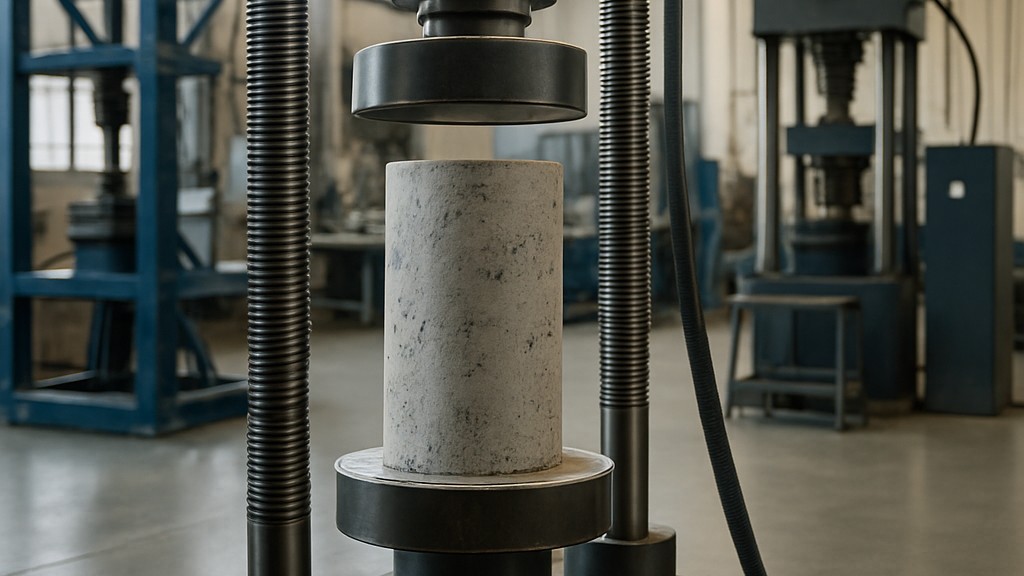
- The standard "EN 12390-3 Part 3: Compressive Strength of Test Specimens" describes a method for determining the compressive strength of hardened concrete test specimens. During testing, specimens are typically loaded to failure in a compression testing machine complying with EN 12390-4. The maximum load supported by the specimen is recorded, and the compressive strength of the concrete is calculated.
- The standard "EN 12390-4 Part 4: Compressive strength - Specification for testing machines" specifies the performance requirements for pressure testing machines used to measure the compressive strength of concrete. This standard is considered important for the following reasons:
- Provides reliable and repeatable compressive strength test results.
- Helps prevent errors caused by machine misalignment, poor calibration, or improper loading.
- Supports compliance with building regulations and quality assurance in construction projects.
- It increases the safety and performance of concrete structures by ensuring correct strength classification.
- The standard "EN 12390-5 Part 5: Flexural Strength of Test Specimens" describes a method for determining the flexural strength of hardened concrete specimens. During the test, prismatic specimens are subjected to a bending moment by applying a load via upper and lower cylinders. The maximum load resisted is recorded, and the flexural strength is calculated.
- The standard "EN 12390-6 Part 6: Tensile strength of test specimens" describes a method for determining the tensile strength of test specimens of hardened concrete. Reference specimens are molded cylindrical specimens. Cores with a minimum diameter of 75 mm, complying with the requirements of EN 12504-1, can be tested using this method. The use of cubic or prismatic specimens is covered in the standard's annex (Annex A). In principle, a cylindrical specimen is subjected to a compressive force applied to a narrow region along its length. The resulting orthogonal tensile force causes the specimen to fail in tension.
- The standard "EN 12390-7 Part 7: Density of hardened concrete" describes a method for determining the density of hardened concrete. This method is valid for lightweight, normal-weight, and heavy-weight concrete. It distinguishes between hardened concrete when:
- As received
- Saturated with water
- Oven dried
The mass and volume of the hardened concrete sample are determined and the density is calculated.
- The standard "EN 12390-8 Part 8: Depth of water penetration under pressure" describes a method for determining the depth of water penetration under pressure in hardened concrete cured with water. The test is essentially performed by applying water under pressure to the surface of the hardened concrete. The sample is then split, and the depth of penetration of the water front is measured.
- The standard "EN 12390-9 Part 9: Freeze-thaw resistance with deicing salts - Scaling" describes the testing of concrete for freeze-thaw scaling resistance with both water and sodium chloride solution. This method can be used to compare new components or new concrete compositions against a component or concrete composition known to perform adequately in the local environment, or to evaluate test results against some absolute numerical value based on local experience.
Extrapolation of test results to evaluate different concretes, i.e. new components or new concrete compositions, requires expert judgment.
In some cases, the test methods may not be suitable for testing special concretes, such as high-strength concrete or permeable concrete. In these cases, the results should be interpreted with caution. Furthermore, the test methods in this standard may not be able to identify aggregates subject to occasional exposure.
There is no established correlation between the results obtained with the three test methods. All tests clearly identify poor and good behavior, but they differ in their assessment of marginal behavior. Applying different acceptance limits to the test results allows for assessment of different degrees of exposure severity.
During testing, slab specimens cut from concrete test specimens are subjected to freeze-thaw attack in the presence of a 3 mm deep layer of deionized water or 3 percent sodium chloride solution. Freeze-thaw resistance is assessed by measuring the mass scaled from the test surface after 56 freeze-thaw cycles.
- The standard "EN 12390-10 Part 10: Determination of carbonation resistance of concrete to atmospheric carbon dioxide levels" describes a method for determining the carbonation rate of concrete. This standard includes a procedure using a standardized climate-controlled chamber and placing samples in a natural exposure area protected from direct rain. The standardized climate-controlled chamber procedure is the reference method. These procedures are applicable for initial testing of concrete, but not for factory production control.
During testing, pairs of beams (or two cubes per test age) taken from the same batch of concrete are stored in a climate-controlled room or natural exposure area as specified herein. After the defined exposure times, a slice of the beam approximately 50 mm thick at each test age is broken and tested for carbonation depth. If cubes are used, they are broken in half, and half of each cube is used to measure carbonation depth, the other half is discarded. Carbonation depth is measured at three points on each face of each beam or cube, yielding a potential total of 12 measurements per sample and a potential total of 24 measurements for two samples. The average carbonation depth of all measurements is calculated. The remaining beams are returned to the climate-controlled room for testing at other predefined ages. The rate of carbonation is determined using at least three sets of measurements taken at 3 months, 6 months, and 1 year.
- The standard "EN 12390-11 Part 11: Determination of chloride resistance of concrete, unidirectional diffusion" describes a method for determining unidirectional, non-steady-state chloride diffusion and surface concentration in conditioned samples of hardened concrete. The test method allows the determination of chloride penetration at a specific age, for example, for ranking concrete quality by comparative testing. Because resistance to chloride penetration depends on aging, including the effects of continued hydration, the ranking may also change with age. The test procedure is not applicable to concrete with surface treatments such as silanes and may not be applicable to concrete containing fibers.
- The standard "EN 12390-12 Part 12: Determination of carbonation resistance of concrete - Accelerated carbonation method" describes a method for quantitatively determining the carbonation resistance of concrete using test conditions that increase the rate of carbonation. After a preconditioning period, the test is conducted under controlled exposure conditions using increased carbon dioxide levels. The test, conducted under reference conditions, lasts a minimum of 112 days, with a minimum sample age of 28 days before curing, a minimum preconditioning period of 14 days, and an exposure period of 70 days to increased carbon dioxide levels. This procedure is not a method for determining carbonation depths in existing concrete structures.
- The standard "EN 12390-13 Part 13: Determination of the shear modulus of elasticity under compression" describes a method for determining the secant modulus of elasticity under compression of hardened concrete that can be cast or removed from a structure. The test method allows the determination of two secant modulus of elasticity: the initial modulus, measured at the first loading, and the stabilized modulus, measured after three loading cycles.
This standard includes two different test methods. Method A is for determining both the initial and stabilized moduli, and Method B is for determining only the stabilized modulus.
In principle, a test specimen is loaded in axial compression, stresses and strains are recorded, and the secant slope of the stress-strain curve is determined at initial loading (Method A only) and after three loading cycles (Methods A and B). The secant slope is known as the secant modulus of elasticity in compression. Test specimens can be cast or taken from an existing structure.
- The standard "EN 12390-14 Part 14: Semi-adiabatic method for determining the heat released by concrete during the hardening process under semi-adiabatic conditions" describes a procedure for determining the heat released by concrete during the hardening process in a laboratory. The procedure for field testing is included in Annex B. The test is suitable for samples where the declared value of the coarsest aggregate fraction actually used in concrete is not greater than 32 mm. Adiabatic thermodynamics is the process in which there is no loss or gain of heat or mass in the working fluid.
- The standard "EN 12390-15 Part 15: Adiabatic method for determining the heat released during the hardening process of concrete" describes a procedure for determining the heat released by concrete during the hardening process under adiabatic conditions. The test is suitable for samples where the declared value of the coarsest aggregate fraction actually used in the concrete is not greater than 32 mm.
In principle, the test determines the amount of heat released from concrete during the curing process under adiabatic conditions at regular intervals immediately after the sample is poured. The test is performed using an adiabatic calorimeter, designed to minimize heat loss from the concrete sample. A freshly mixed concrete sample is placed in a mold, which is then inserted into the adiabatic calorimeter, and the internal temperature of the hardened concrete is measured.
The test is suitable for concrete containing all cement types specified in the EN 206 standard, except for fast-setting cements.
- The standard "EN 12390-16 Part 16: Determination of shrinkage of concrete" describes a procedure for determining the total shrinkage of concrete samples under drying conditions. Any shrinkage or changes in length that occur within 24 hours of age and that may have significant amplitude or consequences in a restrained condition may need to be measured using a supplementary procedure not included in this standard. Information on a simplified procedure for determining autogenous shrinkage is included in Annex A. The test is suitable for samples where the declared value of the coarsest aggregate fraction actually used in the concrete is not greater than 32 mm.
- The standard "EN 12390-17 Part 17: Determination of Creep of Concrete Under Compression" describes the procedure for determining the creep (total creep, basic creep, and drying creep) of hardened concrete test specimens subjected to constant longitudinal compressive loads. This method is suitable for specimens where the declared value of the coarsest aggregate fraction actually used in the concrete is not greater than 32 mm. In principle, test specimens undergo changes in length when subjected to constant compressive loads under specific temperature and relative humidity conditions.
- The standard "EN 12390-18 Part 18: Determination of the chloride migration coefficient" describes the procedure for determining the unsteady-state chloride migration coefficient of hardened concrete samples of a specified age. The test procedure does not account for any interaction of the concrete with the salt solution over time. The test result is an indicator of the durability of the concrete under investigation, in terms of its resistance to chloride penetration.
The test procedure is not applicable to concrete samples with surface treatments such as silanes. If the aggregate or other embedded elements (such as metallic fibers or conductive particles) are electrically conductive, this will affect the magnitude of chloride migration. This fact is taken into account when determining threshold values. If the aggregates produce a difference in chloride migration of more than half an order of magnitude (either higher or lower), it will prevent comparisons of chloride migration values between concretes.
In principle, a concrete or mortar sample is placed between a chloride-free and a chloride-containing alkaline solution, and an electric voltage is applied between two external electrodes to direct chloride ions into the concrete sample. After a specified time, the sample is split, and the penetration depth of free chloride ions is determined using a suitable color indicator solution. The chloride migration coefficient is calculated based on the measured penetration depth, the magnitude of the applied voltage, and other parameters.
- The standard "EN 12390-19 Part 19: Determination of electrical resistivity" describes two methods for measuring the electrical resistivity of concrete under water-saturated conditions: the reference volumetric method and the surface method. This standard includes the procedure for calibrating the surface method using the reference volumetric method. Both methods yield the same resistivity result, provided the principles of the current standard are adhered to.
The volumetric method is applicable to cast samples or cores, while the surface method is suitable for use with cast samples, cores, and on construction sites, although not all of these applications are covered in this standard.
This method is applicable to the standard range of concrete covered by applicable standards. It does not cover concrete containing metallic components or made with porous aggregates. The use of resistivity to assess the corrosion potential of reinforcement in existing structures is not specified in this standard. The use of resistivity to test cores taken from an existing structure that require preconditioning by saturating with water is not addressed in this standard.
- The standard "EN 12390-20 Part 20: Determination of Porosity" describes a method for determining the porosity (open pores) of hardened concrete on test specimens of any type (molded, sawn, cored) or shape. This method is suitable for specimens where the declared value of the coarsest aggregate fraction actually used in the concrete is not greater than 40 mm. The test method is not applicable to concrete containing lightweight aggregate.
Our organization, which has been supporting businesses across all sectors for years through a wide range of testing, measurement, analysis, and evaluation activities, has a strong team of employees who closely follow global developments in science and technology and are constantly improving themselves. In this context, we also provide testing services in accordance with the EN 12390 "Testing of Hardened Concrete" standard.



