

EN ISO 29470 Thermal insulation products for building applications - Determination of apparent density, based on a European standard and later published by the International Organization for Standardization (ISO), describes the equipment and procedures required to determine apparent total density and apparent core density under reference conditions. This standard is applicable to full-size thermal insulation products and test specimens. It can also be applied to individual layers of multilayer products.
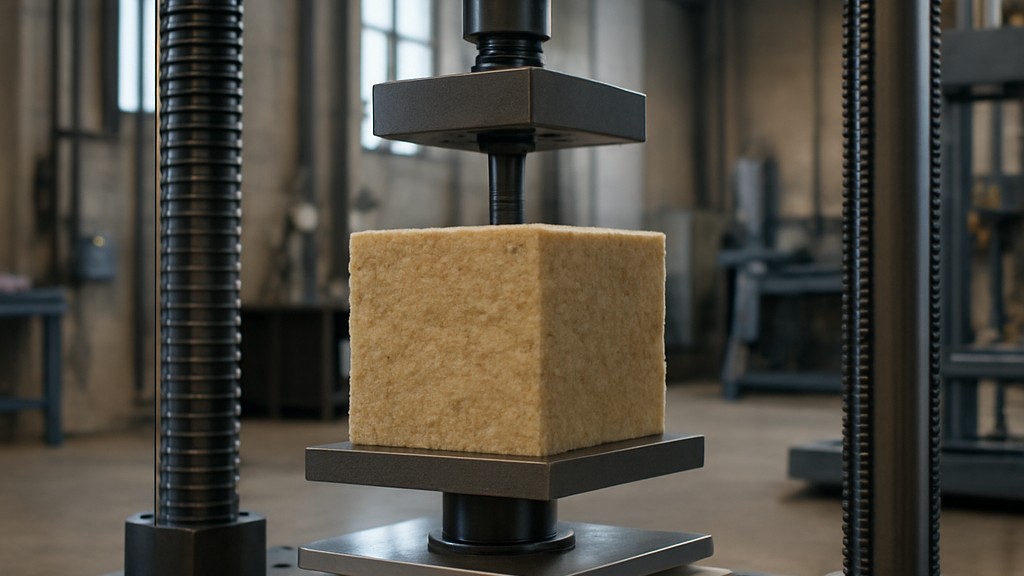
For the purposes of this standard, apparent total density refers to the mass per unit volume of a product, including all surface coatings formed during manufacture, but excluding any coatings or coverings, while apparent core density refers to the mass per unit volume of the core of a product after removing all surface coatings formed during manufacture and any coatings or coverings.
In principle, density is determined as the ratio of the mass of the test sample to its volume.
The tests use balances capable of measuring the mass of a test sample to an accuracy of 0,5 percent and equipment for determining linear dimensions.
Test specimens should be full-size products or parts thereof, or specimens used for other tests. The shape of the test specimens should be such that their volume can be easily calculated. When determining the apparent total density using test specimens cut from a product that has developed surface crust during production, the ratio of the surface crust area to the total volume of the test specimen should be the same as for the product. If the product's shape or surface is not rectangular and is not easily measured and calculated, a representative piece of the product should be cut. The test specimen should be as large as possible within the available equipment and dimensions.
For full-size products, the number of test samples must be as specified in the relevant product standard. If test samples from other tests are used, the number of samples must be as specified in the test method. If the number of samples is not specified, at least five samples must be used. In the absence of a product standard or other technical specification, the number of test samples can be agreed upon between the parties.
Test samples should be cut using a method that does not alter the original structure of the product. The location from which the test samples are taken should be such that the resulting density represents the density of the product. To determine the apparent total density, all coatings or coverings must be removed from the product. To determine the apparent core density, all surface crusts and all coatings or coverings formed during production must be removed from the product. When it is not possible to remove coatings or coverings without affecting the apparent density of the product, the mass of the coatings or coverings must be calculated. Specific preparation methods, where necessary, are specified in the relevant product standard.
Samples should be conditioned at 23°C plus/minus 2°C and 50% relative humidity until constant mass is reached. The conditioning time and the required accuracy of constant mass measurements should be specified in the relevant product standard. If it can be demonstrated that temperature and humidity have a negligible effect on density determination, conditioning may be carried out at 23°C plus/minus 5°C. The conditioning time can be shortened by drying the sample in a ventilated oven at a predetermined temperature. Appropriate procedures may be specified in the relevant product standard. In tropical countries, different conditioning and testing conditions may be more appropriate. In such cases, the conditions should be 27°C and 65% relative humidity and should be clearly stated in the test report.
Tests should be conducted at 23°C (plus/minus 2°C) and 50% relative humidity (RH). If it can be demonstrated that temperature and humidity have a negligible effect on density determination, the test may be conducted at 23°C (plus/minus 5°C). Different conditioning and testing conditions may be more appropriate in tropical countries. In such cases, the conditions should be 27°C (plus/minus 2°C) and 65% relative humidity (RH) and should be clearly stated in the test report.
The linear dimensions of full-size products are measured according to ISO 29465 and ISO 29466. The linear dimensions of specimens are measured according to ISO 29768. For full-size products, length, width, and thickness should be given to the nearest millimeter. Measurements for specimens must be made to an accuracy of 0,5 percent. The volumes of the test specimens are calculated from these measurements. Each test specimen is weighed to an accuracy of 0,5 percent, and its mass is recorded in kilograms.
If surfaces or coatings are protected, the mass of the product should be calculated by subtracting the mass of the surfaces or coatings and any adhesives from the total mass. If greater accuracy is required for full-size products, this should be specified in the relevant product standard.
Apparent overall density or apparent core density is calculated in kg/m3 as described in the standard.
In the pursuit of energy-efficient and sustainable construction, accurate characterization of thermal insulation materials is crucial. Density is a key property that influences not only a material's thermal performance but also its structural integrity, weight, and cost-effectiveness. The EN ISO 29470 standard provides a precise method for determining the apparent density of these materials, ensuring reliability and comparability across products and manufacturers. This standard is essential for compliance with European building regulations and supports the global effort towards low-carbon buildings.
The EN ISO 29470 standard focuses on the apparent density of thermal insulation products, which is the mass per unit volume, taking into account any surface irregularities or voids. This standard applies to full-size products such as rigid boards, flexible mats, and multi-layer assemblies, as well as smaller test specimens. It distinguishes between:
This dual approach allows for a comprehensive evaluation, particularly for composite insulations.
Apparent density is a transitional property for thermal insulation: lower densities generally correlate with better thermal resistance but may compromise mechanical strength. The EN ISO 29470 standard helps architects select materials for energy-efficient designs that comply with the EU Building Energy Performance Directive by ensuring manufacturers declare accurate values.
In practice, it supports CE marking under the Construction Products Regulation (CPR), reducing the risk of non-compliance penalties. For sustainability assessments, density data helps with concrete energy calculations and waste minimization. It facilitates trade by harmonizing test methods globally, benefiting exporters in competitive markets.
Ultimately, the EN ISO 29470 standard is the cornerstone of precision in thermal insulation testing, combining materials science with practical construction needs. By standardizing apparent density determination, it enables the industry to deliver verifiable, high-performance products that advance energy savings and environmental goals. As the construction industry evolves towards circular economies, this standard will continue to be crucial for innovation and regulation.
Our organization, which has been providing services for many years and meticulously follows global developments in science and technology, employs a skilled team and extensive infrastructure to conduct testing, measurement, and analysis in a wide range of areas for businesses across all sectors. In this context, we also provide testing services in accordance with EN ISO 29470 Thermal insulation products for building applications - Determination of apparent density.
To get an appointment, to get more detailed information or to request an evaluation, you can ask us to fill in our form and reach you.

