

The standard “ASTM C167 Standard Test Methods for Thickness and Density of Blankets or Blanket Thermal Insulation” published by the American Society for Testing and Materials (ASTM) describes test methods for determining the thickness and density of flexible, felt or woven thermal insulation blankets, rolls or quilts composed of fibrous materials, with or without surface coating or reinforcement.
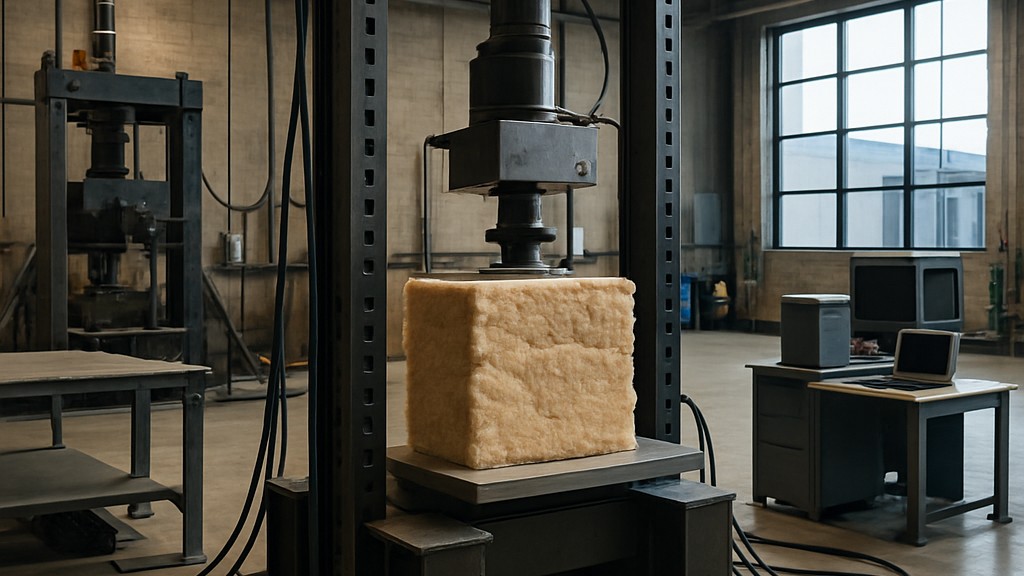
Accurately measuring the thickness and density of blanket or blanket insulation is crucial for determining its thermal insulation properties. For a given blanket or blanket product, thickness and density are often directly related to its thermal insulation value. These testing methods are crucial for manufacturing quality control to ensure that products maintain their claimed insulation values.
Equipment used in the tests includes:
A test sample should consist of a representative roll or bundle of insulation. For bundles containing 20 or more layers of insulation, five layers of insulation should be selected. Otherwise, a three-layer insulation or five-layer insulation selection technique can be used. Doubled insulation layers count as two layers of insulation for the purposes of the selection and selection method. In the three-layer insulation method, the middle insulation and the second insulation are selected from each end of the bundle. In the five-layer insulation method, the bundle is divided into five blanket groups of as equal a number as possible. The first blanket is selected from each group. Only one blanket should be selected from the two end blankets within the bundle. Blankets up to 122 cm plus/minus 0,63 cm are cut.
When sampling from cut rolls, five blankets are cut to a roll width of 122 cm plus/minus 0,63 cm long. One blanket is cut from the center of the roll, two blankets are cut from the ends of the roll, and a fourth and fifth blankets are cut at quarter-points along the length. For blankets wider than 61 cm, each of the five blankets is cut to a roll width of 61 cm plus/minus 0,63 cm and a length of 122 cm plus/minus 0,63 cm.
Before unwrapping the material, the entire roll is weighed to the nearest 0,11 kg. Two methods can be used to obtain the exact roll weight. The first method removes the insulation product from its packaging before weighing. The material expands and may expand slightly; care must be taken to ensure the entire roll is weighed accurately. The second method weighs the packaged insulation product, then weighs only the packaging material. The packaging material weight is subtracted from the packaged product weight to obtain the net material weight.
ASTM C167 is a widely accepted standard. It includes test methods for determining the thickness and density of blanket or quilt-type thermal insulation materials, such as fiberglass or mineral wool. These materials are widely used in residential, commercial, and industrial buildings to improve energy efficiency and thermal comfort. The primary objective of this standard is to provide a consistent and accurate methodology for measuring two key physical properties of thermal insulation:
These features are important in terms of:
ASTM C167 applies specifically to flexible fibrous insulation materials supplied as blankets or quilts. It is not intended for use with rigid board insulation or loose-fill products. This standard is divided into two main test methods:
According to this standard, density is calculated using the formula: density = mass / volume. Here, mass is determined using a precision balance. Volume is the product of the measured thickness and the surface area of the test specimen.
Common applications of this standard include:
This standard is important for the following reasons:
As a result, ASTM C167 is a fundamental standard in the construction and insulation industry, ensuring blanket insulation is accurately measured for thickness and density. These values are critical in determining how well a product performs in real-world conditions and help maintain consistent quality across insulation materials.
Our organization, which has been supporting businesses across all sectors for years through a wide range of testing, measurement, analysis, and evaluation activities, has a strong team of employees who closely follow global developments in science and technology and are constantly improving themselves. In this context, we also provide testing services in accordance with ASTM C167 Standard Test Methods for Thickness and Density of Blanket or Thermal Insulation.
To get an appointment, to get more detailed information or to request an evaluation, you can ask us to fill in our form and reach you.

