

ASTM C1354/C1354M Standard Method for Testing the Strength of Individual Stone Anchors in Dimensioned Stones
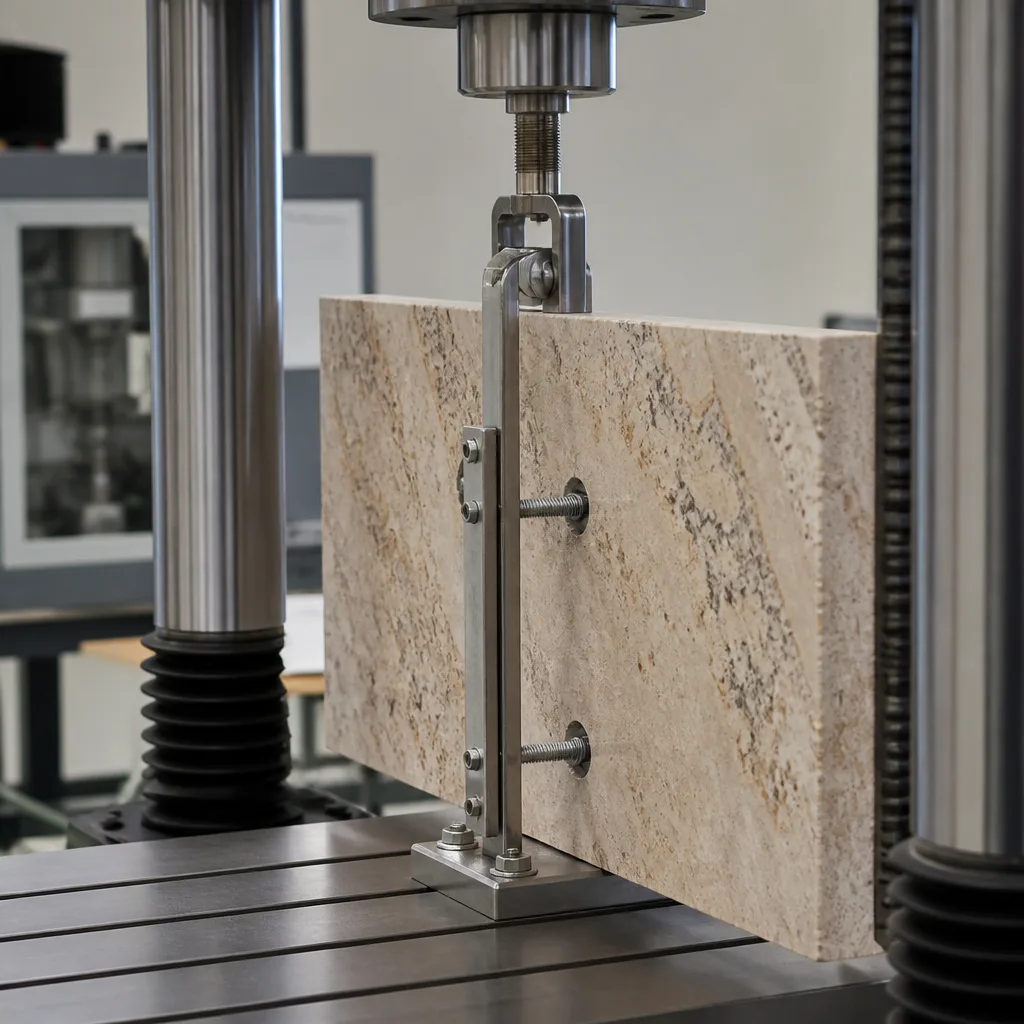
The ASTM C1354/C1354M standard method for testing the strength of individual stone anchors in dimension stone, developed by the American Society for Testing and Materials (ASTM), describes a test method for determining the ultimate strength of a stone assembly supported by mechanical anchors. In this method, the load is applied separately perpendicular to the panel surface and parallel to the panel surface. This test aims to represent the interaction of the anchor with the stone panel. However, the effect of the support structure on the strength of the assemblies is not included. This test method is applicable to stone panels supported by mechanical anchors.
This testing method aims to provide information from which applicable design data can be determined for a specific anchor used to support dimensioned stone panels. The strength of a limited anchor length can be correlated with a longer support length, provided the designer correctly considers the flexibility of the support.
The ASTM C1354/C1354M standard is a widely accepted testing method. It determines the ultimate strength of a connection between a mechanical anchor and a dimensioned piece of stone (such as granite, marble, limestone, or other natural stones used in cladding and exterior facades). This standard provides procedures for evaluating how well the anchor holds the stone under load, which is critical for the safety and performance of stone cladding systems in buildings.
This testing method includes the following:
This test focuses solely on the interaction between the anchor and the stone. It does not include the effect of the supporting structure (e.g., the building's frame or substrate). This method is designed for mechanical anchors (e.g., groove anchors, pins, dowels, or special systems) instead of adhesive or mortar-based bonds.
This test helps engineers and designers obtain design data for a specific anchor-stone combination. Key points include:
This test is widely used in the specification, qualification, and quality control of exterior three-dimensional stone cladding systems.
This method generally follows these steps:
Common failure modes observed include rock fracture around the anchor, anchor deformation, or complete rupture/shearing.
The ASTM C1354/C1354M standard is typically used in conjunction with other standards for a complete assessment of stone cladding performance.
The main areas of application of this standard are:
Anchor failure in stone cladding can lead to serious safety issues, water leaks, or costly repairs. The ASTM C1354/C1354M standard helps ensure stone assemblies meet structural, wind, seismic, and durability requirements by providing a standardized, repeatable way to measure performance.
In short, the primary purpose of the ASTM C1354/C1354M standard is to determine the ultimate load-bearing capacity of a rock anchor system. The test evaluates an arrangement consisting of the following:
This method simulates real-life forces acting on facade systems, such as wind pressure, gravity, and structural movement, by applying loads perpendicular and parallel to the stone surface. Importantly, the test focuses solely on the interaction between the anchor and the stone and does not include the effect of the backup structural system.
This standard plays a crucial role in engineering and design in the following areas:
The results are used to determine design loads and safety factors for anchoring systems in buildings.
The main parameters evaluated using this method are as follows:
These parameters help engineers understand the weak points in the anchoring system.
In conclusion, the ASTM C1354/C1354M standard is a critical standard in the construction industry, especially for dimensioned stone anchoring systems. By defining a consistent and reliable method for testing anchor strength, it enables engineers to design safer and more durable stone facades. Its role is particularly vital in modern architecture, where natural stone is frequently used in complex and high-performance building facades.
For many years, our organization, with its competent and experienced team, has been understanding the needs of its clients, providing the advanced testing services they require, and assisting them in the establishment, implementation, and improvement of management systems. Within this framework, we also provide testing services in accordance with the ASTM C1354/C1354M standard.
To get an appointment, to get more detailed information or to request an evaluation, you can ask us to fill in our form and reach you.

