

The American Society for Testing and Materials (ASTM) standard, "ASTM D7089 Standard Practice for Determining the Effectiveness of Anti-Graffiti Coatings by Pressure Washing on Concrete, Masonry, and Natural Stone Surfaces," describes a basic method for evaluating the performance of anti-graffiti products on mineral structural surfaces using a series of increasingly abrasive cleaning methods. Anti-graffiti materials are applied to a series of concrete, masonry, and natural stone samples for evaluation. Graffiti resistance is based on how well a defined set of markings is removed using a specific set of cleaning techniques.
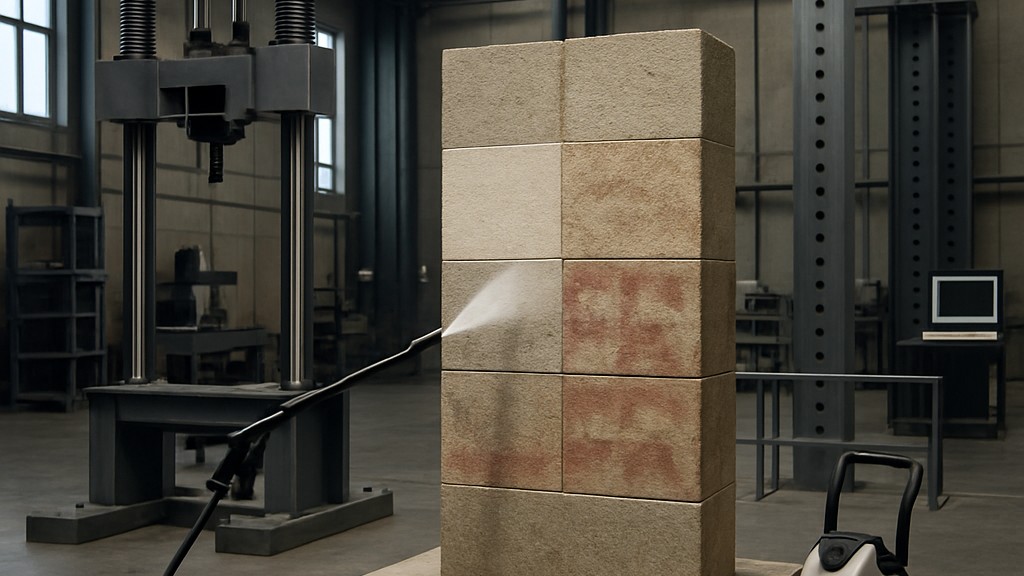
This application also describes a procedure for evaluating graffiti removal after re-marking and subsequent re-cleaning. It does not address the re-treatment of surfaces after a material has ceased to resist graffiti.
Graffiti on buildings and structures is a significant problem in various areas across the country. Various coatings have been developed to resist or aid in removal of paint/pencil applications. This standard describes a procedure for evaluating the effectiveness of anti-graffiti coatings applied to various concrete, masonry, and natural stone surfaces. This standard does not address graffiti removal on metal or other non-mineral surfaces.
This practice addresses graffiti removal from surfaces that have not been exposed to natural or artificial weathering in a laboratory setting only. ASTM D6578/D6578M Standard Practice for Determining Graffiti Resistance includes a method for graffiti removal after exposure to both natural and artificial weathering.
ASTM D7089 outlines laboratory procedures for evaluating the performance of anti-graffiti coatings when cleaned using pressure-washing methods on mineral surfaces (i.e., concrete, masonry, and natural stone). These procedures do not apply to metal or other non-mineral surfaces.
Before testing, treated surface samples are marked with spray paint or markers. Cleaning is accomplished by a series of increasingly aggressive pressure washing methods. First, cold, high-pressure water washes with a commercial graffiti remover, followed by hot, high-pressure water washes, and finally, high-pressure sodium bicarbonate washes.
The degree of graffiti removal is determined quantitatively. For example, "Cleanability level 1" indicates complete removal in all samples.
Coating types are classified as follows:
This standard includes procedures for re-marking surfaces and re-evaluating removal performance over multiple cycles.
Tests are performed on new, unweathered surfaces under laboratory conditions. No aging or environmental degradation is considered. In this case, the ASTM D6578/D6578M standard method applies.
In summary, the ASTM D7089 standard test methods are:
The cleanability rating system is as follows:
This rating is based on visual inspection and may be supported by photographic documentation.
The ASTM D7089 standard is important because it provides a scientific, consistent, and repeatable way to evaluate the effectiveness of anti-graffiti coatings, particularly on concrete, masonry, and stone surfaces. This standard is considered important for the following reasons:
This eliminates guesswork and marketing bias when comparing coatings.
The ASTM D7089 standard helps ensure that coatings:
This is crucial for cost-effectiveness.
Ultimately, the ASTM D7089 standard is important because it ensures that anti-graffiti coatings perform reliably, safely and sustainably as claimed, saving time and money while protecting infrastructure.
Our organization, which has been operating for many years and meticulously follows global developments in science and technology, employs a skilled team and extensive infrastructure to conduct testing, measurement, and analysis in a wide range of areas for businesses across all sectors. In this context, we also provide testing services in accordance with ASTM D7089 Standard Practice for Determining the Effectiveness of Anti-Graffiti Coatings by Pressure Washing on Concrete, Masonry, and Natural Stone Surfaces.
To get an appointment, to get more detailed information or to request an evaluation, you can ask us to fill in our form and reach you.

