

The standard “ASTM E331 Standard Test Method for Water Penetration of Exterior Windows, Skylights, Doors, and Curtain Walls by Uniform Static Air Pressure Difference” developed by the American Society for Testing and Materials (ASTM) describes a test method for determining the resistance of exterior windows, curtain walls, skylights, and doors to water penetration when water is applied simultaneously to the exterior wall and exposed edges when the static air pressure on the exterior wall is greater than the pressure on the interior wall.
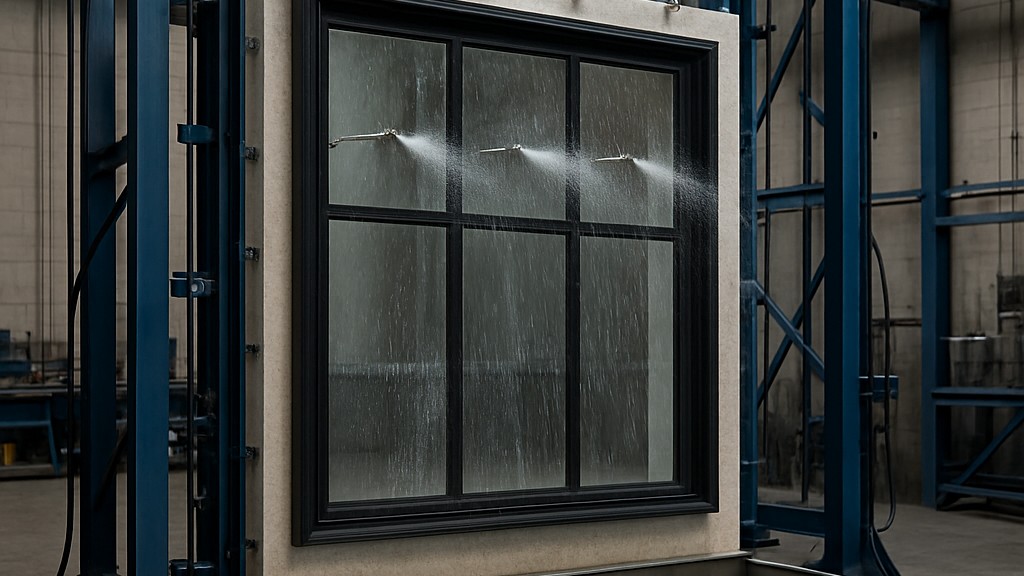
This test method can be applied to any curtain wall area or just to windows, skylights, or doors. This test method addresses water penetration through a manufactured assembly. Water that penetrates the assembly but does not cause failure as defined herein can have adverse effects on the performance of contained materials, such as sealants and insulation or laminated glass. This test method does not address these issues. Proper use of this test method requires understanding the principles of pressure measurement.
This test method is a standard procedure for determining resistance to water penetration under static air pressure differentials. Air pressure differentials acting across a building's exterior vary greatly. These factors must be fully considered before specifying the test pressure differential to be used.
When applying test results with this test method, the performance of a wall, its components, or both is a function of proper installation and adjustment. In service, performance also depends on the stiffness of the supporting structure and the resistance of the components to deterioration due to various factors, such as vibration, thermal expansion, and contraction. It is difficult to simulate the same complex wetting conditions that may be encountered in service, with large wind-driven water droplets, increasing water droplet impact pressures with increasing wind speed, and air and water moving laterally or upward. Some designs are more sensitive to this upward-moving water than others. However, this test method does not identify unobservable liquid water that may penetrate the test specimen.
The test method described in ASTM E 331 is a test standard that describes procedures for determining the water penetration resistance of windows, curtain walls, skylights, and doors when water is applied using a calibrated spray apparatus and uniform static pressure is simultaneously applied to opposite sides of the test specimen.
This standard is often referenced as a laboratory test and is very similar to ASTM E1105, Standard Test Method for Field Determination of Water Penetration of Exterior Windows, Skylights, Doors, and Curtain Walls Installed with Uniform or Cyclic Static Air Pressure Difference. ASTM E1105 is specifically designed for field testing of installed windows. ASTM E331 is also similar to ASTM E547 except for the method in which air pressure is applied. The ASTM E331 test method is a uniform test of consistent air pressure, while the ASTM E547 test method is a cyclic test in which air pressure is cycled on and off during the test.
The ASTM E331 standard test method is performed by applying water to the outside of the test specimen and reducing the internal pressure through an air chamber constructed inside or opposite the test specimen. The water spray system has spaced nozzles on a grid to deliver water to uniformly wet the test specimen, including areas susceptible to water penetration.
The calibrated spray apparatus (spray rack system) delivers water to the test sample at a rate of 5,0 gallons per square foot per hour. The test pressure differential is typically determined by the test specifier. Most general specifications require a minimum test pressure of 6,24 psf.
When it comes to building construction, water resistance is a critical factor that cannot be overlooked. Acting as a physical divider between the conditioned and unconditioned environment, the building envelope plays a crucial role in keeping water away from wall assemblies. This is especially important in areas where wet, wind-driven rain is common. Water penetration can lead to serious problems such as material damage, mold growth, and structural integrity loss. Therefore, ensuring water resistance is crucial for the long-term health of buildings and the well-being of their occupants.
ASTM E331 and ASTM E1105 standards were developed to address the need for standard test methods for evaluating water penetration resistance. These standards include two primary test methods specifically designed for windows. These tests are intended to determine the resistance of windows, skylights, doors, and curtain walls to water penetration under varying air pressure conditions. By subjecting these components to rigorous testing, their performance can be evaluated and appropriate measures can be taken to ensure water resistance.
The ASTM E331 test method is a widely accepted test method for determining the resistance of exterior windows, curtain walls, skylights, and doors to water penetration. This test is conducted by applying water to the exterior surface and exposed edges of the test specimen while simultaneously maintaining a higher static air pressure on the exterior surface than on the interior surface. The goal is to simulate realistic conditions where water is driven by wind pressure, exposing vulnerable areas of the building envelope to potential water penetration.
Testing begins by constructing a full-size test specimen wall with all the components to be tested, using the same details as for an actual wall assembly. This may include installing an air barrier or water-resistant barrier as part of the assembly. The specimen is then placed on one side of a sealed test chamber equipped with a water spray grid and a blower or compressed air system. Water is sprayed evenly onto the specimen at a specified rate, while the air pressure inside the chamber is maintained above the indoor pressure.
During a 15-minute test period, the test specimen is carefully observed, and water penetration points on the internal surface are recorded. The goal is to evaluate the specimen's performance against the specified criteria. It is important to note that while this test method addresses water penetration through the manufactured assembly, it does not address the potential adverse effects on materials such as sealants, insulation, or laminated glass.
Our organization, which has been supporting businesses across all sectors for years through a wide range of testing, measurement, analysis, and evaluation activities, boasts a strong team of employees who closely follow global developments in science and technology and are constantly improving themselves. In this context, we also provide testing services in accordance with the "ASTM E331 Standard Test Method for Water Penetration of Exterior Windows, Skylights, Doors, and Curtain Walls by Uniform Static Air Pressure Difference."
To get an appointment, to get more detailed information or to request an evaluation, you can ask us to fill in our form and reach you.

