

The European standard "EN 13330 Shutters - Rigid impact and denial of access - Test methods" describes test methods for determining the resistance of shutters to conventional blunt impact and denial of access. The shutters covered by this standard are:
In the world of construction and building materials, standards play a vital role in protecting life, property, and the environment. Among these standards, EN 13330 stands out as a specific guideline focusing on the durability and safety of roller shutters, an often-overlooked component. This standard includes rigorous testing protocols to assess the roller shutters' resistance to physical impact and their resistance to unauthorized entry.
The EN 13330 standard addresses a niche but vital aspect of building security. Whether internal or external, or integrated into windows and doors, shutters are ubiquitous in residential, commercial, and industrial environments. They provide privacy, light control, and weather protection, but their vulnerability to forced entry or accidental damage can pose significant risks.
The EN 13330 standard was developed to standardize the assessment of shutters' resistance to impact and intrusion attempts, ensuring they meet minimum security thresholds. This standard applies to a wide range of shutter types, including roller, folding, sliding, and hinged models, made from materials such as aluminum, wood, PVC, or steel. It does not cover shutters integrated into larger systems, such as garage doors, or designed solely for aesthetic purposes without a functional security role.
The main objectives are twofold:
The EN 13330 standard facilitates free trade in shutter products while raising safety standards by harmonizing test methods across Europe. CE marking is generally mandatory under the EU Construction Products Directive (CPR), allowing manufacturers to demonstrate the suitability of their products for market placement.
This standard uses precise and repeatable procedures to simulate real-world stresses. Tests are performed in controlled laboratory environments, and the results determine classification levels (e.g., Class 1 for basic resistance, up to Class 5 for high-security applications). A breakdown of the basic methods is below:
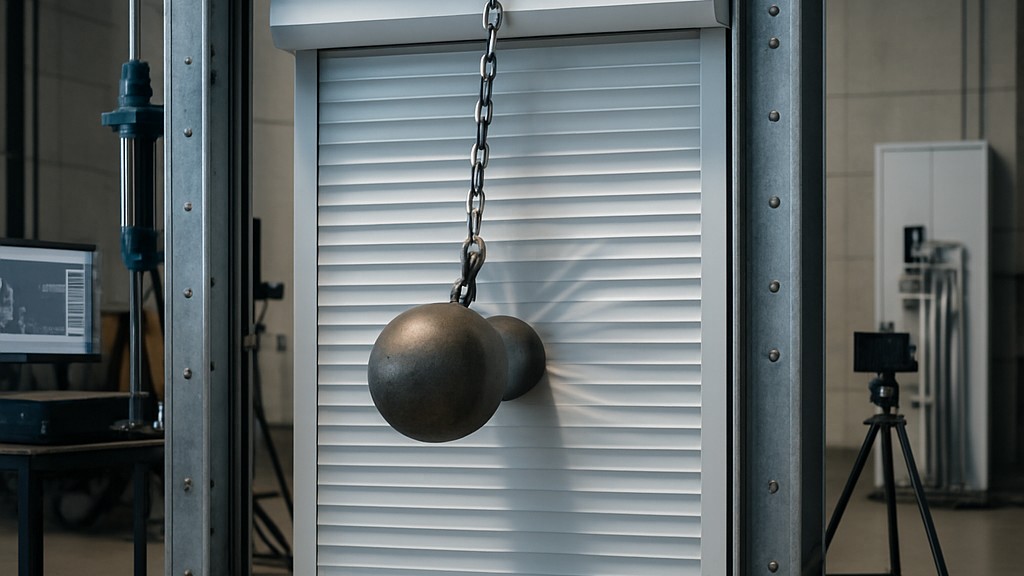
Rigid-body impact testing evaluates the shutter's ability to absorb kinetic energy from a solid projectile. During the test, a pendulum or drop-weight system launches a standardized rigid object (usually a 2 kg steel sphere or sandbag) at speeds of up to 5 m/s. The impactor strikes the shutter at designated points (e.g., center, edges, locks). Multiple impacts (3-10) are applied to assess progressive damage. Criteria include: no penetration, permanent deformation exceeding 10 percent of the original shape, or separation from the fittings. Each test is followed by visual inspections and deflection measurements. Classification is based on energy absorption (e.g., 50-500 joules) associated with environmental hazards such as storms or vandalism.
The intrusion resistance test simulates forced entry attempts using common burglary tools. During the test, manual tools (screwdrivers, pliers, hammers) or mechanical actuators apply forces of up to 1.000 N. Testers attempt to breach the shutter at weak points such as hinges, locks, or slats for a specified time (e.g., 3 minutes). Success is measured by gap creation or complete penetration. Criteria: The shutter must resist intrusion without exceeding permitted force thresholds. Acoustic and visual monitoring detects subtle defects such as cracking. Classification: Levels ranging from A (low risk) to F (high security) are compatible with European burglary resistance ratings.
Both tests require documentation of environmental conditions (temperature 15-25°C, humidity 40-60%) to ensure repeatability. Preliminary non-destructive checks, such as visual and dimensional inspections, are performed before full trials.
Ultimately, the EN 13330 standard exemplifies how targeted standards strengthen everyday building elements against unforeseen threats. By requiring rigorous impact and access prevention tests, it provides consumers with safer and more reliable products while also fostering innovation in the shutter industry. As buildings evolve towards a smarter and greener future, standards like these will continue to be cornerstones of resilience.
Our organization, with its competent and experienced team, understands our clients' needs, provides them with the advanced testing services they need, and assists them in establishing, implementing, and improving management systems. In this context, we also provide testing services in accordance with the EN 13330 Shutters - Hard Body Impact and Access Restriction - Test Methods standard.
To get an appointment, to get more detailed information or to request an evaluation, you can ask us to fill in our form and reach you.

