EN 12150 Glass for Buildings - Thermally Toughened Soda Lime Silicate Safety Glass
The European standard “EN 12150 Glass for buildings - Thermally tempered soda-lime silicate safety glass” consists of the following sub-sections published under the same title:
- The standard "EN 12150-1 Part 1: Definition and Explanation" specifies the tolerances, flatness, edge work, shatter resistance, and physical and mechanical properties of toughened soda-lime silicate safety glass. Information on curved thermally toughened soda-lime silicate safety glass is included in the standard's annex (Annex A), but this product does not form part of this standard.
Other requirements not specified in this standard may apply to thermally toughened soda-lime silicate safety glass incorporated into assemblies (e.g., laminated glass or insulating glass units) or subjected to additional processing (e.g., coating). Additional requirements are specified in the relevant glass product standard. In this case, the thermally toughened soda-lime silicate safety glass retains its bending strength properties and resistance to temperature changes. Glass that has been surface-finished after toughening (e.g., sandblasted, acid-etched) is not within the scope of this standard.
For the purposes of this standard, the following terms and definitions apply:
- Thermally toughened soda lime silicate safety glass: Glass that has been subjected to permanent surface compressive stress through a controlled heating and cooling process to impart, in addition to basic mechanical strength, significantly increased resistance to mechanical and thermal stress and predicted shatter properties. The mechanical properties, namely thermal resistance and mechanical strength, and the safety properties, namely shatter properties, are determined by the level of surface compression. These properties are not dependent on size.
- Flat thermally toughened soda lime silicate safety glass: It is a thermally toughened soda lime silicate safety glass that is intentionally not given a specific profile during production.
- Curved thermally toughened soda lime silicate safety glass: It is a thermally toughened soda lime silicate safety glass that has been intentionally given a specific profile during production.
- Enameled thermally toughened soda-lime silicate safety glass: This is a thermally toughened soda-lime silicate safety glass that has a ceramic frit applied to the surface during the toughening process. After toughening, the ceramic frit becomes an integral part of the glass. This glass is also known as opaque thermally toughened soda-lime silicate safety glass. The application of the ceramic frit can be a continuous process or a discontinuous application, such as screen printing. The enameled surface can be either partial or complete.
- Horizontal process: This is the process in which the glass is supported on horizontal cylinders.
- Air cushion process: This process involves supporting the glass with a cushion of air, with or without additional rollers. The glass must be at a 45-degree angle from the horizontal.
- Vertical process: This is the process in which the glass is hung with tongs.
Thermally toughened soda lime silicate safety glass is usually made from monolithic glass that corresponds to one of the following standards:
- Soda lime silicate glass according to EN 572-1 standard
- Float glass according to EN 572-2 standard
- Sheet glass drawn according to EN 572-4 standard
- Patterned glass according to EN 572-5 standard
- Supply and final cut dimensions according to EN 572-8 standard
- Coated glass according to EN 1096-1 standard.
Glass with nominal thicknesses other than those covered by these standards is also possible.
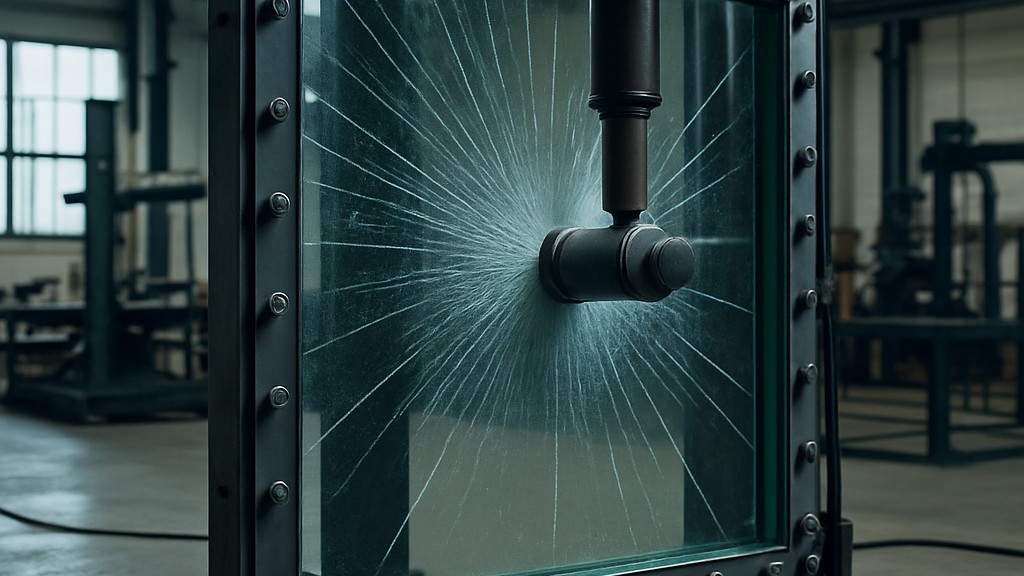
The fracture properties of thermally toughened soda-lime silicate safety glass are directly related to the amount of surface compression. These properties are not dependent on size. When thermally toughened soda-lime silicate safety glass is manufactured with the correct degree of surface compression, upon breakage, thermally toughened soda-lime silicate safety glass typically shatters into numerous small pieces with blunt edges. The degree of surface compression required depends on the type of glass and its thickness. The fracture properties of the glass are unaffected by temperatures between -50°C and +100°C.
- The standard "EN 12150-2 Part 2: Conformity assessment/Product standard" describes a procedure for assessing the conformity of flat thermally toughened soda-lime silicate safety glass for use in buildings and for factory production control. For glass products with electrical wiring or connections, such as for alarm or heating purposes, other directives may apply, such as the low voltage directive.
For the purposes of this standard, the following definitions apply in addition to the terms and definitions given in EN 12150-1:
- First type of testing: Determination of the performance (characteristics, durability) of a product on the basis of actual tests or other procedures (conventional, standardized, tabulated or generally accepted values, standardized or recognized calculation methods, test reports, where available) demonstrating compliance with this standard.
- Test report: A document that includes the results of tests performed on a representative sample of the product from production or a prototype design of the product.
- Product description: Document detailing the relevant parameters (e.g., processing conditions, structure) to define a product that complies with this standard. It includes specific references to the characteristics modified by the manufacturing process.
- Significant change: Indicates changes in performance beyond the allowable tolerance for the feature.
The requirements in this standard are specified as follows:
- Product description: For compliance purposes, the thermally toughened soda lime silicate glass manufacturer is responsible for preparing and maintaining the product description. This description identifies the product or product families. The clarification of the product description is at the discretion of the thermally toughened glass manufacturer or its representative, except in cases of regulatory requirements. The description includes at least one regulatory section. If the manufacturer envisions further development of the product, the description may also include an informative section. The description must include the following minimum regulatory information:
- A reference to EN 12150 parts 1 and 2 and all other standards to which the manufacturer claims compliance
- Radiometric properties and durability of coated glass, i.e. coated glass compliant with EN 1096-1, EN 1096-2, EN 1096-3 standards when these properties are intentionally or unintentionally modified by the thermal toughening process.
The definition of product families must be consistent with the normative part of the product description. Substitution of materials must ensure compatibility with the product description. Substitute materials may be added to the product family and also to the product description once compatibility is demonstrated.
- Compliance with the definition of thermally toughened soda lime silicate safety glass: Products must comply with the definition of thermally toughened soda lime silicate safety glass as defined in the EN 12150-1 standard and fulfil the requirements.
- Determination of performance characteristics: The properties of thermally toughened soda-lime silicate safety glass are generally the same as those of the glass substrate. Soda-lime silicate glass panels used in the production of thermally toughened soda-lime silicate safety glass must be made of soda-lime silicate glass in accordance with EN 572-1, EN 572-2, EN 572-4, and EN 5725. The panels can be coated in accordance with EN 1096-1, EN 1096-2, and EN 1096-3, or enameled in accordance with EN 12150-1. For the properties listed in the table provided in the standard, generally accepted values for soda-lime silicate glass panels or calculated values can be used. Since most of the properties in the table do not change significantly with the thermal toughening process, they should be used for thermally toughened soda-lime silicate safety glass. Exceptions are the characteristic bending strength and resistance to sudden temperature changes and fluctuations.
If a manufacturer of thermally toughened glass wishes to claim that any performance characteristic is independent of the production equipment used, the factory production control system must comply with this standard, including its specific process control conditions.
Our organization, which has been supporting businesses across all sectors for years through a wide range of testing, measurement, analysis, and evaluation activities, has a strong team of employees who closely follow global developments in science and technology and are constantly improving themselves. In this context, we also provide testing services to businesses in accordance with the EN 12150 Glass for Buildings - Thermally Toughened Soda Lime Silicate Safety Glass standard.



