

A European standard “EN 15820 Polymer-modified bituminous thick coatings for waterproofing - Determination of water tightness” describes a procedure for determining the water tightness (i.e. resistance to hydraulic pressure) of polymer-modified bituminous thick coatings for waterproofing.
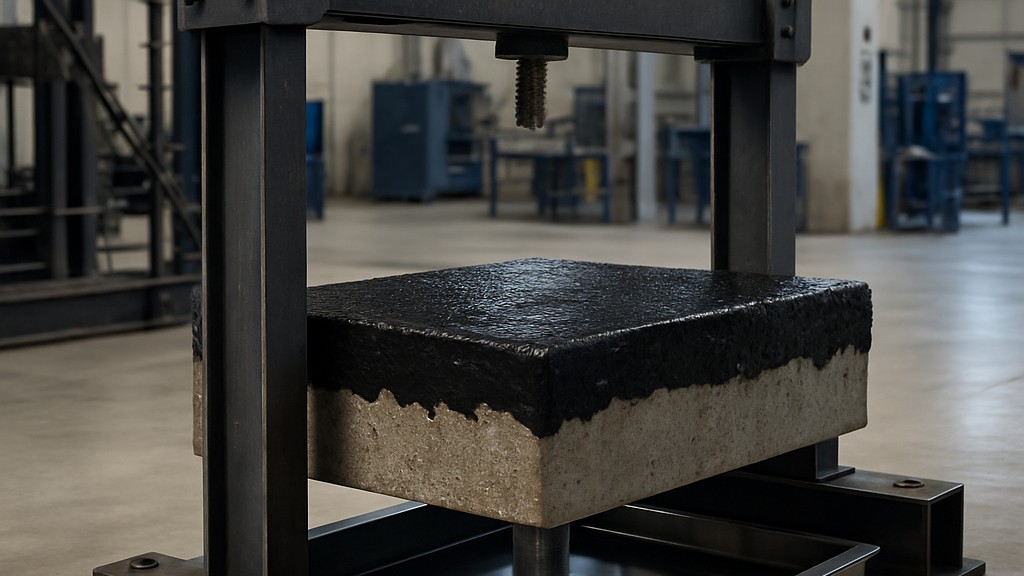
Polymer-modified bitumen coatings are high-performance waterproofing materials produced by blending bitumen with polymers to increase durability, flexibility, and resistance to water and environmental influences. The primary applications of these coatings are:
It is generally applied in thick layers to protect building components from moisture and water ingress.
For the purposes of this standard, the terms and definitions given in EN 15814 apply. Furthermore, for waterproofing, a coating can be considered waterproof if no water seepage is observed on the unexposed side of the sample.
The procedure described in this standard is the test procedure for polymer-modified bitumen coatings intended for use in pressure applications (e.g., pressurized water in soil). In principle, a test specimen is subjected to the specified water pressure for at least 24 hours in a disc containing four slots of specified shape and dimensions. The test specimen is observed to maintain its water resistance.
In the tests, a circular test specimen with a diameter equal to the extension diameter of the three-ribbed plate (approximately 130 mm) is used.
Membranes are obtained from polymer-modified bitumen thick coatings conforming to the classes defined in the table provided in the EN 15814 standard. If reinforcement is used, the first layer is placed on a separating layer approximately half the thickness of the bitumen layer. Reinforcement is then placed, and finally, the second bitumen layer is applied. The wet layer must be thick enough to achieve the specified dry layer thickness after drying. To achieve the specified dry layer thickness, the wet layer must be leveled using a frame or straightedge of appropriate height.
Test samples should be stored for at least 28 days at a normal climate of 23 degrees Celsius plus/minus 2 degrees Celsius and 50 percent plus/minus 5 percent relative humidity, in accordance with the ISO 554 standard. The thickness of the dry layer is measured using calipers that allow measurements up to 0,1 mm. Twelve measurements are taken. The highest and lowest values should be disregarded, and the average value should be calculated from the remaining 10 values.
The test is performed at 23 degrees Celsius (plus/minus 2 degrees Celsius). The test pressure is specified in the product specifications. It is necessary to ensure that the edges are waterproof.
The apparatus is filled with water until it overflows. The test specimen is placed in the apparatus with the top down and covered with the specified slotted plate. The cap is replaced and gradually tightened until the specimen is firmly seated. Pressure is gradually applied to the specified test pressure. Once the test pressure is reached, the pressure is maintained for a period specific to the product, but not less than 24 hours. After the test period, the test specimen is checked for water tightness (sudden pressure drop or the presence of water on the exposed surface of the test specimen).
The waterproofing test is considered successful if the sides of all test samples exposed to the test pressure maintain their waterproofness after the specified test time.
The EN 15820 standard is considered important for many reasons. The main reasons for this standard are:
As a result, the EN 15820 standard is considered important because it verifies the effectiveness of waterproofing coatings, ensures the safety and durability of buildings, provides market access and supports construction quality assurance.
Our organization, which has been supporting businesses across all sectors for years through a wide range of testing, measurement, analysis, and evaluation activities, boasts a strong team of employees who closely follow global developments in science and technology and are constantly improving themselves. In this context, we also provide testing services in accordance with the EN 15820 standard for polymer-modified bituminous thick coatings for waterproofing - Determination of waterproofing.
To get an appointment, to get more detailed information or to request an evaluation, you can ask us to fill in our form and reach you.

