

The European standard “EN 14150 Geosynthetic barriers - Determination of permeability to liquids” describes a method for measuring steady-state liquid flow through a geosynthetic barrier used to contain liquids in long-term applications. This test method and the described device allow for precise measurement of flows down to 10⁻⁶ m³ /m³/day. Specifically, if the test results show that the values obtained for a geosynthetic barrier fall below the sensitivity threshold of this test method, the liquid flow value is declared as lower than 10⁻⁶ m³ /m³/day. Due to its long-term nature, this test method is not suitable for production control tests. Clay geosynthetic barriers cannot be tested with this device.
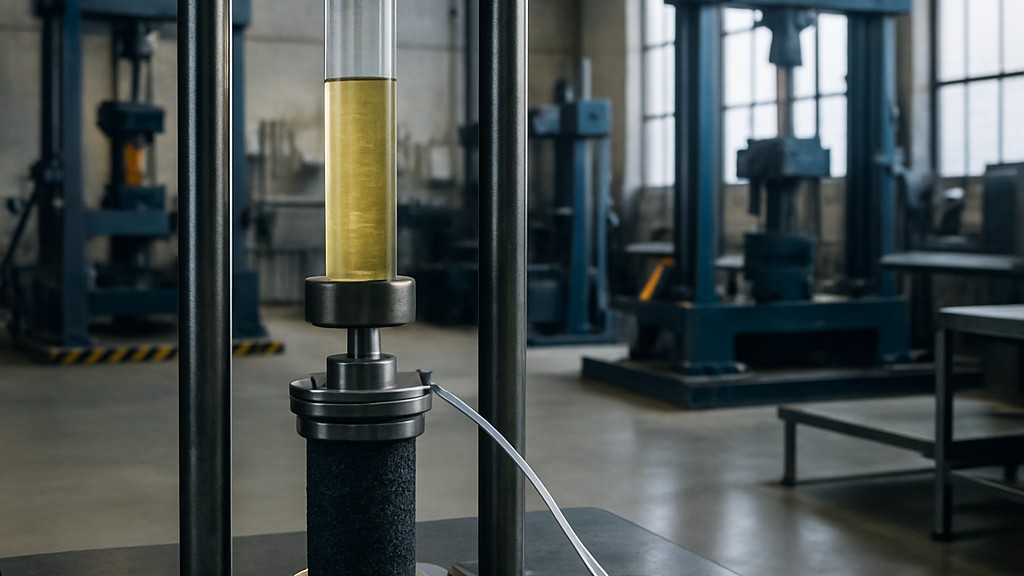
In principle, differential hydraulic pressure is applied between the two sides of a geosynthetic barrier. It is maintained at 100 kPa throughout the test. The inlet pressure is set at 150 kPa, and the outlet pressure is set at 50 kPa. The flow through the geosynthetic barrier is calculated from the changes in fluid volume measured on both sides of the geosynthetic barrier. This test is performed with water, but other fluids can be used as long as chemical resistance and instrument compatibility are met.
Based on laboratory experience, it is recommended that the sensitivity threshold of the test procedure be reviewed, equipment upgrades made, and the applicability of the test procedure to product permeability be evaluated at regular intervals not exceeding 12 months. Different pressure levels may be applied with the agreement of all persons or parties involved. In such cases, it is recommended that the applied pressure levels be described in the test report.
The two-piece cell used in the tests must be resistant to oxidation and hydraulic pressure applied throughout the test. Each cell section contains a cavity that allows for the application of hydraulic pressure. An oxidation-resistant porous disk placed in the downstream cavity prevents deformation of the geosynthetic barrier.
The cell should be designed to compress the sample without leakage. Because compression between flat surfaces is generally sufficient, no clamping system is required. Some materials may require a sealant. Any sealant that is not water-sensitive and prevents leakage can be used. For bituminous geosynthetic barriers, bituminous rubber sealant can be used.
The cavities should be constructed so that the exposed diameter of the sample is 200 mm or greater. This diameter should be measured with a maximum permissible measurement error of plus or minus 1 mm. The cell is equipped with a liquid inlet (Valve U) on the upstream side, a liquid outlet (Valve D) on the downstream side, and flush valves (Valves FU and FD) on both sides. The cell should be positioned vertically to allow easier and better airflow. The flush valves (FU and FD) should be located at the top of the cell, and the inlet (U) and outlet (D) should be located at the bottom of the cell.
The cell may include an annular control cavity in both parts. In this case, the downstream control cavity must be equipped with a porous annular plate. Each annular cavity is connected to an independent volumetric measurement device and a pressure distribution system to apply the same pressure as that in the corresponding measuring cavity. These annular spaces are present to minimize deformation of the measuring cavity.
Volume measuring devices and pressure distribution systems are generally interconnected. Volume measuring equipment should be able to measure liquid flows less than 10 −6 m3/m2/g across the geosynthetic barrier. The maximum allowable measurement error for volume measurement should be plus/minus 10 −8 m3. The maximum allowable measurement error for pressure applied to both sides of the geosynthetic barrier should be plus/minus 2 kPa.
Volume measurements can be performed using capillary tubes (Type A device) or pressure-volume controllers (Type B device).
It is recommended to use deaerated water (less than 1 mg/L dissolved oxygen) for testing. Deaerated liquid is necessary to minimize volume changes due to temperature changes. If testing with other liquids, it is recommended that volatility and safety issues be considered.
When the test is performed using a Type A device, it should be performed at a temperature of 23°C plus or minus 0,2°C (using a thermostatically controlled chamber). When the test is performed using a Type B device, a temperature of 23°C plus or minus 1°C (in a controlled temperature chamber) should be used. In a Type B device, at least three temperature transducers should be used, located at each pressure-volume controller and cell. Temperature measurements should be used to correct for volume changes, if necessary. The maximum permissible measurement error for temperature transducers should be plus or minus 0,2°C.
In the world of civil engineering and environmental protection, geosynthetic barriers play a crucial role in containing liquids and preventing contamination. These materials, often used in landfills, reservoirs, and wastewater systems, must meet stringent performance standards to ensure safety and longevity. This is where EN 14150, a key standard that specifies a definitive method for determining the permeability of these barriers to liquids, comes in. This standard provides a reliable framework for testing the ability of geosynthetics to resist liquid infiltration under steady-state conditions. This standard helps engineers, manufacturers, and regulators verify that these barriers perform as intended in demanding applications. This standard reflects ongoing advances in materials science and environmental regulations.
Geosynthetic barriers, also known as geosynthetic clay liners or synthetic liners, are engineered materials designed for use as impermeable layers in construction projects. They typically consist of thin films, fabrics, or composites that separate, retain, or reinforce soil and other materials. Common types include:
These barriers are important in situations where fluid retention is critical, such as:
Without effective barriers, environmental disasters such as soil and water pollution can occur, making standardized testing indispensable.
The EN 14150 standard specifically addresses the permeability of geosynthetic barriers—the rate at which fluids can pass through them under controlled conditions. Permeability is a measure of how porous or impermeable a material is. High permeability indicates poor retention, while lower values indicate strong performance.
This standard applies to geosynthetic barriers used in long-term liquid containment applications. It excludes clay barriers, which require different testing due to their swelling properties. The test method is designed for comprehensive laboratory validation, not for rapid production control.
The EN 14150 standard standardises this process, ensuring consistency across Europe and facilitating trade, innovation and regulatory compliance.
Our organization, which has been operating for many years and meticulously follows global developments in science and technology, employs a skilled team and extensive infrastructure to conduct testing, measurement, and analysis in a wide range of areas for businesses across all sectors. In this context, we also provide testing services in accordance with the EN 14150 Geosynthetic Barriers - Determination of Permeability to Liquids standard.
To get an appointment, to get more detailed information or to request an evaluation, you can ask us to fill in our form and reach you.

