

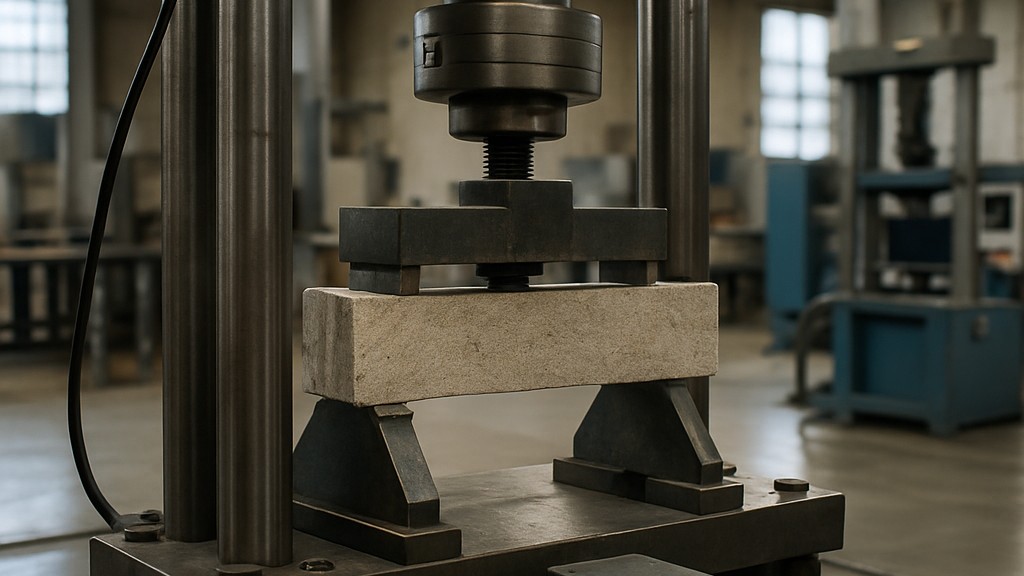
The standard "ASTM C880/C880M Standard Test Method for Flexural Strength of Dimensional Stone," developed by the American Society for Testing and Materials (ASTM), describes a test method for determining the flexural strength of stone using a simple beam using quarter-point loading. Stone tests should be conducted where appropriate for loads perpendicular to the bedding plane and loads parallel to the bedding plane. When necessary, flexural tests should also be conducted under wet conditions.
This test method is useful in demonstrating differences in flexural strength between various sized stones. It also provides a means of comparing stones of the same type.
The testing machine used in the tests complies with the requirements of ASTM E4 standard. In stone bending tests using load-bearing blocks, the quarter-point loading method is used to ensure that the forces applied to the beam are only vertical and without eccentricity. The machine must be able to maintain the span length and distance between the load-bearing and support blocks within plus/minus 1,3 mm. The load must be applied at a uniform rate and in a manner that prevents shock.
The sample is selected to represent the true average of the type or class of stone in question and the quality offered on the market under the type designation to be tested. The sample may be selected by the purchaser or his authorized representative from quarried stone or natural outcrop and must be of sufficient size to permit the preparation of the required number of test specimens. Where perceptible differences occur, the purchaser may select as many specimens as necessary to determine differences in flexural strength.
Test specimens shall be 102 mm wide, 32 mm thick, and 381 mm long, with a tested opening of 318 mm. The specimen edges shall be perpendicular to the top and bottom. The specimens shall have a fine abrasive surface on the planes perpendicular to the load and a fine saw surface on the other four planes. The specimen dimensions shall be measured and recorded to the nearest 0,3 mm. At least five specimens shall be tested for each test condition. The average value of the test results shall be reported as the flexural strength of the stone.
When determining the work thickness (for example, when determining the thickness of stone panels for a project), flexural tests are often required at the work thickness. When testing at the work thickness is required and the work thickness is different from 32 mm, the specimen size should be determined according to the following: The tested opening should be 10 times the thickness. Specimen lengths should be no less than 51 mm and no more than 102 mm longer than the tested opening. When the thickness is less than 68 mm, the specimen width should be 102 mm. When the thickness is greater than 68 mm, the width should be 1,5 times the thickness. If the thickness is different from 32 mm and the specimen size meets the work thickness criteria specified above, the average value of the test results is reported as the flexural strength of the stone at the work thickness.
If the quality of the work surface is specified (for example, if the architectural quality of the panels for the project is specified), it is generally desirable to conduct flexural tests on specimens of the same quality as the work surface. When conducting tests on the work surface, the following points should be taken into account: Specimens should have a quality in a plane perpendicular to the load, consistent with the quality specified for the job. Unless otherwise indicated, the specimen should be positioned so that the finished surface is under flexural stress. The average value of the test results should be reported as the flexural strength of the stone on the work surface.
Before testing, the samples are dried at 60°C (60°F) plus/minus 2°C (120°F) for 48 hours. At hours 46, 47, and 48, the samples are weighed to ensure uniform weight. If the weight continues to decrease, the samples are dried until three consecutive hourly readings of the same weight are obtained. After removing the samples from the oven, they are cooled to room temperature in a desiccator before testing.
Before being tested in a wet environment, the samples are immersed in water at 22 degrees Celsius (plus/minus 2 degrees Celsius) for 48 hours. As soon as the samples are removed from the bath, the surface water is wiped off and the samples are tested.
To begin the test, the apparatus is assembled, the specimen is placed on the span supports, and quarter-point loading blocks are adjusted to contact the specimen. The load is applied at a constant stress rate of 4,14 MPa until failure.
In short, the ASTM C880/C880M standard is a test method developed to determine the flexural strength (modulus of rupture) of dimensioned stone. This property is crucial for assessing a stone's resistance to fracture or cracking when subjected to bending or load-bearing applications, particularly in architectural and structural uses such as countertops, flooring, cladding, or stairs. This test provides designers, architects, engineers, and suppliers with the data they need to ensure their stone products meet performance and safety requirements.
Flexural strength is the maximum stress a material can withstand when bent and is particularly important for dimension stones placed horizontally or subjected to bending forces. The test method described in this standard provides:
This method is commonly used to test materials such as: granite, marble, limestone, sandstone, slate and travertine.
Factors affecting flexural strength are:
ASTM C880/C880M standard test results help:
Using this standard provides the following benefits:
As a result, the ASTM C880/C880M standard is a critical testing method in the stone and construction industries. It helps determine whether a dimensional stone product can withstand the bending and stresses it will encounter in actual use. By adhering to this standard, manufacturers and designers can ensure the safety, durability, and performance of stone-based structures and products.
Our organization, which has been serving for many years and meticulously following global developments in science and technology, conducts testing, measurement, and analysis in a wide range of areas for businesses in every sector with a skilled team and extensive infrastructure. In this context, we also provide testing services in accordance with the "ASTM C880/C880M Standard Test Method for Flexural Strength of Dimensional Stone" standard.
To get an appointment, to get more detailed information or to request an evaluation, you can ask us to fill in our form and reach you.

