EN ISO 24346 Resilient Floor Coverings - Determination of General Thickness
A method for determining the overall thickness of resilient floor coverings is described in the European standard “EN ISO 24346 Resilient floor coverings - Determination of overall thickness”, subsequently published by the International Organization for Standardization (ISO).
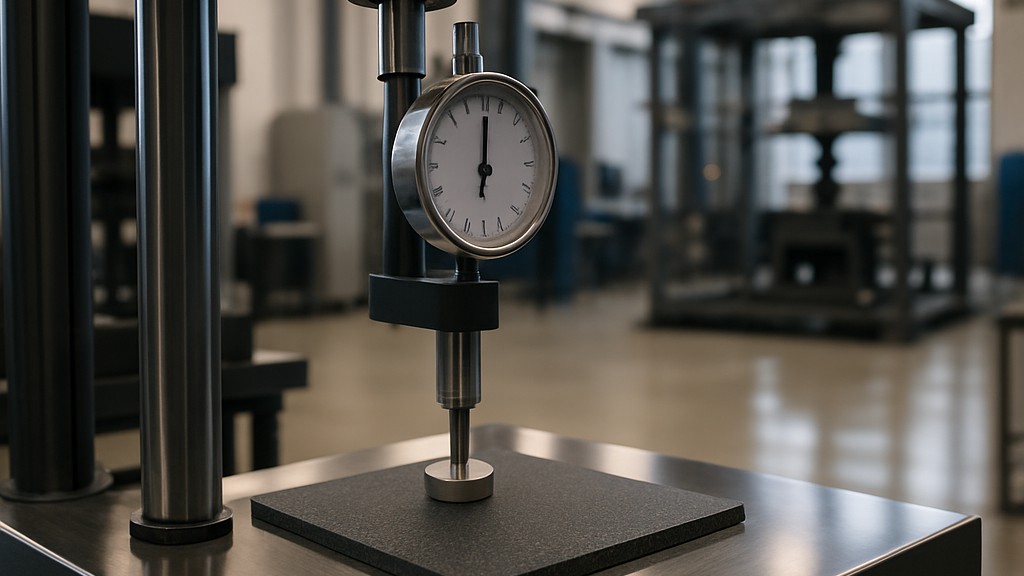
For the purposes of this standard, total thickness refers to the vertical distance between two parallel boards on which a resilient floor covering is placed under a given load.
In principle, the test piece is placed between two parallel plates and the distance between the plates is measured, the contact pressure is adjusted according to the structure of the test piece.
The equipment used in these tests includes:
- Movable circular top plate: For various types of flexible flooring structures, the diameter of the top plate, the applied mass, area and pressure should be in accordance with the table.
- Fixed bottom plate: Must be at least equal to the size of the top plate and at least 15 cm2.
- Dial indicator: Used to measure the distance between plates with an accuracy of 0,01 mm.
- Weighted ring or horseshoe (500 g): Used to keep the circumference of the sample evenly flat against the fixed bottom plate.
For sheet material, two representative samples are taken from a roll for testing: one from each end or the beginning of two rolls. A test piece of at least 100 mm is cut from each sample, spanning the entire width of the sample. For tile material, five tiles are selected from cardboard as test pieces and cut to a suitable size of 50 mm x 100 mm. If the sample consists of a tile pack or carton, it is necessary to ensure that the first and last tiles are not used as test pieces.
Samples are conditioned at 23 degrees plus/minus 2 degrees temperature and 50 percent plus/minus 5 percent relative humidity for at least 24 hours and tested in the same environment.
The testing procedure consists of the following steps:
- During the preparation phase, it is necessary to ensure that the test device is level.
- The appropriate top plate and force to be applied are selected according to the table titled "Plate and Force Settings" provided in the standard for the type of test sample to be measured. It is important to ensure that the presser foot and plates are clean.
- The dial indicator is set to zero by resting the presser foot against the bottom plate (anvil).
- Calibration of the measuring instrument should be verified by means of measuring blocks or wedge stock of known thickness appropriate to the measured thickness.
- During thickness determination, the sample is placed on a fixed base plate (anvil) with the wear surface facing up, making flat contact with the anvil. A weighted ring or horseshoe is placed in the center of the presser foot. The presser foot is slowly lowered until it contacts the sample surface.
- When measuring foam sheet materials, select a flat, unembossed area, if possible significantly larger than the presser foot and at least 20 mm from any edge of the sample. The presser foot is lifted and the test sample is placed in place.
- The thickness of the loaded plate is read 5 seconds after application. The thickness is read to the nearest 0,001 mm or within the measurement limits of the instrument used. All measurements are made at least 20 mm from any edge of the sample.
- Unless otherwise stated, a total of five measurements are made at randomly selected locations on each sample.
- The measured values for each test specimen are recorded to the nearest 0,01 mm.
- The average thickness value is calculated and the result expressed to the nearest 0,01 mm. Minimum and maximum measurements are reported if required by the specification.
The test report should include the following information:
- A statement that the tests were performed in accordance with this international standard
- Full description of each sample, including type, source, colour and manufacturer's reference numbers
- Previous history of the sample
- The exact test atmosphere (temperature and relative humidity) in which the test is performed
- Any deviation from this standard that may have affected the results
- Thickness of the test sample (this should be the average value of the overall thickness calculated to the nearest 0,01 mm)
- Minimum and maximum thicknesses if required.
The EN ISO 24346 standard is considered important because it provides a consistent and reliable method for determining the thickness of resilient, textile, and laminate floor coverings. This standard generally includes a method for measuring the total thickness of various floor coverings, including resilient floor coverings such as vinyl or rubber, textile floor coverings such as carpet tiles, and laminate floor coverings. The key reasons for this standard's importance are:
- Quality assurance: This standard ensures that floor coverings meet design specifications. It helps verify manufacturer claims regarding product thickness.
- Performance evaluation: Thickness affects critical performance characteristics such as:
- Durability
- Acoustic insulation
- Thermal performance
- Underfoot comfort
- Comparability: Provides a standard way to compare products from different manufacturers.
- Regulatory compliance: This standard is required for building regulations, industry regulations, or certification (e.g., CE marking in Europe). It is used in contract specifications or procurement documents.
- Consistency in Production: This standard guides manufacturers in quality control during production. It reduces disputes over product dimensions between suppliers and buyers.
For example, a business selecting vinyl tile for a high-traffic commercial area would use measurements aligned with EN ISO 24346 to ensure the tiles are thick enough to withstand wear and tear while meeting installation standards. This standard helps ensure the product performs as expected.
Our organization, which has been supporting businesses across all sectors for years through a wide range of testing, measurement, analysis, and evaluation activities, has a strong team of employees who closely follow global developments in science and technology and are constantly improving themselves. In this context, we also provide testing services in accordance with the EN ISO 24346 Resilient floor coverings - Determination of overall thickness standard.



